
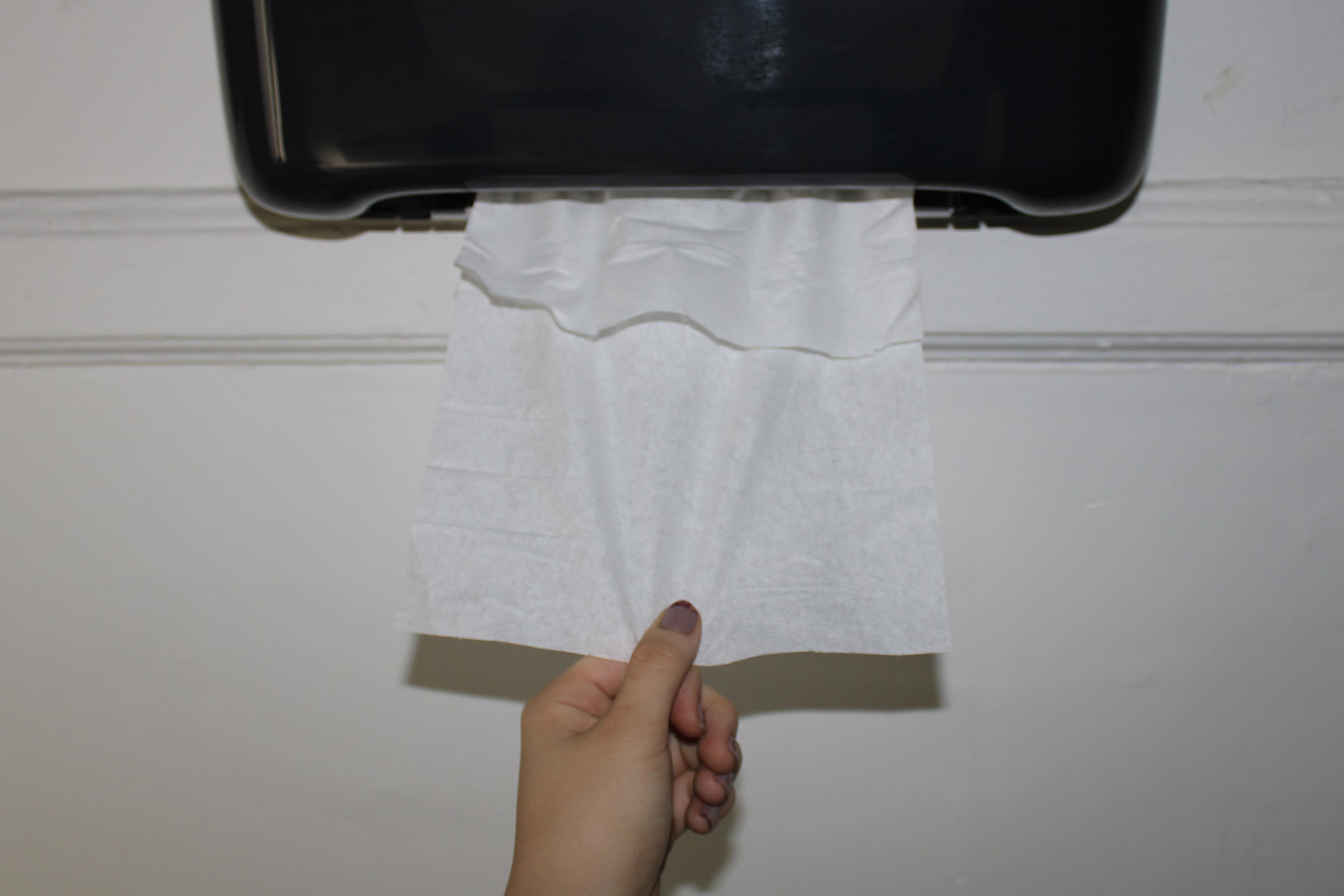
U of T recently removed paper towels from many of the washrooms on campus, to make washing your hands at U of T more eco-friendly and reduce waste. Is this really going to have an impact? Is this the right move, or is it an example of performative environmentalism? Here’s what two U of T students had to say.
Small changes for a more sustainable campus
As of August 2025, the Student Leadership Subcommittee of the Committee on the Environment, Climate Change, and Sustainability (CECCS) led an initiative to stop restocking paper towel dispensers in washrooms. This new initiative will only affect washrooms that have energy-efficient hand dryers at the St. George campus.
Does this new initiative actually have a positive impact on the environment? I would argue that it does.
Most paper towels can’t actually be recycled. Contrary to popular belief, their manufacturing process and the wood, cardboard, and paper by-products inside most paper towels render them unrecyclable before they can even enter our bathrooms. Therefore, the abundance of paper towel waste that our campus produces every day cannot be disposed of sustainably.
Additionally, multiple studies have proven that hand dryers are significantly more sustainable than paper towels in terms of energy usage. For example, a study from the Science of the Total Environment Journal found that per use, a conventional hand dryer had a smaller environmental impact than using two paper towel pieces from a roll dispenser.
During an interview with Juliette LeBlanc, a second-year student studying political science and peace, conflict, and justice, she was asked whether she had noticed any changes in campus washrooms since paper towels stopped being refilled.
“There has been some bathrooms that normally have an overflow of paper towels that now no longer do,” said LeBlanc, highlighting how many bathrooms are now cleaner.
When asked how she felt about not having access to paper towels anymore, LeBlanc replied, “In peak cold season, I would sometimes find it more hygienic to use a paper towel rather than the hand dryer because you see things [online] that say hand dryers have as much bacteria as the inside of a toilet bowl. But ultimately it just takes a few more seconds to stand there and dry my hands, and it’s a sacrifice I’d be willing to make.”
Similarly, others have been led to believe that hand dryers are less hygienic than paper towels. However, according to a study featured in the World Health Organization (WHO) guidelines on hand hygiene, results found that there was “no significant difference in the efficacy” between paper towels, cloth towels, and warm air dryers.
Overall, as the most sustainable university in the world, U of T should be taking as many actions as possible to reduce our waste production and increase our sustainability. Moreover, I believe that we should take this step before it is too late.
When asked about whether or not U of T’s decision to eliminate paper towel usage would encourage a similar action in her own life, LeBlanc stated, “I do think, with consistent use of a hand dryer on campus, it might give me that extra moment of reflection… to instead use the hand dryer rather than opting towards the paper towels, which is an impulse that I might have previously had.”
And that’s exactly what sustainability initiatives aim to do: make small changes that, over time, eventually shift our habits and help to build a more sustainable campus.
Lila Sparks is a second-year student studying peace, conflict, and justice, and international relations.
Performative sustainability
I believe that U of T’s removal of paper towels from washrooms is a form of performative environmentalism, designed to make the university appear as if it is accomplishing something, when in reality, it is just doing more harm.
What is the alternative to paper towels? The answer is air dryers, which have been proven to be the worst way to dry your hands. We wash our hands to make them clean, and air dryers reverse that effect by increasing the amount of bacteria on our hands. This is why some experts argue that hospitals should not use hand dryers for the sake of cleanliness, so why should a university be any different?
You may say, “Fine, but it’s not possible to recycle them, so they are filling up landfills.” To that I say, “Just compost them!”
That’s right, many types of paper towels that we use can be composted. However, they must be clean, which they probably will be since you are mostly using them to dry your hands.
Putting aside the objective reasons why paper towel-drying is superior, the bottom line is, most people prefer to use paper towels over hand dryers. A Mayo Clinic study shows that 62 per cent of people would choose paper towels as their preferred method of drying their hands. This can be due to many reasons, including hygiene and hand irritation. They are, in my experience, slow, loud, and oftentimes, too hot.
Another often overlooked fact is that some hand dryers can reach noise levels of up to 90 decibels, which is as loud as a truck at a close distance. Who would willingly want to suffer through that?
Additionally, frequent exposure to hand dryers can irritate the skin. This effect can be especially bad for people like me, whose skin becomes easily irritated during the winter. I believe there is no reason we should be subjected to the use of hand dryers when paper towels, as an accessible alternative, exist.
Finally, I think that we should keep paper towels as they are versatile. Lots of people use them for more than just drying their hands. They can be used for opening doors and laid on toilet seats for cleanliness. These usages can increase our overall sense of hygiene and make bathrooms more inclusive for different hygiene standards.
In conclusion, I think that the idea of removing paper towels is a hasty one that hasn’t been thought through completely. There are many other ways we can improve our environmental footprint around the university, without causing our bathroom experience to be unhygienic and non-inclusive.
Moeez Nasir is a second-year student at Trinity College, studying health and disease.
