
Imagine the GTA hit by a summer heatwave. The surge in demand for air conditioning would immensely strain the province’s electrical infrastructure. The electrical grid becomes less reliable, with blackouts and power outages becoming more prevalent.
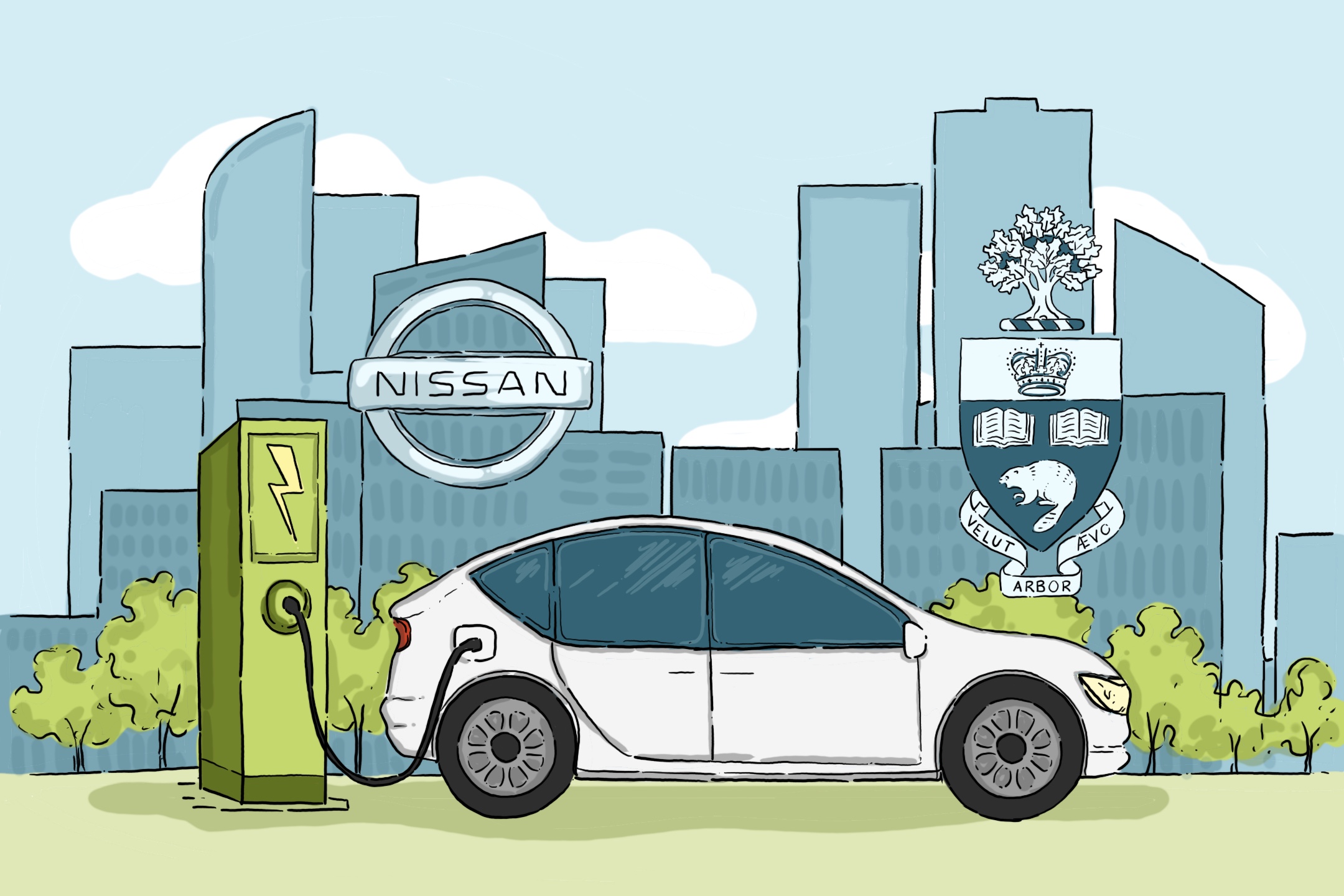
A groundbreaking new partnership between the U of T and Nissan — a major Japanese motor company — is pioneering an alternative future; one where electric vehicles (EVs) can power electricity grids while earning their owners a few extra dollars.
On August 26, the two parties launched a multi-year research collaboration to turn EVs from simple transportation devices into smart batteries that can feed electricity back into the grid when it’s needed most.
The agreement is facilitated by U of T’s Lawson Climate Institute, which is dedicated to developing sustainable technologies and practical climate policies. The partnership will combine the specialized knowledge of the university’s Grid Modernization Centre with Nissan’s extensive industry experience to unlock the potential of vehicle-to-grid technology (V2G).
The technology fueling the partnership
V2G technology transforms the relationship between a car and the power grid from a one-way street into a two-way highway. Currently, an EV owner must plug their car into the grid to draw electricity to charge their battery.
V2G systems will also enable the grid to draw energy from an EV’s stored electricity. This same car could even directly power a home during an outage. This function could fundamentally reshape how Canada approaches energy storage, as EVs can be used to provide electricity during times of high demand.
The vision is to create what energy experts refer to as a “virtual power plant.” Instead of a single facility, this new type of power plant would consist of thousands of individual EVs, all connected and coordinated through intelligent software. When the grid needs a boost, the system could draw a small, almost unnoticeable amount of energy from each participating vehicle. Collectively, this distributed network of car batteries would function as one enormous power source, capable of stabilizing the grid in moments of peak demand.
“Electric vehicles have the potential to not only decarbonize everyday transportation for drivers, but also to serve as a crucial part of smarter, greener, stronger electrical grids for the future,” explained Atsushi Teraji, the General Manager of Nissan’s EV System Laboratory in Japan, to the press. “Collaborative research with the University of Toronto in this crucial field will help us develop real-world applications for the power of EVs and V2X technology.”
Solving current challenges through their partnership
“Some of the challenges to be overcome in order to maximize the potential of vehicle-to-grid technology include privacy, cybersecurity, and the complexity of both the energy management system and communication standards,” noted Timothy Chan in an interview with Electric Autonomy. Chan is a mechanical and industrial engineering professor who also serves as U of T’s Associate Vice-President and the Vice-Provost of Strategic Initiatives.
The cybersecurity component is critical; researchers must design a system that is impervious to attacks that could destabilize the grid. Furthermore, the system must protect the privacy of vehicle owners. To tackle this, the U of T team will leverage edge computing — a method where data is processed locally rather than being sent to a central cloud, minimizing security vulnerabilities.
Leading this ambitious project is Olivier Trescases, a professor at the Department of Electrical and Computer Engineering. His expertise will be complemented by that of Baochun Li, another professor at the Department of Electrical and Computer Engineering, who will apply his knowledge of AI to develop smart energy management systems.
The future effects of the partnership
The societal and environmental benefits of U of T and Nissan’s collaboration are immense. During periods of high demand, electric utilities rely on peaker plants, which are notoriously insufficient and used only as a last resort. A fully realized V2G network could significantly reduce, or even eliminate, the need for these polluting plants.
On an individual level, an EV with a full battery could power essential appliances in a home for days during a blackout. It also opens up the possibility for EV owners to earn passive income by selling their stored energy back to the utility grid during peak hours.
In the age of artificial intelligence, every flexible source of power matters, and EVs are uniquely positioned to help.
“Our strategic collaboration with Nissan is essential to developing breakthrough research in cleaner mobility and energy storage,” Chan stated in a U of T News article. “This partnership will not only accelerate innovation but also ensure that our research has real-world impact.”

No comments to display.