
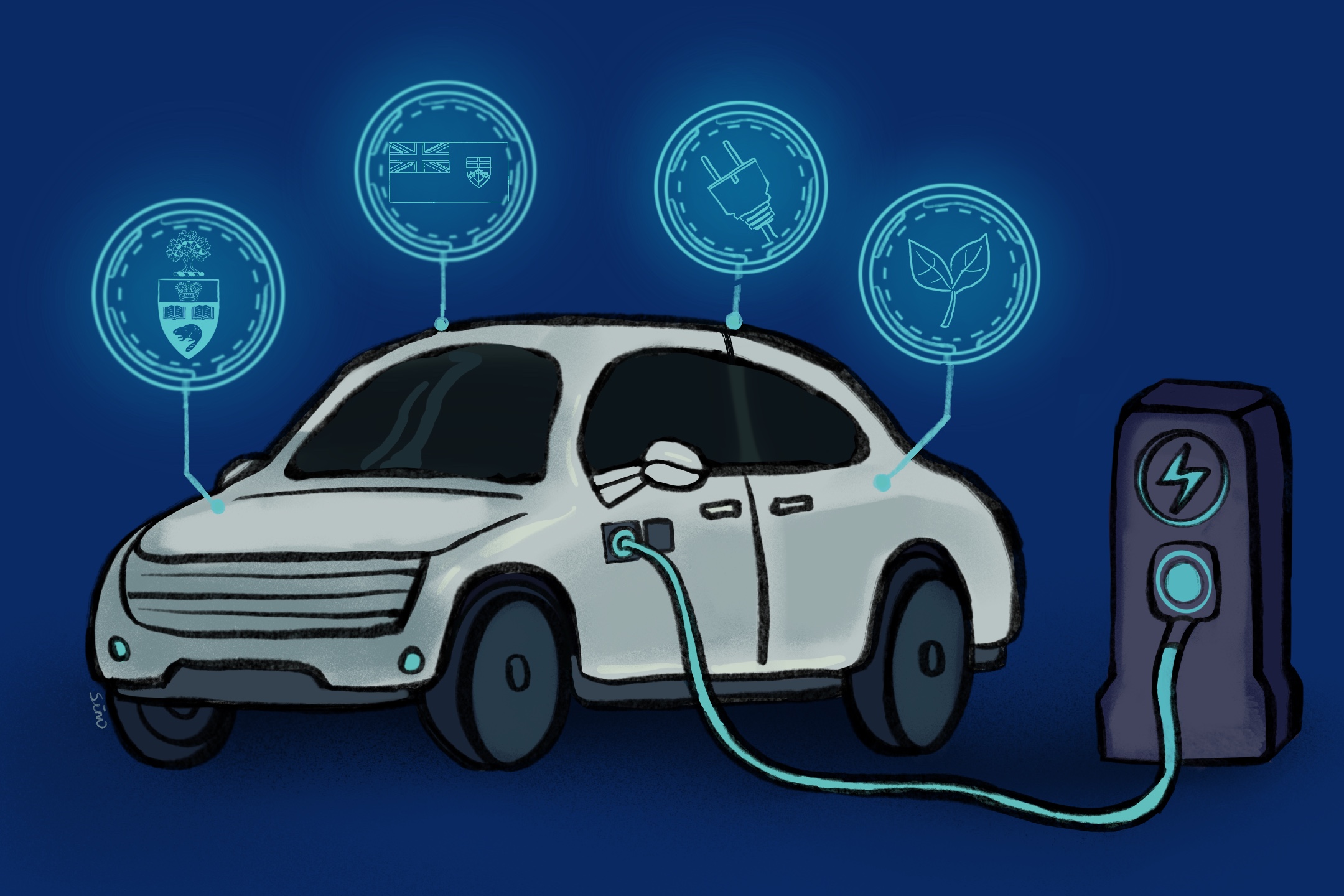
In mid-December 2025, the University of Toronto announced a partnership aimed at boosting Canada’s position in the global electric vehicle market. The Electric Vehicle Innovation Ontario (EVIO) project, led by U of T’s Department of Computer Science, will send nearly 40 graduate students from universities in southern Ontario to work at 20 electric vehicle (EV) and mobility firms. This initiative places researchers directly inside companies to work on real-world problems.
Eight Ontario universities are involved: U of T, Queen’s University, Toronto Metropolitan University, University of Ottawa, University of Waterloo, University of Windsor, Western University, and York University.
The program is receiving $2.5 million in federal support from the Federal Economic Development Agency of Southern Ontario (FedDev), which helps Canadian businesses grow. With additional contributions from industry and academic partners, EVIO has secured nearly eight million dollars in total funding and is “expected to generate over $30 million in economic activity.”
According to Arvind Gupta, a computer science professor at U of T and EVIO’s scientific director, the program speeds up EV technology development by embedding graduate researchers within industry. In an article published by U of T’s Computer Science Staff on the Faculty of Arts & Science website, he said the initiative will generate new intellectual property and drive economic growth, giving Canadian innovators a competitive edge internationally.
How EVIO works
Students participating in the EVIO project are embedded within partner companies for at least eight months. Eligible participants include master’s students, PhD students, and postdoctoral researchers. Each project is valued at roughly $90,000, with partner companies covering about half of the cost and the remainder funded through academic and government sources.
Each student works under two mentors — one from their host company and one from their university — allowing them to learn from both the research and business sides of the industry. This can include gaining experience in protecting intellectual property, navigating regulations, and designing products for mass production.
The program’s model draws on similar initiatives that have proven successful elsewhere, including Germany’s Fraunhofer Gesellschaft, a leading applied research organization, and the UK’s industrial doctoral training programs. Both have a strong track record of turning research into commercial products.
Charmaine Dean, who leads research and international initiatives at the University of Waterloo and chairs EVIO’s steering committee, emphasized the program’s hands-on nature in an interview with U of T. She said in the Faculty of Arts & Science article that embedding top researchers directly inside firms closes “the gap between discovery and deployment.” The goal is faster commercialization, a stronger Ontario EV sector, and a more competitive Canada.
The economic value of the project
Ontario has landed major EV and battery investments in recent years, but turning those commitments into finished products presents another challenge. Canadian winters add to the difficulty — batteries lose efficiency in extreme cold, and charging infrastructure must withstand harsh conditions.
Paul Slaby, managing director of Canada’s Semiconductor Council, highlighted the pressure Canadian firms face. He said Canadian firms are under “real technical and competitive pressures, and programs like [EVIO] help bridge the resources they need to move ideas into the marketplace.” He added that the initiative strengthens the talent pipeline by giving graduates meaningful industry experience and preparing the workforce for the sector’s demands.
Minister Evan Solomon, who oversees FedDev of Southern Ontario, called the EVIO project critical to Canada’s economy. In a December 12 statement, he said the funding supports Canadian ingenuity by growing a world-class EV supply chain, strengthening competitive advantage, and creating jobs.
The path ahead
EVIO placements will continue rolling out between 2026–2028 as the program expands across southern Ontario’s EV sector.
U of T’s existing EV infrastructure extends the program’s reach. The university’s Electric Vehicle Research Centre and Grid Modernization Centre offer specialized labs and testing facilities, while collaborations such as the recent U of T–Nissan partnership, which connects EVs to the power grid, open additional opportunities for participants.
Whether EVIO lives up to expectations remains an open question. But as Canadian firms race to compete with established players in Europe, the United States, and Asia, programs that fast-track commercialization and build local talent could prove decisive in helping Canada develop a competitive advantage in the field.

No comments to display.