
Content Warning: This article mentions misogyny, sexism, racism, and violence.
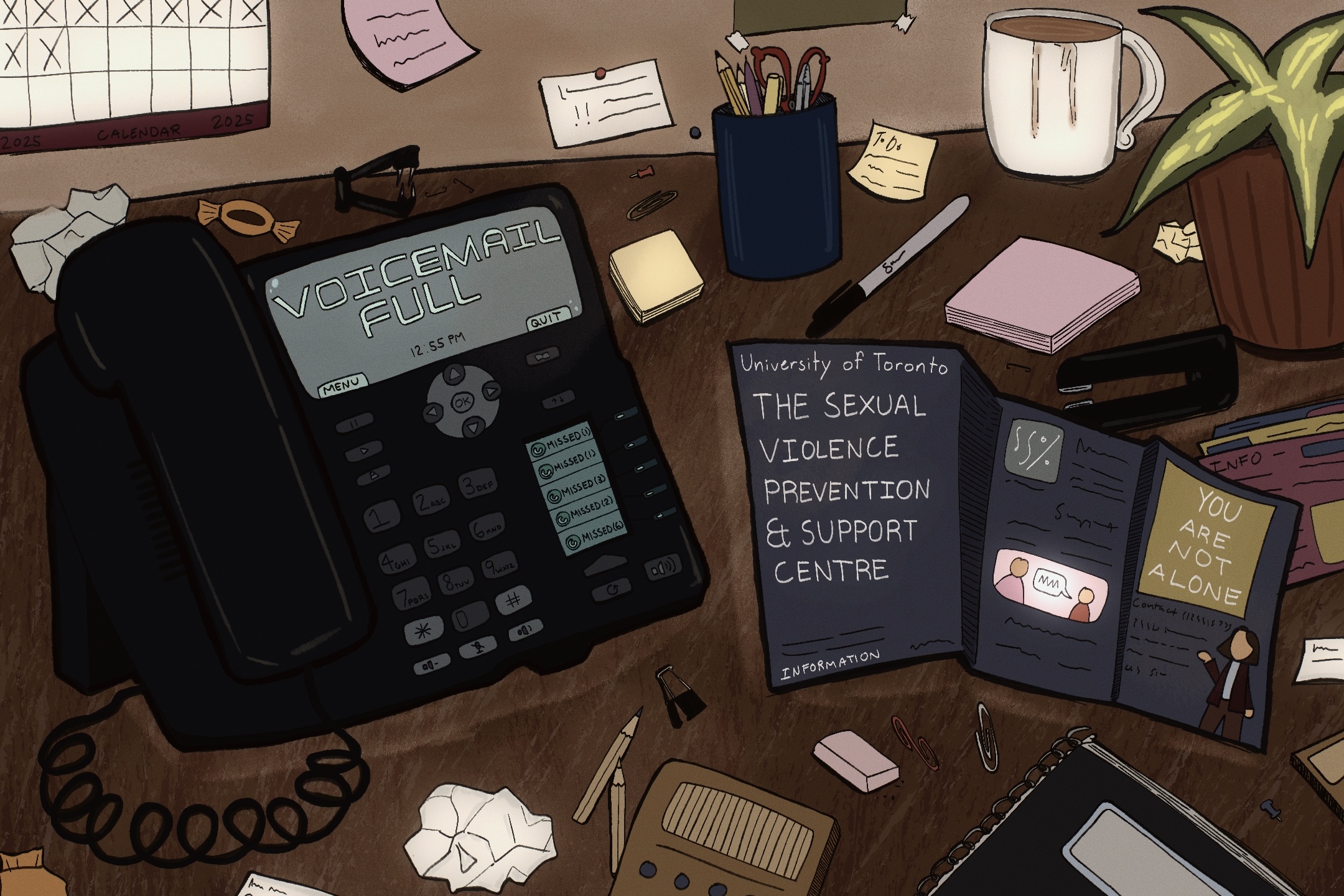
The Prevention, Empowerment, Advocacy, Response, for Survivors (PEARS) Project –– a grassroots organization that advocates on behalf of survivors at U of T and provides peer support to survivors of sexual violence at U of T –– posted a video on April 9, about their communication with the U of T Sexual Violence Prevention and Support Centre (SVPSC) in which there was no one answering phone calls during their work hours.
Instead, survivors were directed to leave a voicemail. The voicemail box was full, leaving survivors unable to leave messages.
In my view, this incident indicates an ignorance towards survivors from the SVPSC, a support centre many survivors rely on. After the PEARS Project reported this issue to the SVPSC, the SVPSC replied in an email that they had retested their phone lines, and they confirmed that they were accepting new voicemails. After learning of the problem, the SVPSC moved to an entirely new phone system that has no space constraints. However, in my opinion, the root cause of this issue is not about how many voicemails the phone system can accept; it’s that the SVPSC failed to clear their voicemail box, thus not allowing survivors to leave voicemails.
Despite these changes, U of T’s support for survivors, from my point of view, falls short; the university’s inadequate response mechanisms and lack of seriousness towards survivors seeking help risks subjecting them to further trauma and secondary harm. As an educational institution with a duty to protect and support its students, U of T should do a better job at providing students with information on community resources, informing them of available accommodations, and ensuring that these supports are always available to survivors.
How survivors are made vulnerable on campus
This is not the first time U of T has demonstrated a dismissive attitude towards survivors. Student-led groups like PEARS have noted this. In March, the PEARS Project updated its document listing 15 professors who are alleged by the PEARS project to be “problematic and/or predatory.” Yet, some of these professors continue to be affiliated with U of T or other academic institutions, facing effectively no investigation or punishment.
With long-term or tenured positions, those in power can easily exploit their advantages to manipulate and abuse vulnerable students, as they face little risk of dismissal. Meanwhile, students face barriers to speaking up for themselves, and as a result, are often forced to live in fear and trauma.
Power dynamics operate within academic institutions, and when abused, they oppress and harm students. An institution’s tolerance of sexual and gender-based violence leaves survivors in a vulnerable situation. When there is a power imbalance, silence becomes complicity.
It can take survivors hours, weeks, or even months to make a seemingly simple call. U of T’s cold response, as I see it, not only dismisses their attempts to reach out and seek help, but can also damage their hope for seeking help in the future.
Indifference toward victims and survivors is part of rape culture, creating an atmosphere in which victims feel unheard and unsupported. This harm does not only work in aggressive ways as we often assume, but it can also appear in actions that leave survivors feeling powerless or hopeless. When a survivor gathers the courage to confront their traumatic experience and seek help, they should never be turned away.
From my view, it is the responsibility of an educational institution to maintain a safe space for students, to ensure that they have a space to live and study freely with dignity. This includes efforts in sexual violence prevention and survivor support.
U of T fails in preventing sexual harassment
In my opinion, U of T misses the mark in terms of aligning its efforts to create the safe, inclusive, and equitable space for students it claims to be. The PEARS Project conducted an analysis of U of T’s Review of the Policy on Sexual Violence and Sexual Harassment in 2022. As the PEARS Project noted, Bill 132 requires all Canadian post-secondary institutions to review their sexual violence policies at least once every three years, establishing a legal expectation for these institutions when creating policies to address sexual violence. However, this analysis highlights serious concerns about the review process itself.
The PEARS Project commented that the university’s review misleads the public, as it uses language that suggests its authors are external or independent. Notably, the 2022 review was conducted in part by U of T employees — people paid by the university to evaluate its own policy and report their findings to their superiors.
For U of T’s 2025 review of the sexual violence policy, the university brought in Professor Faye Mishna, a professor at the Factor-Inwentash Faculty of Social Work and the Department of Psychiatry and hired Gillian Hnatiw, a legal expert on gender-based violence to assist in this review process. In response, Micah Kalisch, the founder of the PEARS project wrote to the Varsity in January 2025 that U of T still “need[s] someone who can speak out about injustice at UofT without fear of repercussion[s].”
This has raised concerns about bias and performativity due to the conflicts of interest.
We deserve a safe environment
Known for its humanistic and social science scholarship as a top-ranked university, U of T should not neglect humanistic care in practice. One of the fundamental contributions of the humanities and social sciences lies in deepening our understanding of the structures and functions of history, culture, and society. By examining how history has unfolded and how social systems operate, we can work toward advancing social fairness and justice.
Care and support for survivors are essential to advancing social justice and upholding humanistic values. I believe that U of T’s professed commitment to equality and inclusivity exists only as a superficial statement. Without substantive implementation, it fails survivors and it fails to address the broader problem of gender-based violence on campus.
A genuine commitment to humanistic values is demonstrated through the careful development and effective execution of policies and actions, not merely through words displayed on a website.
Creating a safe environment for students should be just as essential to U of T’s mission as academic excellence and reputation. It is time for a change.
Lorraine Pan is a fourth-year student in Women and Gender Studies. Their research interests lie at the intersection of trans and queer people, (im)migrant communities, and transnational activism. They are also a writer, activist, and illustrator, focusing on feminist movements, disability justice, and transnational solidarity.
Correction: This article has been corrected to reflect that the voicemail messages recorded before the inbox was full had already been responded to and had been saved but not deleted. The inbox was not cleared and became full, therefore students could not leave a voicemail. The SVPSC switched to a system without space constraints after learning of the problem.

No comments to display.