
“Clocks are now kind of irrelevant to me. Time, where it used to have the linear progression feel to it, now feels like a space to me.”
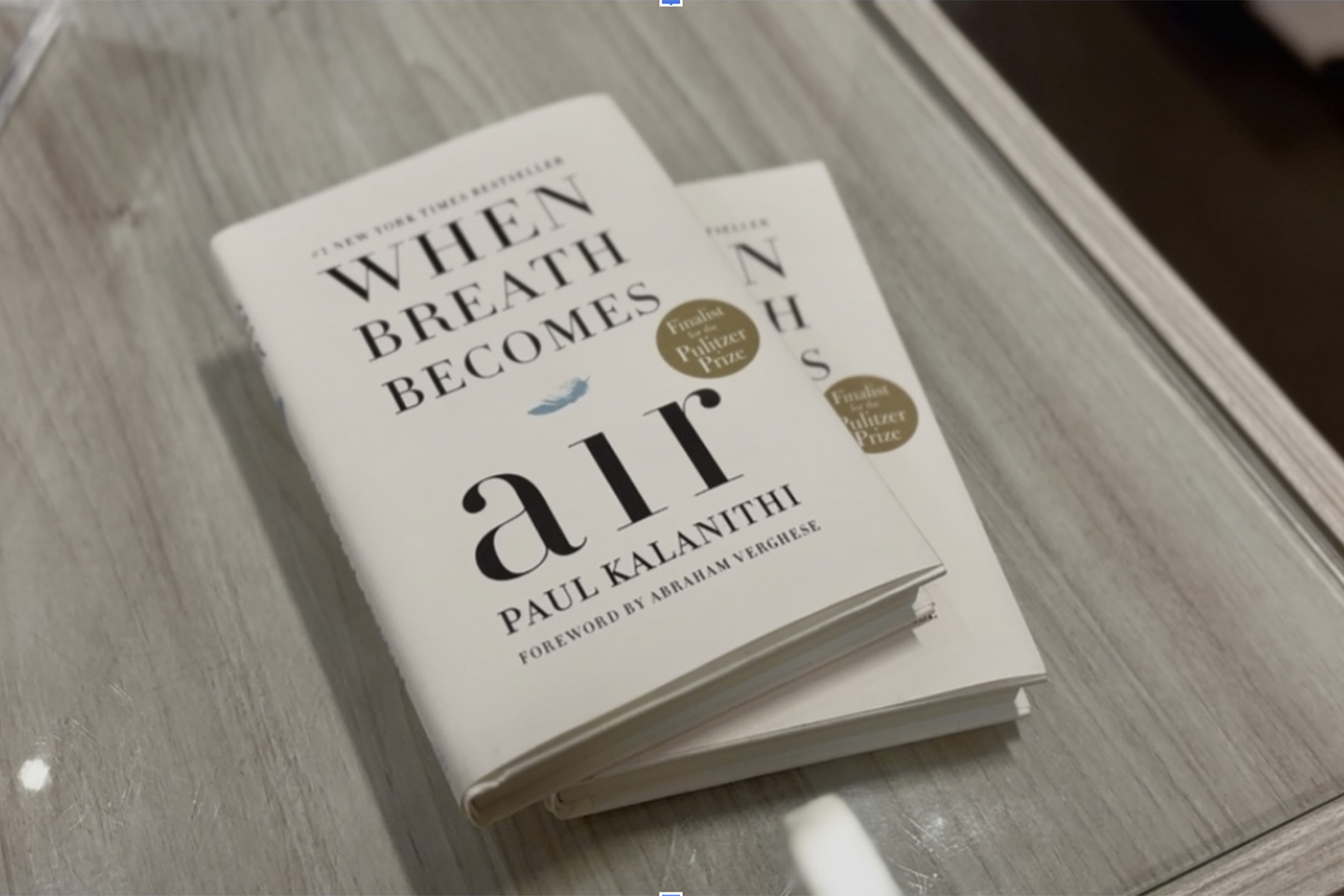
These words — from a YouTube video posted by Stanford Medicine — said by late neurosurgeon Dr. Paul Kalanithi, offer a window into the altered perception of time that came with his terminal lung cancer diagnosis. A physician turned patient, Dr. Kalanithi’s experience and his 2016 memoir, When Breath Becomes Air, embody the collision of medicine and philosophy as well as life and mortality.
Dr. Kalanithi was a neurosurgery resident doctor practicing at Stanford University School of Medicine. After experiencing back pain, a cough, and developing night sweats, he was diagnosed with stage-four non-small-cell EGFR-positive lung cancer, a mutation in the EGFR lung cancer biomarker.
Before donning his white coat in 2007, Dr. Kalanithi earned a Bachelor’s in English Literature and a Bachelor’s in Human Biology. He pursued these fields to probe a central question: what makes life meaningful?
He believed literature and philosophy offered rich insight into human purpose, while biology and neuroscience provided the physical framework for that meaning to emerge. It was this coupled curiosity that propelled him toward medicine.
Writing at the edge of life
Everything changed when Dr. Kalanithi — the neurosurgeon, doctor, the caregiver of his patients, who’d always evaluated case studies during medical school — became the patient himself.
Suddenly, the medical tools he once used to assess others became the framework for understanding his own mortality. Questions about survival and treatment effectiveness were no longer theoretical — they were deeply personal.
The Kaplan-Meier curve, often used by physicians and statisticians, measures the likelihood of patient survival over a period of time. These medical tools that he once used to assess others suddenly became a framework for understanding his own mortality. Numbers that once informed his clinical decisions now dictated his own personal future.
Numbers can not fully grasp the human experience: what is a 60 per cent chance compared to a 40 per cent chance of survival? These numbers are only predictions of fate. How does one balance hope, fear, and uncertainty in the face of mortality? How must one rely on abstract numbers and percentages to determine the outcome of one’s life?
As a surgeon, Dr. Kalanithi, who was fully accustomed to his scalpel, used words as his instrument of care. The words spoken by medical practitioners to patients and families colour the perception of these individuals moving forward and shape their perceptions of life and death. The change in perception often lingers long after events unfold.
For Kalanithi, the words he encountered as a patient carried immense weight: what hope remained, and how should it be measured? As a patient, he came to feel the power of words more intimately than ever before. Every phrase, every diagnosis, or prognosis, shaped his understanding of what hope meant — what life would look like.
Would he live to see his daughter walk? Publish the book he has always sought to write? Would he be able to teach while performing neurosurgery? Would he finish the book he had long dreamt of writing? These questions hung in the air, profoundly human but unanswerable.
Where healing meets humanity
Grappling with the devastating news of his diagnosis, Kalanithi pursued what first brought him into medicine — the writing craft. He authored a number of essays, such as How Long Have I Got Left? published in the New York Times, and Before I go in the Stanford Medicine Magazine, using writing as a way to translate his own mortality into something comprehensible.
Employing the strength that writing gave him, he returned to the OR, determined to continue living his purpose. “Until I actually die,” Kalanithi wrote in his memoir, “I am still living,” demonstrating that, despite living with the news that he was on the very brink of mortality, Kalanithi made the effort to still go on living.
Writing and neurosurgery, Kalanithi realized, were not opposing callings. Both required precision, empathy, and a sheer understanding of what it means to live and be fully human.
A legacy of thought and care
Kalanithi’s intellectual journey, spanning from literature to neuroscience and philosophy to surgery, was a lifelong attempt to bridge the mind and the body, thought and being. He sought to understand how the brain gave rise to produce consciousness, compassion, and meaning — how matter could make sense of itself.
Through his memoir, Kalanithi offers no easy answer to approaching life and mortality. Though perhaps that’s the point. His story reminds us that medicine is not only about prolonging life or measuring survivability using statistics, rather illuminating it.
Philosophy, he shows us, is not about abstractly pondering death, but preparing to meet it with dignity — just as Kalanithi had. In the end, the greatest challenge for both the physician and the patient is living to one’s full potential and up to life’s meaning, even when light begins to dim.
