
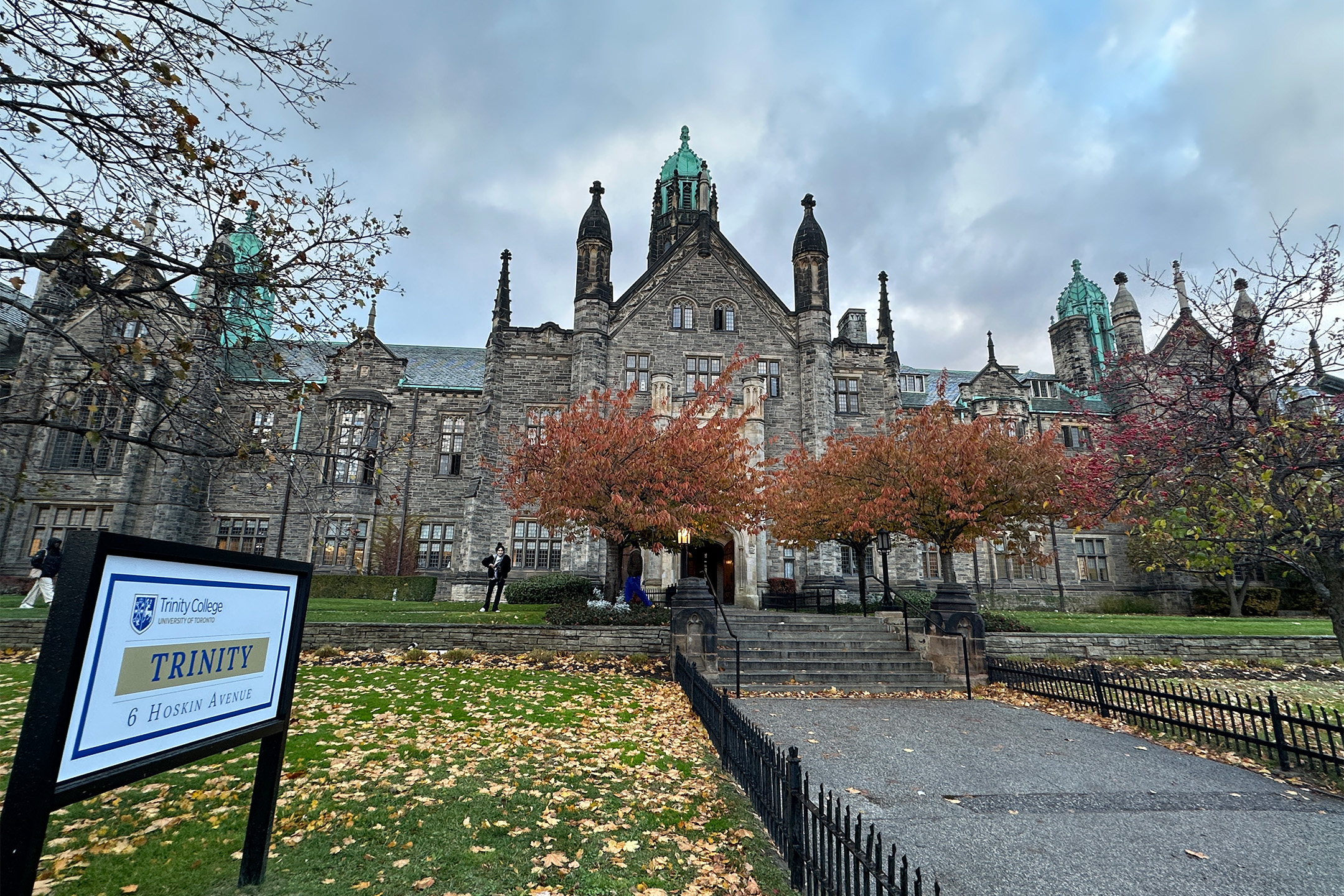
Draped in nostalgia, gowns have returned to Trinity College. When Trinity College joined U of T in 1904 as a federated college after being an independent institution, it entrenched gowns as a symbol of its history; students wore them to classes and university events as a marker of their identity as Trinity students. Once an everyday uniform, the gowns were quietly retired during the pandemic, and their recent return is facing mixed reactions.
More recently, the gowns were worn at specific Trinity College events, such as academic and High Table dinners, where students eat dinner alongside faculty and special guests. For some, they conjure memories of an elitist past, the visual shorthand for Trinity’s reputation as the most insular of U of T’s colleges. While for others, the gowns’ return sparks the revival of a sense of belonging at the college, serving as an avenue to restore communal traditions that make college life about more than just coursework.
As a Trinity student, I’ve found myself caught between these competing narratives. However, I believe the debate misses a larger point: the problem was never the gowns themselves, but the implications attached to them. We need to assign a new meaning to the gowns as symbols of equality rather than hierarchy.
When everyone wears the same garment, the lines between wealth, style, or background begin to blur. The gown can flatten the very same hierarchies that critics claim it enforces. “Historically speaking,” said Trinity College Meeting (TCM) Chair Anneke Lee in a message to The Varsity, “the purpose of gowns has been to champion a spirit of academic excellence.”
At Trinity, wearing a gown wasn’t a sign of division or exclusion. “It was a way we could express our shared identity as learners.” She adds that, if anything, “gowns make Trinity less exclusive, as wearing them reduces our focus on visible signs of socioeconomic status and wealth.”
Trinity College student Lily Portsmouth admitted she was initially indifferent. “I thought they didn’t serve a special purpose,” she said in an interview with The Varsity. “But now that I’m seeing everyone excited about the gowns, it’s uniting Trinity into more of a community.” I believe that the return of gowns brings Trinity students closer together, something that has notably been lacking since COVID-19.
Still, some skepticism around the gowns lingers, especially the criticism that Trinity, in comparison to other colleges, is more isolated and elitist. This sentiment is a common one, and it’s not entirely unfair. From High Table dinners to Latin graces, Trinity’s distinct culture can appear closed off to outsiders. But its distinctiveness doesn’t necessarily indicate a sense of superiority. I believe traditions also have the capacity to evolve without erasing their history.
The question isn’t whether the gowns are elitist, but whether we allow them to remain so. I feel that symbols only carry the meanings we give them. Portsmouth said, “Other colleges could do this if they wanted to. They just don’t. Trinity’s traditions don’t have to be about privilege; they can be about participation.”
Despite this, the financial accessibility argument also deserves nuance. During COVID-19, former leadership discontinued the gowns on equity grounds, believing that it was unfair to ask students to buy or rent one. But as Portsman said, “banning traditions doesn’t solve class differences. A better response is helping people join in, not excluding everyone altogether.” Reclaiming the gown in this sense means making it accessible, steps which Trinity College has taken by allowing students to borrow gowns for free for specific events.
Traditions are living and are shaped by those who inherit them. I believe that today’s Trinity students are, by and large, socially conscious and politically engaged; so why should the gown be any different?
I don’t romanticize the college’s history. Trinity’s reputation for exclusivity didn’t emerge from nowhere; it reflects decades of cultural ignorance and social stratification that can’t be brushed aside. But rejecting every remnant of that past risks throwing out what’s worth keeping: the sense of belonging that makes university more than a purely academic experience.
The gowns will become a shadow of Trinity’s past if we allow them to be. The return of the gown doesn’t have to mean a return to old hierarchies. It can mark a break from them. So yes, I believe the administration made the right call. Not because Trinity should cling to its previously tethered image, but because it should revise it. The gown can become a statement of unity and belonging; the choice is ours.
Eishaal is a second-year student pursuing a double major in public policy and political science. She currently serves as the head of finance at the Women in Political Science student association.

No comments to display.