
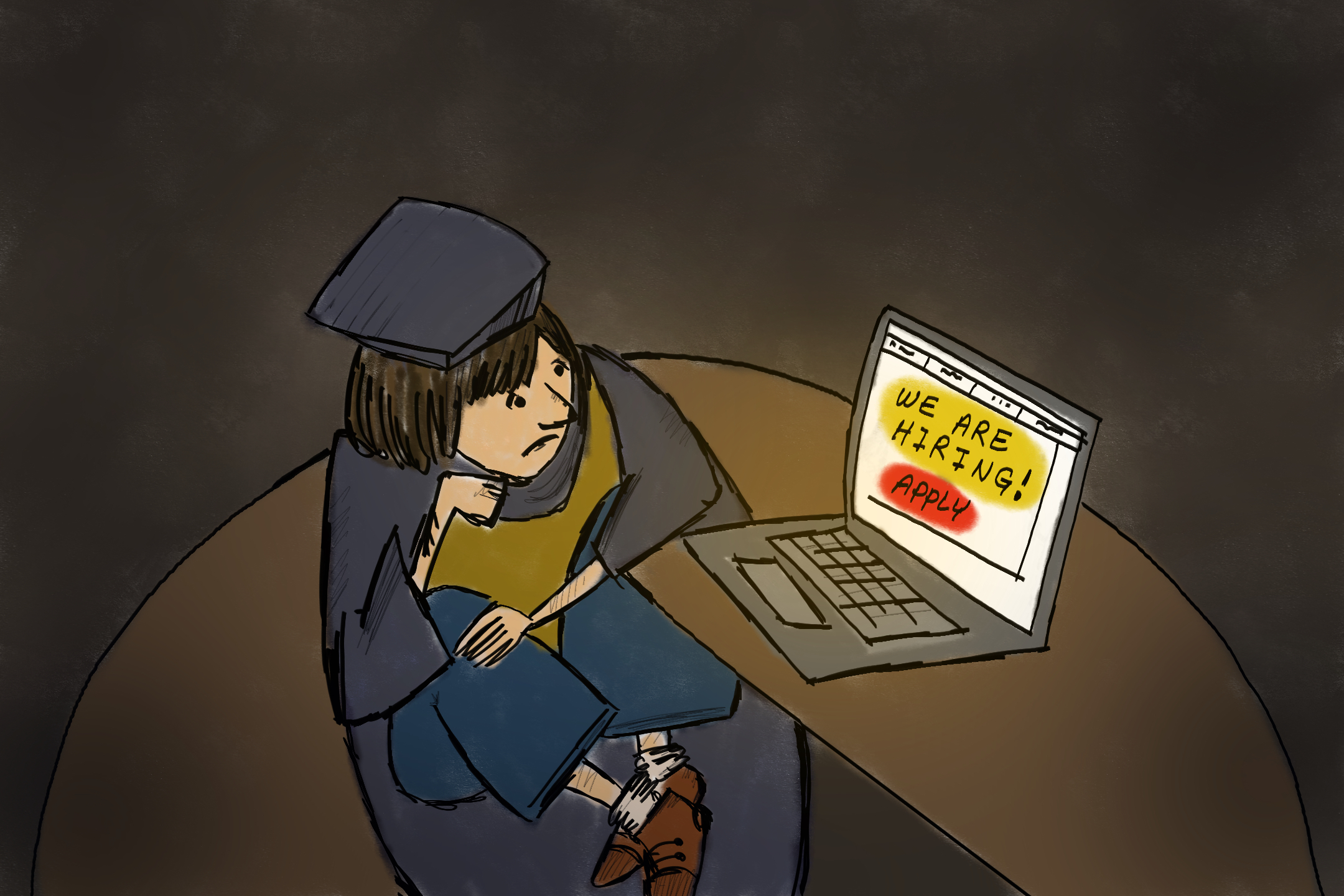
Over 4,000 students graduated from U of T during the fall convocation ceremonies between October 27–30. While many of these students may choose to attend graduate school, a large number will also enter the job market.
However, finding a job as a student could be a challenge right now. A recent report from Statistics Canada revealed that only 457,400 jobs were vacant in August, the lowest number observed since 2017. In fact, this marked a shocking 15.2 per cent decline in available jobs from last August.
Things do seem to be improving — the unemployment rate in October was 6.9 per cent, 0.2 per cent below forecasts. While this is encouraging, it’s hard to tell if this is a long-term trend given that unemployment has been fluctuating around this level for the past few months.
How are things looking for students?
Youth unemployment peaked at a 15-year high of 14.7 per cent in September.
This number is rising largely due to shortage of available jobs. Geopolitical uncertainty, which may stem from American tariffs, has made employers cautious about future sales growth. Consequently, businesses are limiting hiring in anticipation of reduced workload.
A substantial increase in job applications is also impacting younger people seeking employment. Trina Smith, a program manager at Prospect Human Services, told CTV News, “It’s hard to sift through all the applicants when so many people are looking for work right now.”
To address the shortage of jobs for youth, the government plans to create 175,000 new positions over the next three years, investing $1.6 billion into various government programs. This includes the Canada Summer Jobs program, which will create 100,000 jobs next summer, and funding to further develop young workers’ skills.
On the bright side, youth unemployment fell to 14.1 per cent in October. Part-time employment drove much of this improvement, with 85,000 people gaining part-time jobs last month. Analysts attribute the increase in temporary work to higher demand in restaurants and hotels, boosted by the Blue Jays’ World Series run. However, the economy saw a decline of 18,500 in full-time jobs in October, showing that challenges remain in the job market.
AI’s effect on the job market
The emergence of AI is also impacting students’ ability to find work.
Automation of various tasks is threatening many entry-level roles. For example, according to Bloomberg, more than 50 per cent of a market research analyst’s role could be replaced by AI, while only nine per cent of a manager’s role in the same industry would be affected. Employment of people aged 22–25 in roles particularly vulnerable to automation is down 13 per cent, suggesting that finding work is becoming increasingly difficult for young people in the age of AI.
While this may cause anxiety for graduating students, it could also reflect the economic concept of “creative destruction,” where new methodologies replace old ones.
The World Economic Forum predicts that 170 million new jobs will be created by 2030 due to global trends, including technology, with many roles likely focused on evaluating and certifying AI outputs.
The process is not unprecedented. Researchers from MIT, Northwestern, and Utrecht University found that 60 per cent of today’s jobs did not exist in 1940. Roles like elevator operators have disappeared, making way for engineers and analysts. Of course, the future remains uncertain, and it is difficult to predict how AI will reshape opportunities for students.
A student’s perspective on finding a job
Ekaterina Brechko, a fourth-year computer science student, shared her experience looking for employment after graduation in an email to The Varsity.
“[AI] has made the pool of applicants much wider because of the ease of making resumes,” she wrote, noting the increased competition brought on by technology. According to The New York Times, job applications on LinkedIn have risen by 45 per cent, largely due to generative AI tools. “This makes me feel a bit discouraged of putting super high quality into my applications because I often feel they won’t be read anyway,” Brechko wrote.
As a computer science student, she is also cautious about applying to certain roles in her field. The mass public discourse surrounding AI has made her aware of the criticism related to her industry.
While she recognized that there is often misinformation, she is mindful of AI’s real-world impacts. “There are very real issues regarding ethics, privacy, environment, etc that the quick rise of AI brings about. I want to be careful with what impact I have in this area,” she explained.
