
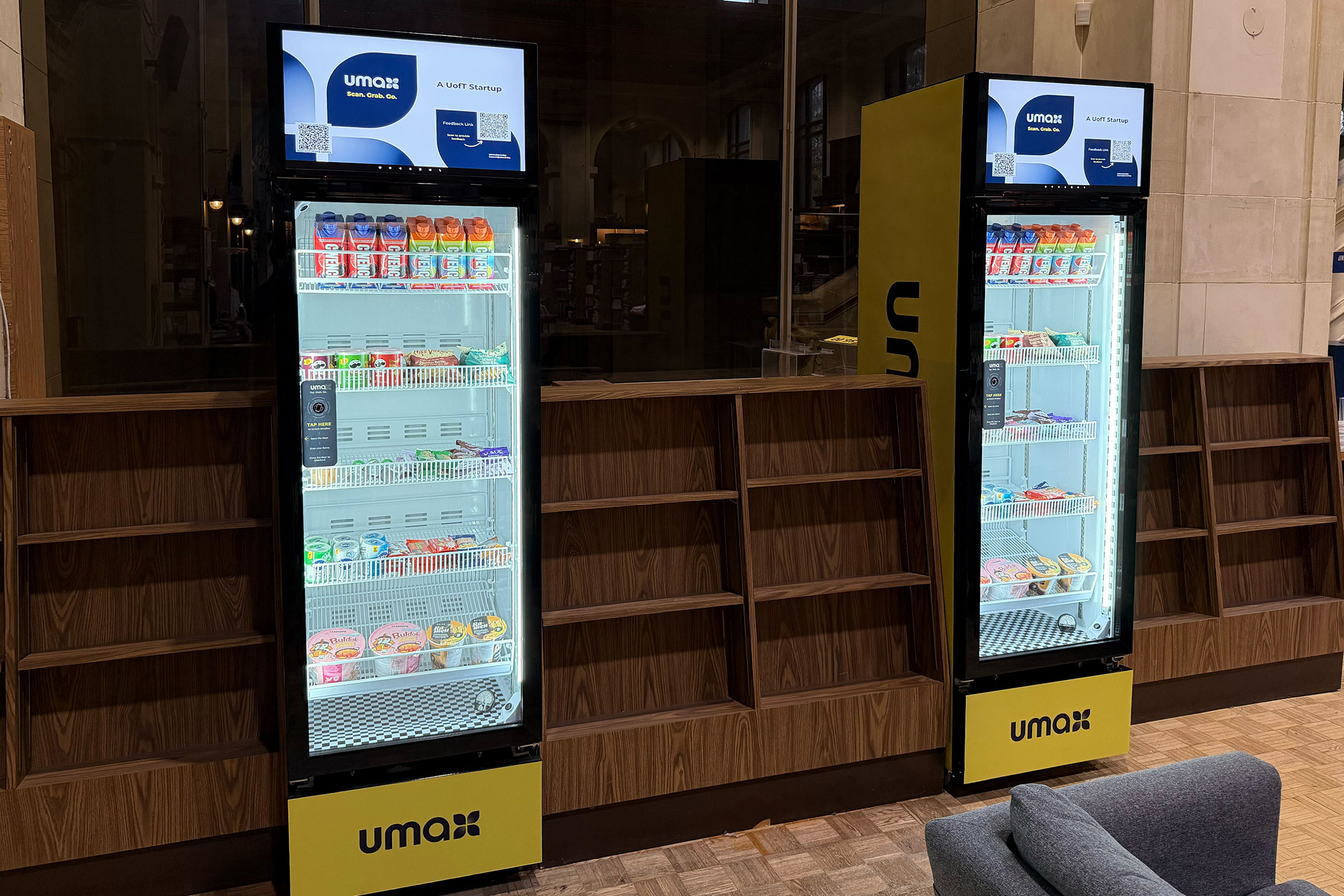
On the second floor of the UofT Bookstore, among the shelves packed with thick textbooks and stacks of assigned readings, you’ll find two yellow appliances that don’t quite belong. Futuristic, bright, and about the height of a bookshelf, quintessential vending machine snacks and drinks gleam behind their glass doors. These next-gen vending machines are UmaBoxes, the flagship product of Uma, an autonomous retail startup launched by a pair of U of T students.
In an interview with The Varsity, Uma co-founders Walid Al Khalidi — a 2024 Rotman alumnus — and Jim Ma — an economics student taking a gap year — discussed launching a startup as students, the impact of U of T’s entrepreneur environment, and what the future holds for the young company.
Snack to the future
“What we’re trying to build is… an AI-run vending cabinet that redefines the traditional way of retail,” explained Ma, who began working on Uma in November 2023. “We want to provide this ultra point of convenience for the consumer.”
Instead of paying with change or a bank card, you pay the machine by scanning a QR code through the Uma app to unlock it: “You open the door, you grab your items, and then you close the door, and automatically, we detect what you take out what you didn’t take, and we charge you accordingly,” said Al Khalidi. Users are charged based on the payment method they have listed in their Uma account.
Uma is currently integrating AI for “[UmaBoxes’] front end, centre piece, and back end,” explained Ma. An AI avatar will act as a shopkeeper at each location as the product’s front end. The centrepiece will be the AI model collecting sales data in each location. The backend system of the product will manage logistics based on the data each box collects.
Al Khalidi and Ma also highlighted unique features such as dynamic promotions, user requests for products, and local partnerships — such as stocking Toronto brands Quench and Earth Greenhouse — as keys to Uma’s ambitious attempt to shake up the snacking industry.
Despite launching live UmaBoxes this May, there are already 15 units in operation across the city — such as in physiotherapy studios and gyms — and Uma plans to expand to offices and residential buildings.
Three of these UmaBoxes can be found on campus; two are placed on the second floor of the UofT Bookstore, selling snacks and drinks, while the third unit is located in Kelly Library, selling St. Michael’s College merchandise. “These are huge accomplishments for us to be trusted by large corporations like U of T,” explained Al Khalidi.
U of T’s entrepreneurship ecosystem
Over the last five years, University of Toronto Entrepreneurship (UTE) has reported that U of T accelerators and innovation hubs have raised a staggering $14 billion in funding for startups. Although Uma has not received any capital from UTE, they have nonetheless directly participated and benefited from the startup-friendly environment cultivated by UTE and U of T.
Al Khalidi and Ma first connected with The Entrepreneurship Hatchery, a U of T program that “provides a comprehensive suite of activities and programs designed to create startup companies.” The program is open to all U of T students and faculty and provides various services to help launch startups, including connecting potential founders together.
“[The Entrepreneurship Hatchery] is the first [incubator] that we applied to,” explained Al Khalidi. A business incubator is a program that gives early-stage companies mentorship, investors, and other support to help them get started.
The two used the “workshop space to critique [our] business plan… everyone that we talked with was super encouraging of the idea. They said, ‘You have a product here. Let’s do a demo, and we’ll make it happen.’ ”
In December 2024, Uma attended the Startup Holiday Market organized by UTE. Hosted in collaboration with the UofT Bookstore, the Holiday Market is one of several UTE events that allow student entrepreneurs to showcase their products and services.
There, the duo participated in an “on the spot” pitching opportunity hosted by UTE Director Jon French. “Jim and I, we went up and we talked to the crowd,” said Al Khalidi. “That’s how we got lucky. If you just sit at home and do nothing, you don’t even put yourself out there, you’re not gonna get lucky.”
Following the impromptu pitch at the Holiday Market, Uma was connected with potential investors, the UofT Bookstore, and French himself. French then “wanted us to go to this event called True Blue Expo,” another UTE-hosted community event that runs in March, where startups demo their products.
“The event was extremely useful for getting our name out there and getting initial customer feedback, because at that point, on March 3, we still did not have any real-life deployments,” said Al Khalidi. Just two months later, in May 2025, Uma secured their first live deployment. “We never took part of the [UTE’s financial] resources, but we did leverage the connections that it brought.”
Responding to a question about advice for student entrepreneurs, the pair continually emphasized shaping your own luck. “You can twist your luck. You need to position yourself where you can be the luckiest,” said Al Khalidi.
The future of Uma
When asked about the future of the company, the founders highlighted how the expansion starts from right here on campus. “We have many more [UmaBoxes] to roll out. We want to leverage current students in U of T to help us put machines out there. We’re hiring brand ambassadors. We want to grow our U of T team. We want to make a local team for the products,” said Ma.
The company is currently collaborating with the University of Toronto Machine Intelligence Student Team to develop its own in-house software. The startup also hosted a live demo in the Rotman School of Management last month.
The team behind Uma believe that the environment at U of T, where everyone has the drive to accomplish something, is a great atmosphere to be in. “U of T is a central hub… [in] Canada to make things happen,” said Ma.

No comments to display.