
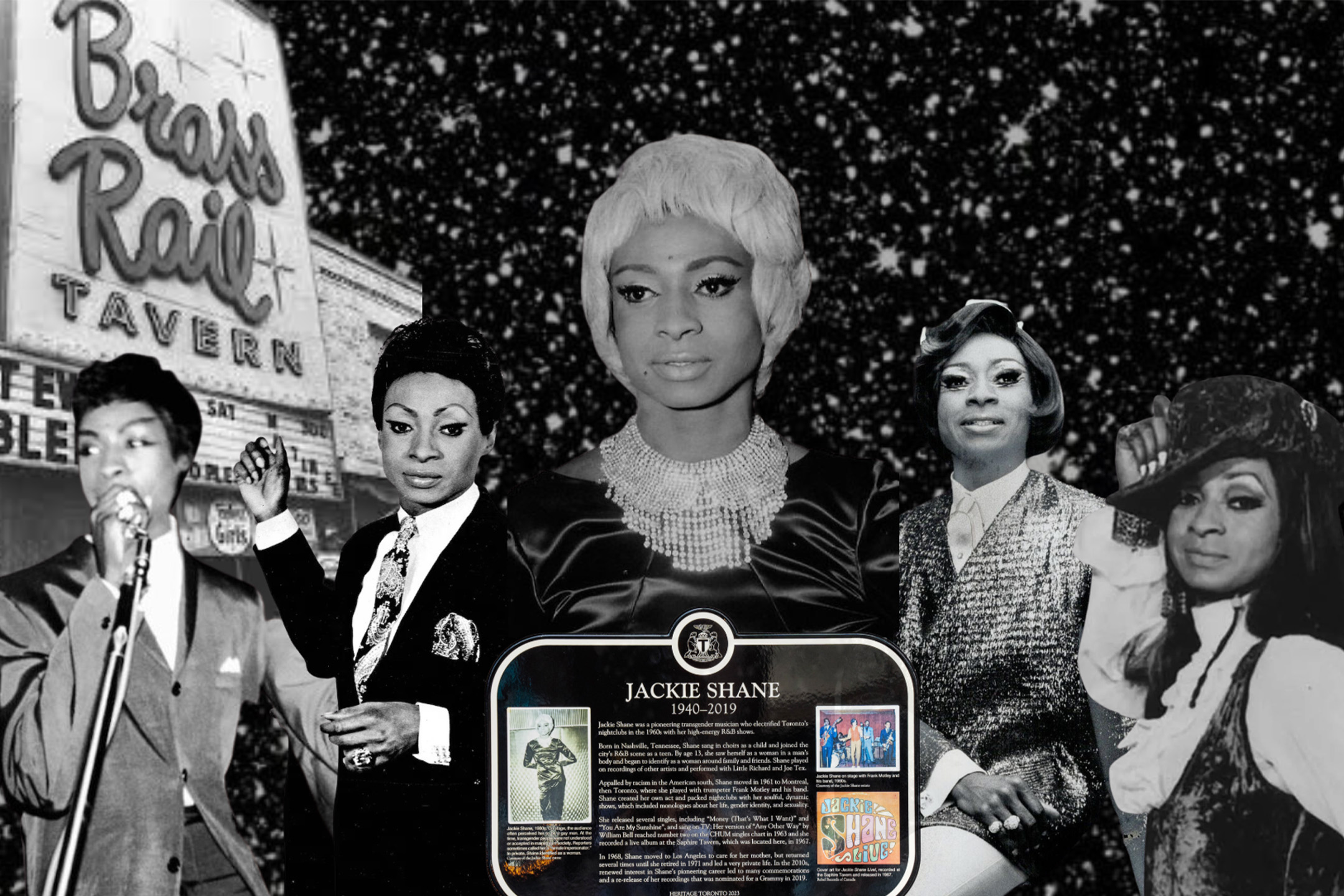
Nashville-born singer Jackie Shane dominated Toronto’s R&B scene throughout the 1960s. She regularly performed at Yonge Street’s swinging go-go club Saphire Tavern, and the burlesque club The Brass Rail. If you’ve ever passed by the north-facing music mural on Yonge Street, you’ve likely seen her face before.
As a Black woman, Shane was displeased with the Jim Crow laws, which enforced racial segregation in the Southern United States, and found her temporary home in Toronto in the early ’60s with fellow American musician Frank Motley and his band.
Shane experienced immense success in her career, touring with American singer Etta James, breaking through on the charts, and selling out Toronto nightclubs. Shane’s biggest hit was her cover of William Bell’s song “Any Other Way.” In 1963, the single reached second in Toronto’s top 50 songs ranked by CHUM charts, and in the US, it was 124th on Billboard’s bubbling under the Hot 100 chart, which features popular tracks outside of the top 100.
In addition to a velvety tone, Shane’s rendition of “Any Other Way” gives the song new humour and meaning. When Shane sings the lyrics, “Be sure to tell her this, tell her that I’m gay,” she connotes both her happiness and her queerness. In doing so, Shane resists standard society through the re-invention of a song that emphasizes her joy and identity.
In a live recording of the song, Shane monologues to the crowd near the end of the track: “I live the life I love, and I love the life I live. I hope you’ll do the same. You know you’re s’posed to live. As long as you don’t force your will and your way on others, forget ‘em baby.”
Shane used monologues in many of her songs and performances to connect with the crowd by sharing her wisdom from living in a white hetero society. On “Money,” she reiterates her self-confidence and urges the audience, once again, to adopt her golden rule: “Don’t force your will and your way on anybody else, live your life.” Living by her own will and way, Shane performed in sequins and silk, wore cat eye makeup, and always returned to stage with a different hairdo — all while telling folks to mind their own business.
The spotlight proved to be a mixed blessing. Opportunities to receive greater exposure as an artist came at the expense of Shane’s full identity. Shane declined an appearance on the American Ed Sullivan Show due to the condition that she must not wear makeup; she also refused to perform on American Bandstand because they did not allow Black children on their program.
Although Shane received substantial admiration during the peak of her career, she was unsatisfied with an industry that persistently demanded that she live outside of her truth. Shane retired in 1971, moved back to Nashville, tended to her mother, and lived a private life until her death in 2019. Shane abandoned stardom at her peak, but her influence would define Toronto’s R&B sound forever.
The mainstream was not prepared to meet Shane’s conditions of gender and race inclusivity. In recent times, however, Shane’s memory is preserved throughout spaces in Toronto, as well as in the city’s art scene, reaching a scale of visibility much larger than she did during her career.
Only one video exists of Shane performing from 1965 on a Nashville R&B broadcast called Night Train, where Shane exudes a classy nonchalance accompanied by her snapping finger. However, we can still see glimpses of her on Yonge Street in a Music Mural, on her heritage plaque at the corner of Victoria Street and Richmond Street, and in record shops carrying her Grammy-nominated reissued record, Any Other Way.
Maybe you’ll catch Shane in Canadian filmmakers Michael Mabbott and Lucah Rosenberg-Lee’s 2024 documentary, Any Other Way: The Jackie Shane Story. If you wander through the Museum of Toronto’s current exhibition, “Stories of women who transformed Toronto,” you’ll find Shane celebrated among 51 other women, her record lying across a light-bulb-studded vanity. Travel to Nashville and find Shane on the first historical marker to celebrate a trans person in the Southern US.
But Shane didn’t live to see half of this. The world played a game of catch-up with Shane, only righting their wrongs in her old age or after her passing.
Shane wrote in her unpublished autobiography, “I was born, but I have never lived.” We remember Shane for her songs, for the texture she gives Toronto, and for her position as a historical anomaly. But to truly honour Black trans lives, we must also acknowledge the life never lived.

No comments to display.