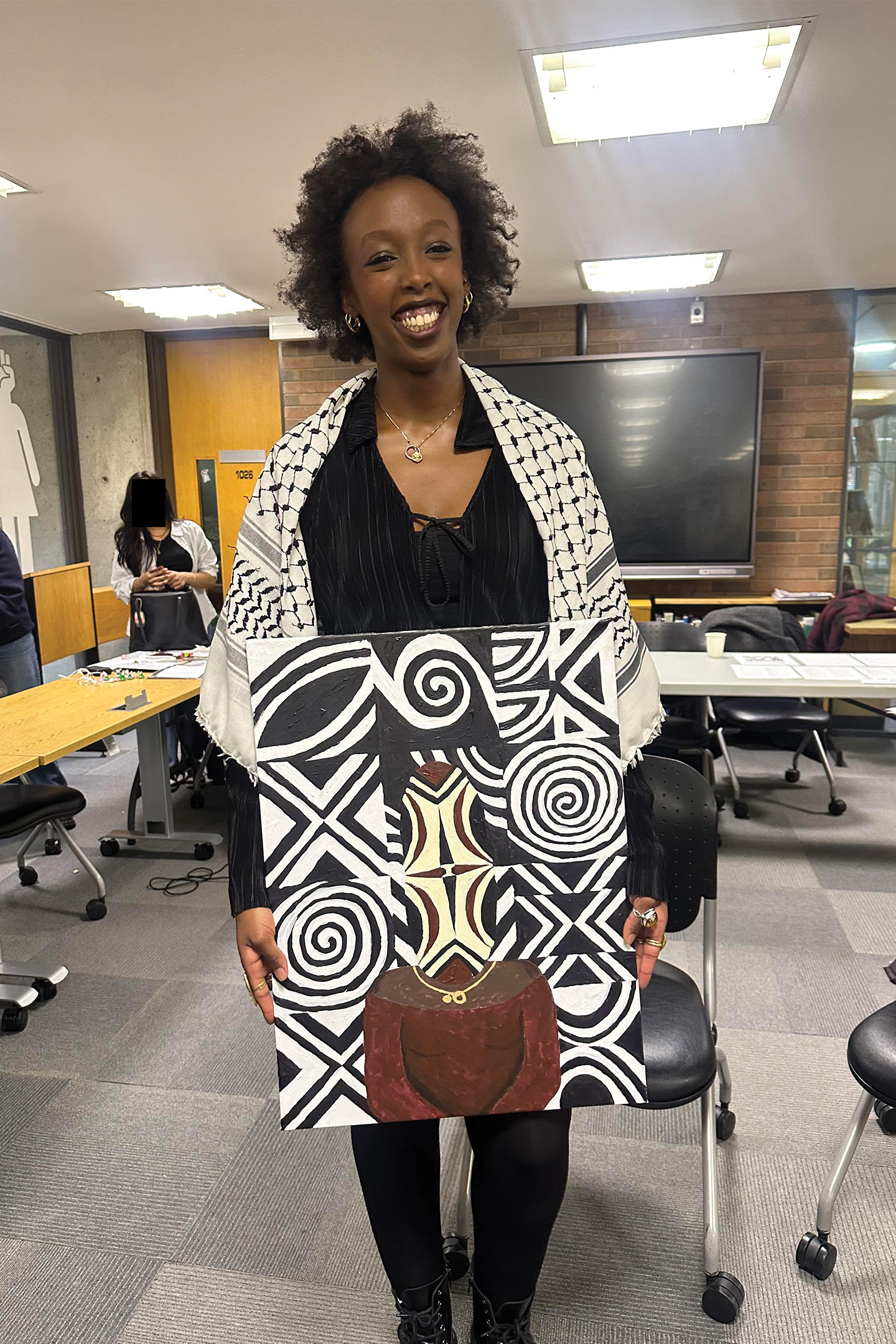
Ineza Mitako Kayihura Rugari is a Rwandan-Canadian visual artist and an upper-year student in U of T’s Women and Gender Studies and African Studies programs. On February 14, I had the pleasure of speaking with Rugari about her artistic practice, storytelling, and the people who inspire her.
Rugari is an abstract artist who mainly works with acrylics. Through her art, she explores themes of identity, community, decolonization, and cultural memory. A deep influence for Rugari is her family, “Our family history is really interesting, and my people’s history is fascinating as well.”
Before coming to U of T, Rugari’s formal education was Western-centric; at her American international school in Rwanda, she learned more American history than Rwandan history.
To make up for this, Rugari’s parents made an active effort to speak to her and her siblings in Kinyarwanda, to teach them about contemporary and precolonial history, and to share their family’s histories. Rugari said, “I could always see that difference between going to school and learning something in a book, versus coming home and sitting around the TV or the coffee table, chatting with my family. Seeing the difference in the histories and the way they were conveyed always left me curious.”
“Uburemere: Heaviness”
Rugari is drawn to abstract art because she is more interested in process-working than the final product itself. Rather than worrying about how the product will look, she focuses on the emotions she wants to convey, and “how it feels to let go of everything on the canvas.”
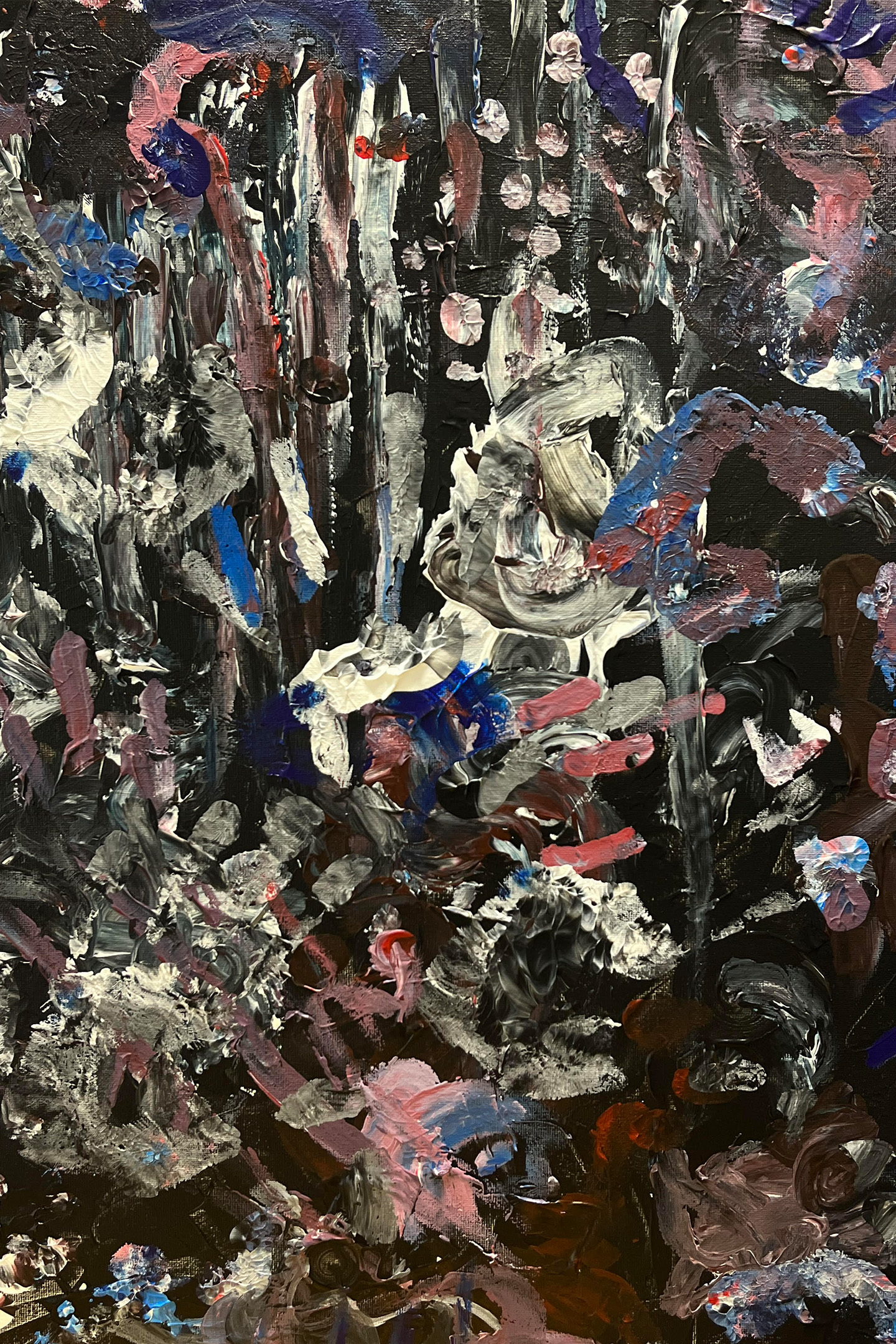
Rugari centred process, particularly in a piece called Uburemere — which means weight, or heaviness in Kinyarwanda. It is a collaborative piece with her dad, her sister, and two of her friends. This piece spoke to “the very gendered violence that Black and African women face, both on the continent and within the Black diaspora. In collaboration with my family members and my friends, I wanted to demonstrate how integral community can be in the healing process.”
Rugari painted the base of the piece, then had her friends and family members contribute. The artmaking process was intimate and collective — she described her friends and family members holding out their hands so she could paint the colours they mixed onto their hands, and giving them free rein to drag their hands across the canvas.
“Imitako yerekeye kwirwanaho: Adornments of resistance”
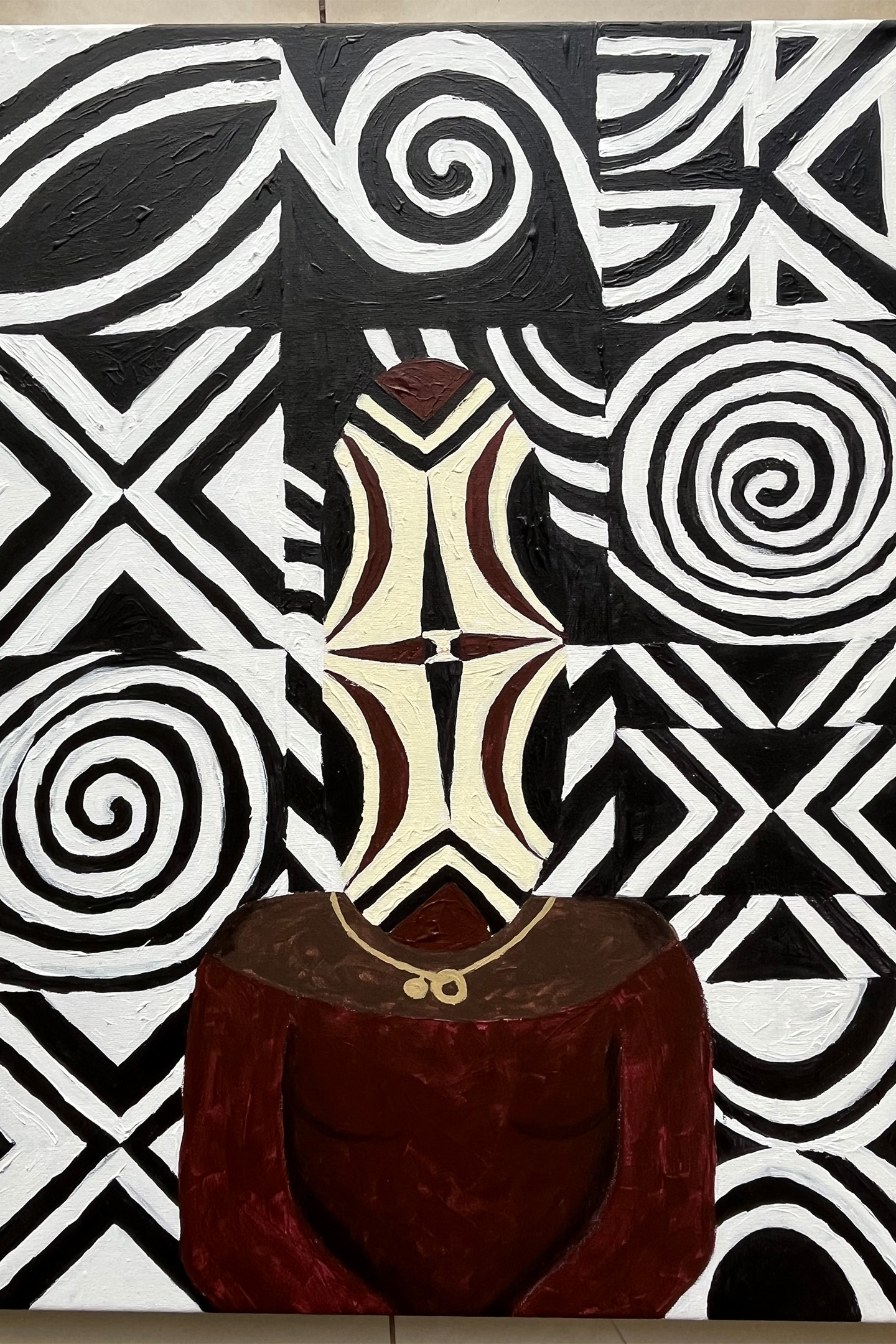
Rugari also shared with me a self-portrait she created called “Imitako yerekeye kwirwanaho,” or “Adornments of resistance.” In this piece, she aimed to “reflect on my identity as a Rwandan woman, and as a Black woman and my family histories, and think about how colonialism and imperialism affected me directly, as a Rwandan and as a settler in Canada.”
In the place of her face, Rugari painted a shield that precolonially was carried by warriors, and is now carried by traditional dancers. In putting the shield in front of her face, she was thinking with Aimé Césaire’s concept of “thingification,” where colonial subjects are dehumanized.
She explained that “oftentimes, the way colonialism is spoken about, is that the people who have experienced [it] passively accepted and assimilated the colonialism and imperialism, when in reality, people were fighting, people were resisting.” She wanted to emphasize resistance to colonialism, to remind her audience that the shields and spears once served a very real purpose.
The patterns surrounding the subject of the painting are drawn from Imitako Gakondo, or traditional decorative patterns, which are three-dimensional art pieces made using a mixture of cow dung and ash to sculpt the motifs on wooden boards by hand. They are traditionally black, white, red, and gray, and have geometric patterns like spirals.
Rugari is drawn to acrylics as a medium because when acrylic paint dries, it has ridges and textures. Like Imitako Gakondo, her art is three-dimensional.
Rugari also shares a name with the art that inspired this piece — her middle name is Mitako, which means adornment in Kinyarwanda. Rugari comes from a family of artists and storytellers — she shared that when she and her siblings were born, her dad wrote poetry explaining their names, and the intentions they had for their children in naming them this way. For example, her first name, Ineza, means generosity and goodness.
She also fondly recalls her grandparents’ storytelling, “They would tell us about moving around different countries within East Africa, or travelling to Belgium for the first time, or when they moved to Canada… and what we were like growing up. In Kinyarwanda, people were very indirect; sometimes it feels like you’re speaking to someone in riddles, and they’re always beating around the bush before getting to the point. So in that way, they were storytellers, because you’d ask a question, and they’d say so much before answering the question.”
Rugari takes a similar approach in her art. She explained that abstract art is an outlet for her creativity and emotions, “I love spirals. I love spirals because I feel like I spiral a lot. If I were a shape, I’d be a spiral, both positively and negatively.”
Like a spiral, “Once something is on my mind, I will just continue coming back to it, continue coming back to it, and continue coming back to it. Even in the way I talk, in the way that my people talk, in the way that my friends and I will gossip, it’s always rehashing, always coming back to the thing, like a continuous spiral. This constant state of revisiting and revisiting also leads to my curiosity in finding out more, which inspires my work.”
You can find more of Rugari’s art on Instagram at @spirallingwithmitako.