
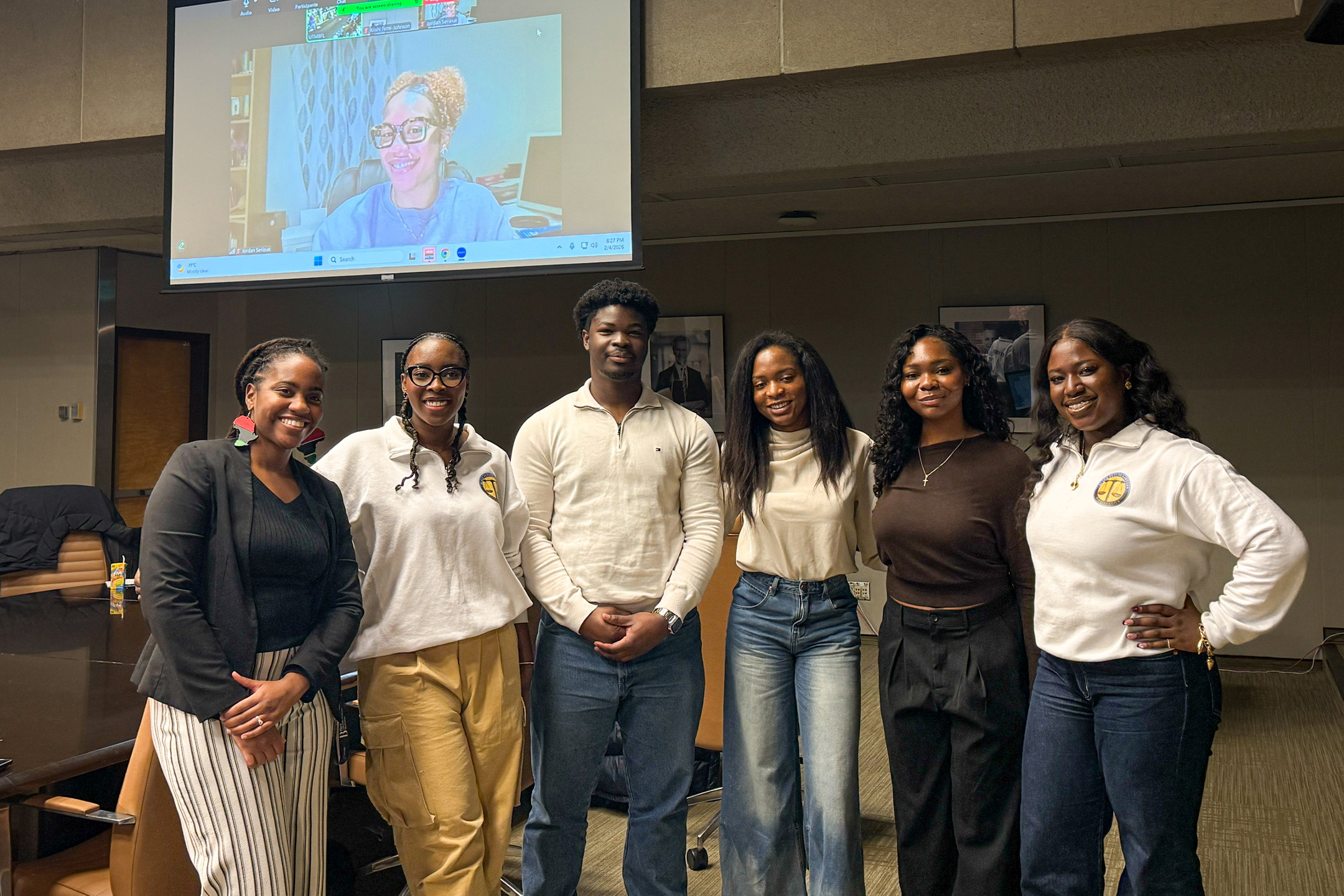
On February 4, Black Future Lawyers UTM (BFL UTM) hosted Breaking Barriers: A Student Success Panel to support Black students as they navigate pathways to law school and the legal profession.
The panel, organized for Black History Month with the University of Toronto Mississauga Students’ Union (UTMSU), brought together undergraduate and law students, U of T alumni, and UTM community leaders to discuss mentorship, LSAT preparation, and the challenges Black students face entering competitive and costly legal fields.
Addressing representation gaps
Black professionals remain underrepresented in Ontario’s legal fields. According to a 2016 report from the Law Society of Ontario cited by The Globe and Mail, only about 3.2 per cent of lawyers in the province identified as Black, despite comprising 4.7 per cent of Ontario’s population at the time.
Kishi Femi Johnson, president of BFL UTM, said the lack of representation continues to motivate the organization’s work in supporting Black students interested in pursuing legal careers.
“We have such little legal representation, but such mass incarceration of black people, which is why we’re really pushing to ensure that people are able to have all the resources that they need to apply to law school.”
Johnson said the organization aims to provide students with financial and informational resources to pursue law school, including networking opportunities, LSAT preparation support, and guidance on applications.
“Law school is extremely expensive. It’s extremely competitive … and it’s a ‘you-know-someone’ industry,” she said. “A lot of the people that were competing against [us] have fathers or mothers that are partners, have grandfathers who started law firms, or have pictures of their great, great grandfathers on the walls of the U of T law school. But we can’t relate to that.”
The panel featured Black students and speakers who discussed applying to law school, recovering from academic setbacks, and building professional networks.
“Even if you failed in [the] first year, we want you to believe that you can still be a lawyer,” Johnson added.
Expanding representation in law
Panellist Oluchi Isiuwe, a double major in psychology and criminology, law, and society, said her interest in law stems from seeing gaps in representation within areas such as real estate and land law.
“There’s not a lot of black lawyers in real estate and in that kind of space, and land is everything to me,” Isiuwe said. “Land protects dignity, land protects generations. Where you live is so important, and it affects so much of how your life progresses. People can be blocked out of different opportunities depending on where they live, and there are not that many black people in the space to talk about the barriers that their people face.”
She added that limited representation can make it difficult for Black students to feel they belong in legal or professional spaces.
“As a black student, I felt like I didn’t belong in certain spaces, like legal spaces or professional spaces… I did not see people like me as much as I saw others,” she said. “It was a little bit of a barrier, in that sense, because my access to mentors who could connect to my specific experience was less than [for] other people.”
Isiuwe said attending Black student events and networking through organizations like BFL UTM helped her connect with mentors and law students.
“Seek out the resources that you have, join black clubs, be in the spaces that you want to be with black students,” she emphasized.
Community and mentorship
For many attendees, the event offered both practical guidance and a sense of community.
Wendy Adebo, a second-year criminology major and Vice-President Internal of UTM BFL, said attending the panel strengthened her motivation to pursue law.
“Coming to this event was really beneficial, because if I can get a mentor, I can be able to know exactly what to do, and it’s making me more motivated to want to study law,” Adebo said, adding that participating in BFL UTM has encouraged her to step outside her comfort zone, connect with others interested in law, and continue developing her public speaking skills.
Giovanni Williams, a third-year criminology and political science student, said returning to the event this year reinforced his commitment to pursuing law, despite academic challenges.
“Knowing that there are people like me who have struggled and are still pursuing law and still are triumphing against the struggles that they have in breaking those barriers — that’s really what motivates me, even though I hear about all these struggles and even though I experience some of them,” Williams said.
Organizing challenges
Johnson said organizing the panel came with logistical and financial challenges, including securing speakers and funding.
“The biggest challenge, I would say, is finding panellists,” Johnson said. “Racialized people have part-time jobs. They have a lot of things that are going on at home. Some people in the room are caretakers for their family. So it’s hard for us to get students that are… successful, that also have the time to do things like [a panel].”
Support from the UTMSU helped make the event possible by providing funding, marketing, and logistical assistance.
Despite challenges, Johnson described the event as a success, citing strong turnout and engagement.
“To see new first years, to see people who weren’t even looking into law in their first year, but are now attending this event and considering law [was a success]. I’m so proud of how many people that we were able to fit into the room today, and I couldn’t be more grateful,” she reflected.
Students said events like the panel are valuable but should extend beyond Black History Month.
“I feel like every month should be Black History Month. Like every month, you should be able to… showcase your blackness [and] be out there,” Adebo said.
Williams added that hosting similar events earlier in the academic year could help students prepare for LSAT exams and law school applications.

No comments to display.