
Twenty-six years ago, only 8.7 per cent of the university’s faculty identified as visible minorities, according to a study done by now-retired professor Chandrakant Shah. Shah estimated that “it could take anywhere between 25 and 119 years for U of T’s faculty composition to reach the desired target of 15 per cent visible minority representation,” The Varsity reported in a January 2000 news article titled “U of T decades away from diversity.”
It’s now two and a half decades on from Shah’s study, and The Varsity analyzed U of T’s employment equity data from 2017–2024 to see how things have changed and if the university’s faculty composition is still decades away from diversity.
What the data says
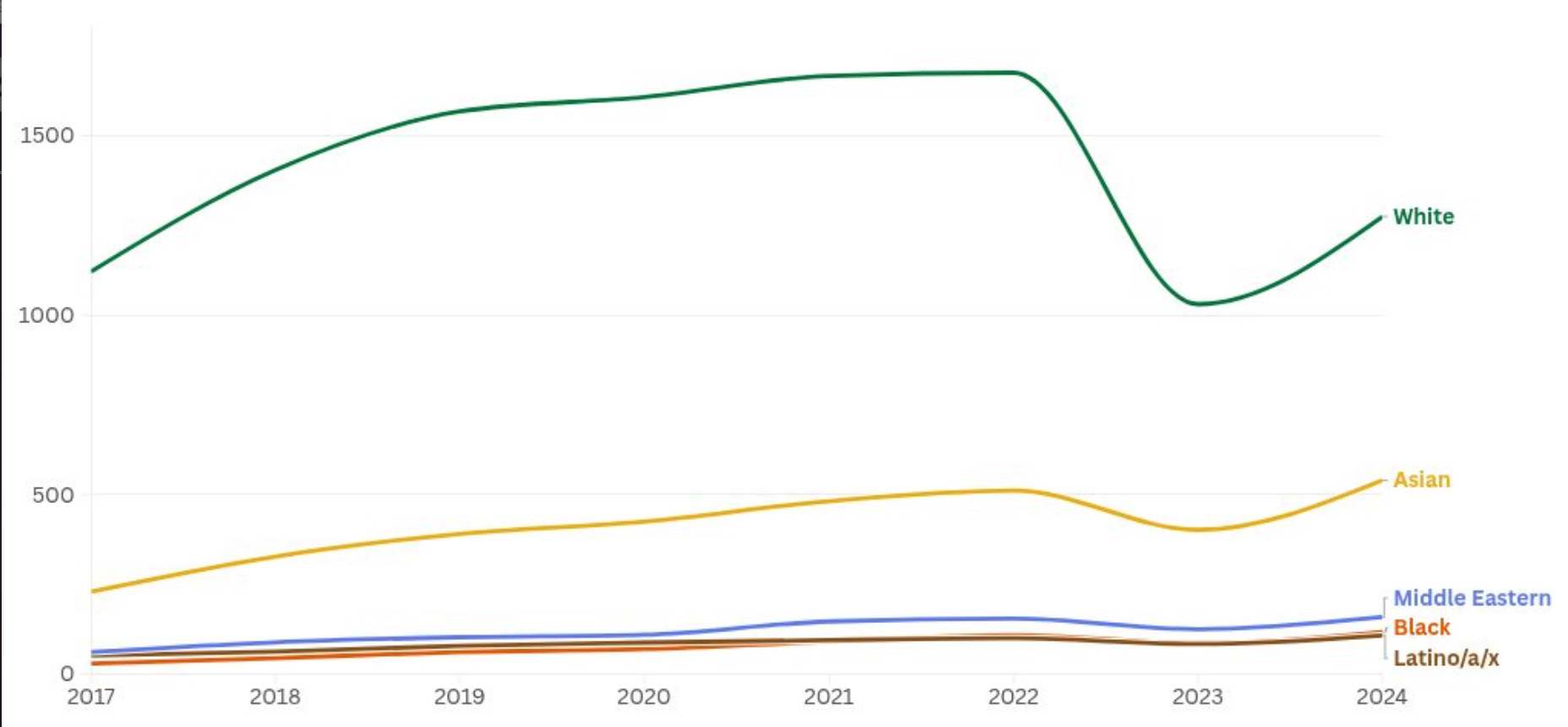
The faculty composition has changed significantly in the last decade, with the number of Black-identifying faculty members increasing from a mere 30 in 2017 to 118 in 2024. However, the number of white faculty members dwarfs this increase, as they remain the decisive majority at 61.7 per cent of all faculty members, while Black faculty members make up around 5.7 per cent, as of 2024. Asian faculty members are the best represented minority, at 26.2 per cent. This drops to the single digits for the next best represented minority, Middle Eastern faculty members, who comprise 7.7 per cent. Latino/a/x faculty members are the least represented racial minority, and account for only 5.2 per cent of the university’s faculty.
Since 2017, the number of university faculty members has increased across the board. The number of white and Asian faculty members increased faster than the number of Black and Latino/a/x faculty members, which has remained comparatively stagnant.
Over the past few years, the university has consistently hired more white faculty members each year than Black faculty members. In 2023, when the gap was the smallest, the university hired 29 more white faculty members. In 2017 and 2018, the number of hired Black faculty members was “not reportable due to small sample size,” the university noted in the database.
A similar disparity extends to faculty members’ career advancement, with white faculty members promoted at significantly higher rates than Black faculty members every year. From 2017–2022 — excluding 2019, during which the database reports that all faculty members were promoted — the number of Black faculty members to receive a promotion was “not reportable due to small sample size,” the university noted in the database.
In his 2000 study, Shah defines the diversity target as a faculty composed of 15 per cent visible minorities. 26 years later, this target is easily met, with 24 per cent of faculty members identifying as a person of colour.
This is a big improvement from the 8.7 per cent in 2000, but the university still has a long way to go. As of 2024, all of the Black, Middle Eastern, and Latino/a/x faculty members combined still only account for 10 per cent of the faculty, and hiring and promotions for all minority groups lag behind their white coworkers.

No comments to display.