
Content warning: This article contains mentions of self-harm and violence.
“It is a peculiar irony that the most famous of all the Mohawks — arguably the most well-known nation of the Rotinonhsión:ni (Iroquois) Confederacy — is a seventeenth-century woman who, by her vow of celibacy, isn’t an ancestor to any of us.” — Darren Bonaparte, Mohawk author and historian
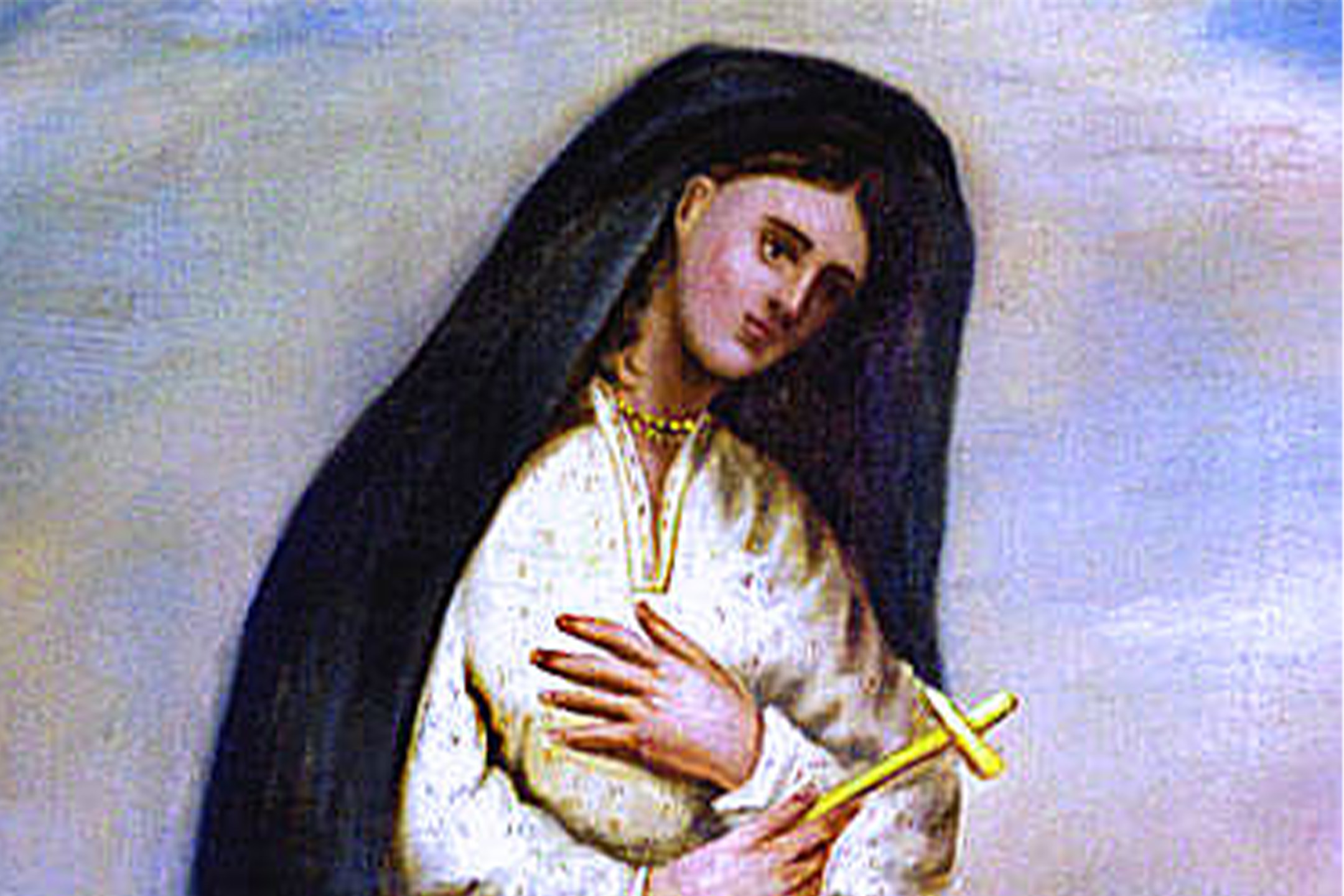
Honoured variously as ‘Lily of the Mohawks,’ ‘Geneviève of New France,’ and ‘Blessed Catherine Tekakwitha,’ St. Káteri Tekahkwí:tha (1656–1680) was baptized on Easter Day in 1676. She was declared venerable by Pope Pius XII in 1943, beatified nearly three centuries after her death by Pope John Paul II in 1980, and officially canonized on October 21, 2012, by Pope Benedict XVI.
She is the first Indigenous person from North America (Turtle Island) to be elevated to sainthood. Yet while Tekahkwí:tha is more richly documented than any other Indigenous person in colonial North or South America, she neither wrote nor spoke English or French, and no firsthand accounts of her life survive. Her legacy instead emerges through a complex negotiation between missionary authorship and Indigenous reinterpretation.
An inadvertent vehicle of nation-building after the War of 1812, Tekahkwí:tha’s life story underscores the power of white settler-colonial narratives surrounding Indigenous converts to Christianity and illustrates the projections of what ‘Indigeneity’ is imagined to be. Beyond the flattened portrait of a ‘noble savage,’ I argue for a more nuanced consideration of who Tekakwitha was — and what she meant, and continues to mean — for Indigenous peoples across Canada, the US, and Mexico.
What’s in a name?
Born in 1656 to an Algonquin mother and a Kanien’kehá:ka (Mohawk) father, Tekahkwí:tha is tied to both Anishinaabe and Haudenosaunee nations. Orphaned at four years old, Tekakwitha’s entire immediate family — her mother, father, and baby brother — died in the 1661–1662 smallpox epidemic, leaving her scarred, sickly, and unable to stand bright light. She was taken in by her maternal uncle, a chief of the village, and raised as one of his daughters.
By the age of 10, she lived in eastern Mohawk country or Kahnawà:ke, meaning “At the Rapids.” It was the first Indigenous village destroyed by the French — an event objectively traumatic for her to experience as a child.
The name Tekahkwí:tha is a reference to the way she used her hands to ‘feel her way’ due to visual impairment. Her many names — Kateri, Catherine, and Tekakwitha — reflect linguistic negotiation.
When the Jesuits first met her as a teenager, they rendered her name as “Tegakouita.” Choosing between k and g was difficult because the Mohawk sound they sought fell between the two in French and English pronunciation. Hence, when English speakers later developed a written version, they inserted a w to approximate the French “oui,” producing the name “Tekakwitha” [Degagwitah].
At her baptism, Tekahkwí:tha was named for St. Catherine of Siena, canonized in 1461. Amidst her vow of celibacy, St. Káteri’s rechristening as Catherine likely resonated with First Nations conceptions of personhood, insofar as the rite entailed complete adoption of a new personal identity and name, establishing a connection with the past through a Christian saint.
Religious devotion and social attachment
The Brain Opioid Theory of Social Attachment (BOTSA) suggests that early relational trauma may alter internally-produced opioid regulation, therefore motivating antisocial behaviours and influencing later attachment behaviours in adulthood. Having endured early-life trauma, I believe that Tekahkwí:tha likely developed a heightened drive to find an alternative, more secure, attachment strategy.
Infants learn to interpret the world through their primary caregiver; threats to self or parental abandonment shape later emotional processing and socialization. Tekahkwí:tha’s intense penitential behaviours and practices — undertaken in pursuit of closeness to Christ — may be interpreted through this neurobiological lens, as is the case for other people who experience grave challenges in their lives.
Much of Tekahkwí:tha’s life was recorded by Jesuit priest Pierre Cholenec. According to Cholenec, Tekahkwí:tha engaged in extreme self-discipline, including self-flagellation and self-exposure to the extreme heat and cold, to name a few.
Acts of self-mortification — a practice of self-discipline often in the name of religious devotion — described within European religious biographies, may simultaneously be understood as attempts to regulate overwhelming emotional states. Arguably, non-suicidal self-injury, in intense passion for Christ, was a form of self-mortification for Tekahkwí:tha. This triggered endorphin release, and could connect to the Anishinaabemowin concept of sustaining trials “to open [oneself] to the store of mercy that is manitou [or sacred power].”
Making space for the both/and
Tekahkwí:tha’s trials are undivorceable from the collective trauma experienced by the Kanienʼkeháka nation. Ultimately, St. Kateri’s historic imitation of Christ’s redemptive suffering is positioned at the confluence of Indigenous theological agency and Jesuit biography.
To sanctify is to authorize a life as exemplary. In Tekahkwí:tha’s case, that authorization occurred within the Canadian nation-state that simultaneously suppressed Indigenous ceremonial life and legal traditions.
Who, then, gets made a saint? Tekahkwí:tha’s life story invites us to sit within complexity rather than solve it. Past the porcelain icon, a more human portrait emerges: not of a saint, but of a young Indigenous woman forging meaning amid loss, devastation, and encounters with the Other.
Instead of treating ‘sanctified Indigeneity’ as a fixed singularity, Tekahkwí:tha’s subtle silence appears to allow one to see their stories through hers and, respectively, hold the multiplicity of her truths.
Sabrina Isabelle McLennon is an Indigenous Voices Columnist of Lokono-Arawak, Indo-Guyanese, and Jamaican Maroon descent, with ancestral roots in Orealla, East Berbice–Corentyne (Region 6), Guyana, pursuing a focus in law & history specialist.
