
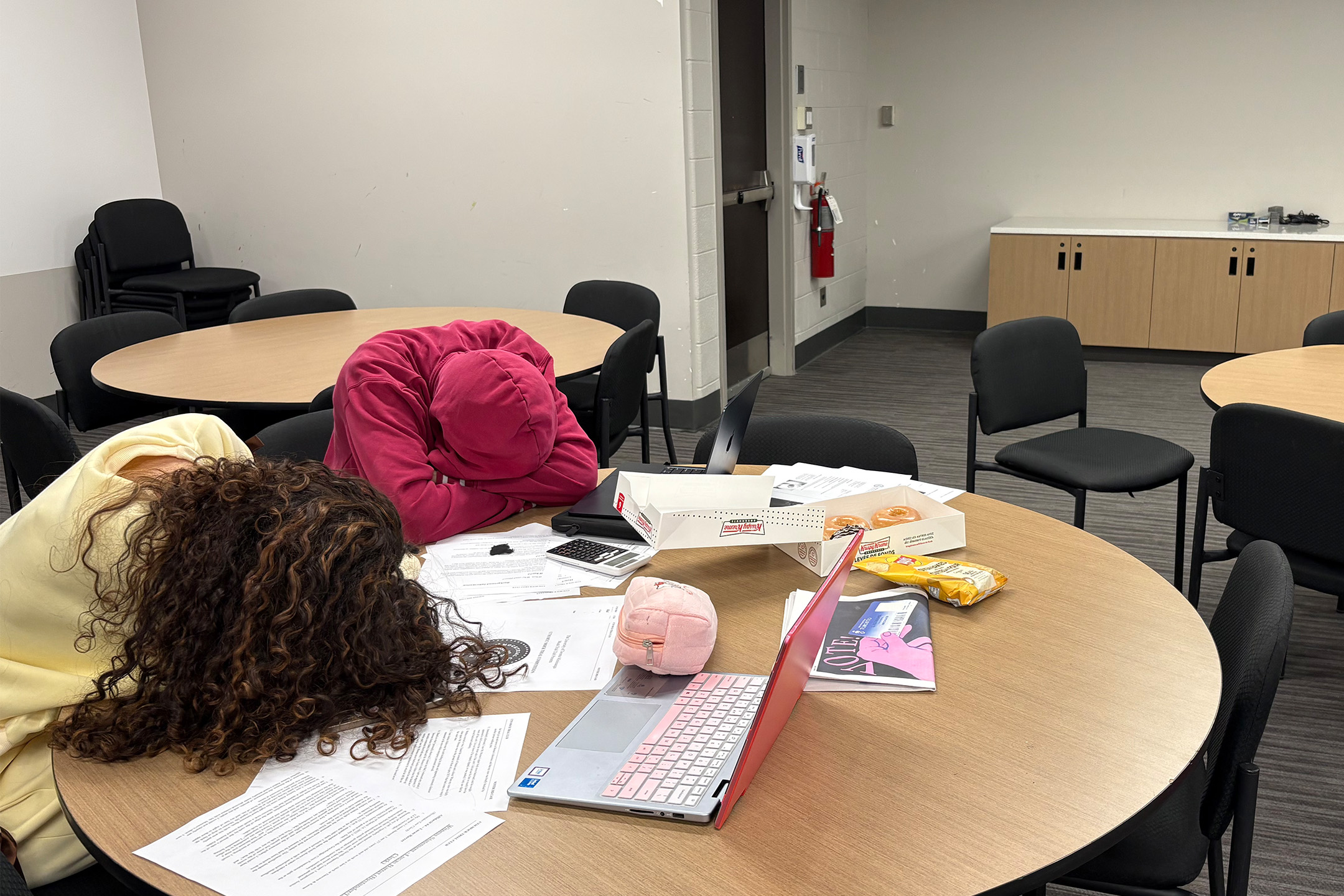
Picture a classic all-nighter: you’re awake at 3:00 am, laptop open, notes spread across a desk — all hallmarks of a disciplined study session. However, sleep research indicates that over time, getting less sleep results in cognitive decline that goes unnoticed by our brains.
A 2003 study published in Sleep by Hans Van Dongen and colleagues examines what happens when people consistently deprive themselves of sleep. Participants limited to six hours of sleep a night for two weeks performed the same as those who didn’t sleep for an entire day. Both groups showed a progressive increase in attention lapses and slower reaction times.
Specifically, six hours of sleep every night didn’t cause an immediate decline in cognitive performance, but this performance deficit gradually increased each night. The National Sleep Foundation recommends that adults aged 18–25 sleep for seven to nine hours every night.
Initially, students who skip sleep to study may experience some academic benefit. But the impacts of losing sleep extend beyond reduced attention span. The costs of this tradeoff affect multiple areas of the brain, especially those involved in memory and executive control.
Memory does not consolidate while you are awake
Students may defend losing sleep as part of a greater academic strategy. More waking hours create more time to review material. However, neuroscience research shows that learning depends not only on time spent studying, but on sleep-dependent memory consolidation.
In the brain, memories are formed and retrieved by collections of specific brain cells, or neurons, firing together. In a 2010 Nature Reviews Neuroscience article, Susanne Diekelmann and Jan Born identified sleep as an active component of memory consolidation — the process of converting newly learned material into stable memories.
During slow-wave sleep — also known as deep sleep, neurons fire repeatedly, replaying the same firing patterns as when new information was originally processed. This occurs in the hippocampus, a key brain structure for forming new memories. From there, information is then gradually distributed to brain regions where long-term memories are stored.
Without sufficient slow-wave sleep, newly encoded memories are less stable, leaving your brain more vulnerable to forgetting new information — a critical function for students trying to retrieve facts under stressful exam conditions.
The executive brain under restriction
Functional neuroimaging research shows that sleep deprivation reduces activity in the prefrontal cortex — the region associated with working memory, reasoning, and impulse control. These functions are central to exam performance, for example, when a student must hold multiple pieces of information in mind, evaluate answer choices, resist selecting a familiar but incorrect option too quickly, and shift between problem-solving strategies under time constraints.
Data on student performance reflect that sleep deprivation causes more harm than good. A 2018 study published in Nature Partner Journals Science of Learning by Kana Okano and colleagues found that consistent long sleep predicted academic performance more strongly than total study time.
If additional waking hours do not reliably produce higher grades or improved test scores, then why is the all-nighter so popular?
Why does the all-nighter persist?
One explanation relates to how sleep loss alters self-perception. In the same 2003 study, participants’ subjective ratings of alertness plateaued after several days of sleep restriction, even as objective reaction-time lapses continued to increase. This mismatch suggests that individuals may feel cognitively stable even as measurable performance declines.
Campus ‘hustle’ culture may reinforce the idea that staying awake is part of a shared social ritual. In a 2018 Life @ U of T blog post titled “The Social Event That Is an All-Nighter,” a fourth-year student described first-year all-nighters as a shared ritual, writing that “there [is] a real social culture surrounding all-nighters,” with group chats “livelier than a squirrel on caffeine” the night before assignments are due.
Sleep restriction does not immediately prevent task completion, which contributes to its short-term appeal. Although recovery sleep can mitigate some acute deficits, repeated sleep restriction produces cumulative effects that are not immediately reversible. In the end, sacrificing sleep to study may undermine the very mechanisms required for optimal academic performance.

No comments to display.