
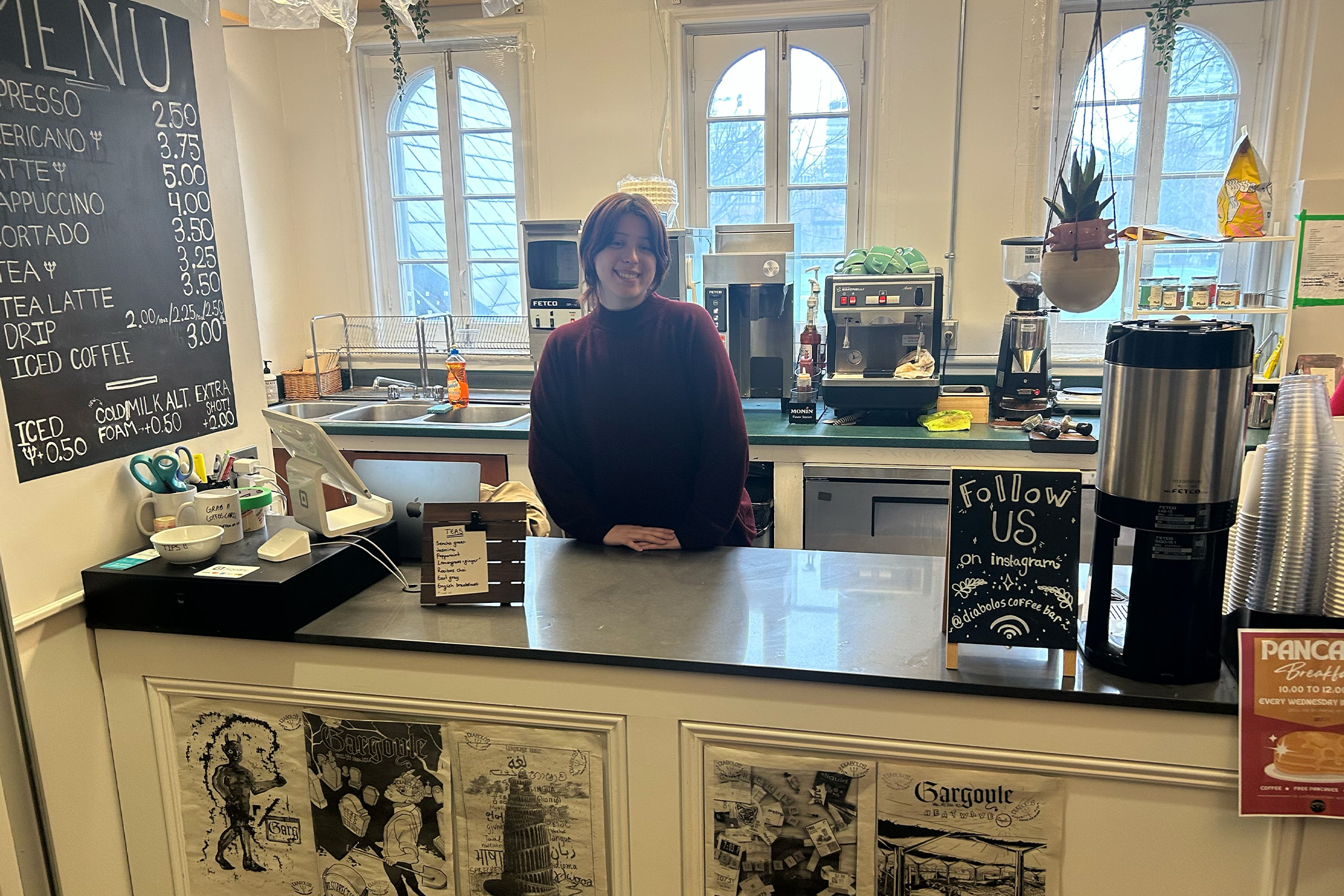
Despite previous financial and labour challenges, University College’s (UC) Diabolos’ Coffee Bar has been running off a budget surplus since it reopened in January. Its initial costs were covered by funds that sat in its bank account during its closure, surprising both management and the UC student government.
The student-led café closed in 2023 because of conflicts with the United Steel Workers (USW) and the Canadian Union of Public Employees (CUPE), as well as financial difficulties within the University College Literary and Athletic Society’s (UCLit).
“The thought process was absolutely that Diabolos’ was going to be financially dependent on the the Lit,” said UCLit Finance Commissioner Behram Hathi in an interview with The Varsity.
During the reopening process, the UCLit assumed the café bank account was empty.
“We had absolutely no idea how much was in that account for a long time,” Hathi described. “There was, surprisingly enough, money when we got it. So far, they haven’t had to ask for a penny from the Lit.”
Hathi added that although Diabolos’ is currently breaking even, the UCLit would “function as a stopgap” if the café were to operate at a loss. Diabolos’ surplus funds currently cover the cost of its labour and raw materials, and is managed as a separate entity under the UCLit.
“There [have] been dips… but we are at the very least, breaking even […] I was cautiously optimistic that [Diabolos’] would be self-sustaining, which is always a goal, and I’m glad to report that it is now,” Hathi said.
Closure
UC doesn’t charge Diabolos’ rent for its space in the Junior Common Room (JCR), making labour its largest expense. Of U of T’s three student-run cafés, Diabolos’ is the only one that pays its staff; the others — Victoria College’s Caffiends and the Faculty of Music’s Edward Johnson Cafe — are volunteer-run.
In the 2010s, Diabolos’ and the UCLit faced major tax issues with the Canada Revenue Agency (CRA), prompting the college to take over staff hiring. The UCLit was still responsible for the hiring decisions, but the university was responsible for payroll. This arrangement allowed Diabolos’s manager and baristas to be hired through the Work Study program, with wages subsidized by the provincial government.
After closing during the pandemic, Diabolos’ first reopened in January 2023. Soon after, UC reviewed casual job postings against the USW pay grid and determined that the café’s manager — contracted as a Work Study employee — should be receiving $50 per hour rather than minimum wage.
Additionally, the university could not hire outside of CUPE bargaining agreements, and Diabolos’ roles were deemed comparable to CUPE positions on campus.
“It would have been completely unsustainable to run at that. Again, this was during a time when the Lit was not just in [dire] financial straits, it was also in debt,” said Hathi. At the time, the UCLit was $60,000 in debt, and because of incomplete audits, the university was withholding funding.
The café subsequently closed again for the 2023–2024 and 2024–2025 academic years.
Reopening
Diabolos’ employees are no longer contracted as Work Study employees and are instead directly employed by the UCLit again. Unlike the university, the student government is not bound by agreements with the CUPE or USW. Staff are paid minimum wage plus tips, and the café manager receives an end-of-year honorarium.
“We’re no longer ruled by union rules, which in some ways is good and in some ways is bad. Unions are an amazing thing… but also, $40 an hour is completely untenable for the organization to afford,” current Diabolos’ manager Raquel Lewin said to The Varsity in an interview.
“I get paid minimum wage now… I would love to [be paid] more, but I understand that that’s all that they could pay me right now,” they added.
When asked whether the UCLit had considered making Diabolos’ positions volunteer-based — like those at Caffiends and the Edward Johnson Cafe — Hathi said the idea was considered but ultimately rejected.
“The number one reason is, historically, it was a paid position, it was a student job opportunity, and there was frankly no reason to take that away… If you go back to 2021… there’s a different situation completely […] But when we’re financially solvent, there’s absolutely no reason to take away student jobs.”
Lewin added that while Diabolos’ maintains a working relationship with the UCLit, she hopes the café will continue to cover its own labour costs.
“The goal is to be able to… cover our own labour […] It’s one of those things [that] would be nice, but it’s also okay if it [doesn’t happen]. I trust that… the UCLit has good finance commissioners.”
Lewin feels that Diabolos’ employment model provides students with an opportunity to gain work experience in a low-stakes environment.
“My intention here is to provide students with an opportunity for work experience […] Finding… an entry-level job, especially in Toronto, [is really difficult]. I wanted to make a position… specifically for students [so they can have] a stepping stone to other things outside of university.”
