
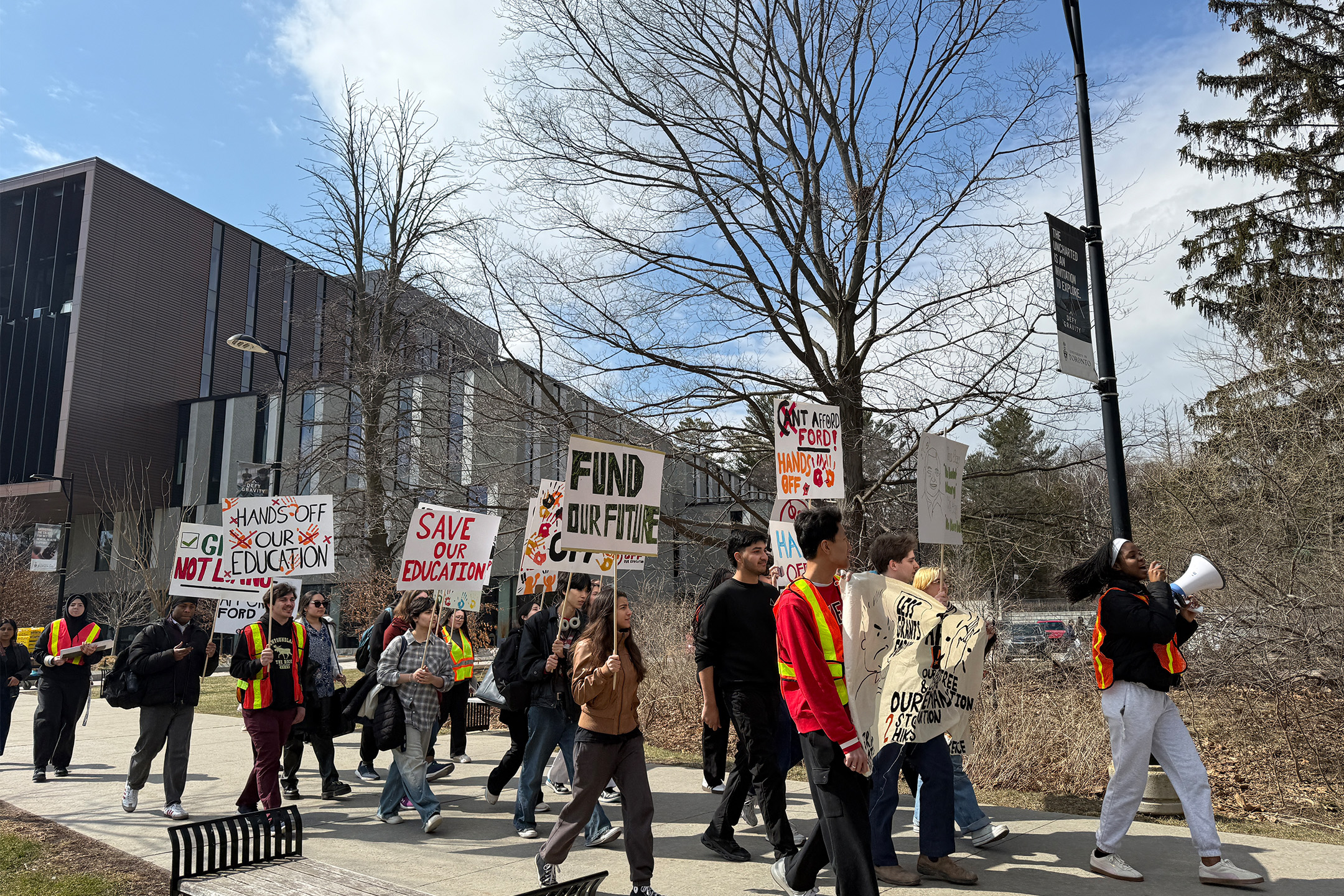
Over March 18–19, students gathered at UTM to protest recent changes to the Ontario Student Assistance Program (OSAP) and the tuition freeze lifting. In interviews with The Varsity, organizers warned that the shift toward loans will make postsecondary education less accessible.
Town hall outlines concerns over affordability
At a March 18 town hall, University of Toronto Mississauga Students’ Union (UTMSU) leaders described the Ford government’s OSAP restructuring as a significant threat to affordability. Under the new cuts, the program is shifting from a primarily grant-based system to one dominated by loans.
The town hall also featured Liberal MP Iqra Khalid, who said she had raised the issue in the House of Commons.
“I stood in the House of Commons, and I raised this issue at the federal parliament, siding with students,” Khalid said. “But as much as it frustrates me, the realm of education is within the provincial government.”
Khalid encouraged students to continue organizing and contacting elected officials. “Political will doesn’t just come about,” she said. “It is built by people like yourselves.”
“I would like to acknowledge that we did invite a Conservative Member of [Provincial] Parliament, Sheref Sabawy, and they unfortunately did not respond,” UTMSU Vice President External Lois Ogunnubi-Oriade said. UTM admin were also contacted.
Ogunnubi-Oriade later added that students had submitted several questions intended for administrators, but those questions could not be answered in their absence.
Students raise concerns about protest safety and barriers to participation
Students at the town hall raised concerns about protest safety, referencing reports of police violence at previous demonstrations.
“I know a lot of people that want to go to the protest, but the main thing stopping them is protection from violence,” a student attendee said. “I went to the first protest… There was an excessive amount of police violence, specifically toward minors. I witnessed this myself.”
“We know that students are scared to attend another protest,” one UTMSU organizer said. “We’re organizing direct action training… because we believe that we keep each other safe, and we need to know what we can do to protect ourselves in these situations.”
The organizer added that trained protest marshals and legal support from the Canadian Federation of Students (CFS) would be available.
Some students — particularly international students — said they remain hesitant to participate due to potential immigration risks.
“We are worried about our status in Canada,” another student said. “We would rather… do nothing in these rallies than risk being sent back.”
Organizers acknowledged these concerns and suggested alternative forms of participation, including spreading awareness online and supporting advocacy efforts indirectly.
“If you can’t be there physically, be there virtually,” one organizer said.
Rally highlights awareness gap among students
On March 19, students gathered at the UTM Student Centre and marched across campus, chanting slogans such as “Hands off our education,” “Hands off our OSAP,” and “No cuts, no fees, no corporate universities.”
Although the rally began with a small group, participation grew as students moved through campus.
“OSAP is a tool that most students at this university, along with every other institution, depend on,” Mekayel Omier, a UTMSU Division I board director, said to The Varsity. “I personally also depend on OSAP… and we need to raise awareness on this issue, because the provincial government can’t get away [with] making such huge changes to the way we get our education without any sort of repercussion.”
However, Omier said many students he met during the rally “were initially surprised and very unsure about this whole situation… they had no idea that their OSAP would be cut, their tuition would increase.”
Organizers seek momentum beyond a week of action
UTMSU leaders framed the town hall and rally as part of a broader organizing effort to increase student engagement and build pressure on decision-makers.
“We as a union have a mandate to fight for free, accessible and high-quality education for all,” Park said in an interview with The Varsity. “We strongly oppose these threats to education.”
Park said, “Students are coming up to us saying, ‘How can I help? How can I volunteer?’ We’re having conversations with students saying, ‘I can come by, I want to help with outreach, let my friends know what’s going on.’ ” He continued, “So it’s just having ground-level conversations with students that you normally wouldn’t be able to reach.”
“We can’t plan for what announcements the government’s going to make,” Park said. “When something like this comes up out of the blue, we had no heads up that this was happening […] this is more of a stepping stone for us to build engagement from the students.”
In an interview with The Varsity, Ogunnubi-Oriade said, “I would count today’s event as a success, not necessarily because of the number of people that showed up, but because of the conversations that were had in the room.”
“One thing that I really want to implement from the conversations today is to kind of do a survey to understand how students are feeling,” she added. “[If] the reason for the apathy… for maybe the lack of engagement… is hopelessness… is lack of awareness… then how can… the student union change that?”
“If apathy continues, nothing will change,” Ogunnubi-Oriade said. “If we stand and encourage our fellow students to do something, there can be, and there will be change.”
Editor’s Note: This article was corrected on March 29, 2026 to reflect that the UTM Admin were contacted.

No comments to display.