
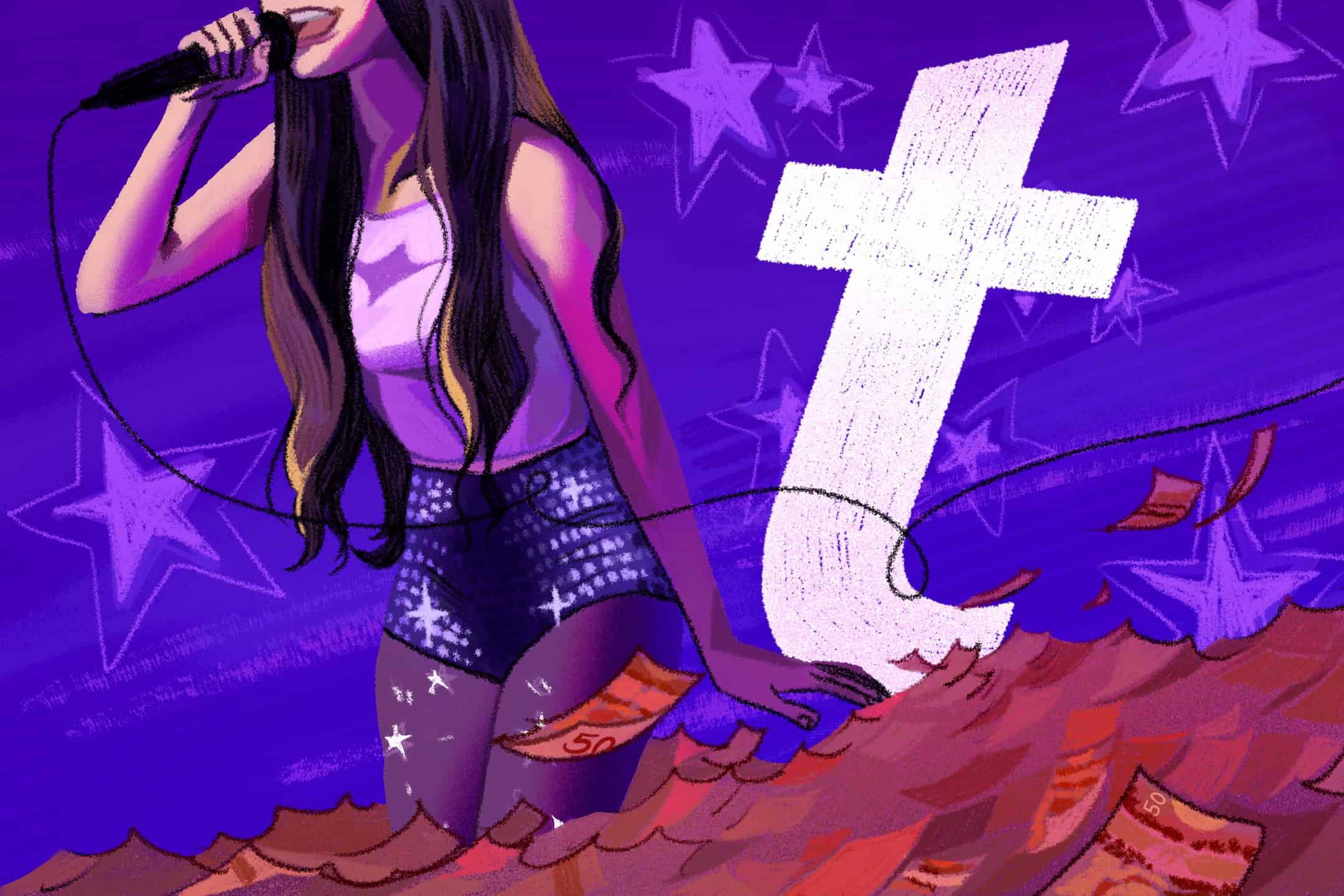
Concert going (and buying) woes
“May the odds be ever in your favour,” the popular catchphrase from Suzanne Collins’ Hunger Games franchise, is uttered like a prayer before fans embark on the quest that buying concert tickets has now become. With presale codes, long online queues, and signing up for credit cards becoming standard practices, words like “egregious,” “highway robbery,” and “greedy” describe the current ticket-purchasing experience.
On April 30, Olivia Rodrigo announced her upcoming tour, The Unraveled Tour, with Canadian stops in Toronto, Montréal, and Vancouver, along with the release of her third album, you seem pretty sad for a girl so in love. Being an avid Olivia Rodrigo fan, like many others in the country, I was desperate to get my hands on tickets.
Pains of presales passed
Rodrigo, who made her recording debut in 2021 with the hit single “drivers license,” embarked on her first arena tour in 2024 for the Guts World Tour.
Buying concert tickets for a big artist is usually done in one of two ways: the presale and the general sale. Most presales, including Rodrigo’s, are run through a loyalty program from banking companies like American Express or Scotiabank, and often require a subscription to a line of credit or loyalty card. Presale codes and links are sent through a Ticketmaster account. If a fan wants access to a presale, they need to have a Ticketmaster account. This expands the corporation’s hold on the global concert-attending customer base.
I had zero luck obtaining tickets during either the presale or general sale for the 2024 tour. I had to join the exceedingly long queue twice because the website kept crashing due to the large traffic of people in line. By the time I made it to the front of the line, there was nothing under $400 left.
Other fans also reported excessive wait times in the queue and glitches at checkout when attempting to secure tickets. This was a problem for many dates on the tour. Ticketmaster later stated that these issues were because there were “far more registered fans than tickets available.” This statement does not address the skyrocketing of resale ticket prices in the absence of price control laws, instead blaming fans for ticket scarcity. Ticketmaster’s statement was a blatant attempt to absolve both the company and the artist of any responsibility for the market manipulation of tickets. The company profits off this market manipulation at the expense of the fans.
Oversaturated lines
Canadian concertgoers are familiar with ticket queues being oversaturated with demand. The “North American” leg of most international artists’ tours often consists of no more than a handful of dates in Canada — most often in Toronto, Vancouver, and Montréal.
Another familiar part of ticket-buying for Canadians is the sky-high prices set by Live Nation. Live Nation is a global entertainment company which merged with Ticketmaster in 2010 and became a conglomerate named Live Nation Entertainment Inc. (LNE). The company has cornered the market on both promoting and selling tickets to live events around the world, giving it a monopoly over concerts. Artists are often forced to work with them due to a lack of alternative companies.
In April, a Manhattan jury ruled that LNE had obtained an anti-competitive monopoly over big concert venues. An anti-competitive monopoly occurs when one company gains market power over a service or product by eliminating competition. They achieve this by either buying out competing businesses or driving them out of the market. Despite the ruling, LNE Executive Vice-President Dan Wall has insisted that LNE will fight to have Ticketmaster remain under their corporation by challenging any orders to split their operations.
This ruling comes months after the company quietly added new terms to its user agreement to steer any customer lawsuits into a corporate-friendly private justice system. The binding term was introduced after a US federal judge ruled that LNE’s use of this arbitration process violated American federal law.
In 2023, Taylor Swift announced the Canadian dates for her long-awaited Eras Tour. Concert goers had to compete for nine shows across the whole country: six in Toronto and three in Vancouver. Tickets were limited compared to the ginormous demand, with an estimated 31 million people registering for just the Toronto dates. The stage was set for hyperinflated resale tickets to make an ugly appearance.
In recent years, the number of ticket resellers has risen due to LNE’s monopoly and the lack of bylaws restricting price hikes on resold tickets. With this combination of market monopoly and nonregulation, the greed of resellers has inflated their prices without any authority pushing back. Resale tickets for Swift’s Eras Tour went from anywhere between $2,000 and over $4,000, with the most expensive seats at center stage reaching a high of $19,590.
Bill 63 amendment
The Government of Ontario has taken steps to avoid these resale price hikes by introducing Bill 63, “Stop Ripping Off Fans Act (Ticket Resale Price Caps).” The 2025 act amends the “Ticket Sales Act of 2017,” and now states that ticketholders may not sell their tickets for any amount that exceeds the tickets’ face value by more than 50 per cent.
The new act is a rebranding of the bill proposed by the Ontario Liberal government in 2018, which also proposed to cap ticket resales at 50 per cent above the tickets’ original value. This bill was delayed and eventually scrapped by the incoming Progressive Conservative (PC) government of Ontario. The PC government had scrapped the bill on the basis that there was “no way to enforce [the] cap.”
Unraveled
The demand for Rodrigo’s Unraveled tour was projected to be just as high as the last one, with only six Canadian dates announced.
The general sale started on May 7 at 12:00 pm. I joined the queue as soon as it opened and was met with a staggering 3,973rd place in the line. I had decent hopes for securing a reasonably-priced ticket during the sale because Rodrigo had announced the release of $20 tickets. A limited number of these tickets were made available to anyone who had registered for the general sale, on the condition that they be bought in pairs. Aside from these limited $20 tickets, pricing for this tour ranged from $116 to a whopping $789.
After a 35-minute wait, I made it to the front of the online sales queue and was greeted with a gray-washed screen with maybe 50 tickets left scattered across the arena. I selected tickets in the upper stands with a partially obstructed view and found them to be priced at over $140.
This was unacceptable. For an obstructed view at the very back of the stadium to be priced this highly made me wonder what the prices for tickets closer to the stage had been. Just as egregiously, standing-room-only general admission (GA) was listed as $789. With GA, fans gamble with the possibility of being able to make stage barricade. This possibility is heavily exploited by Ticketmaster through the price of the section’s tickets.
Despite Rodrigo’s efforts to make her live shows accessible, she has failed to make them realistically affordable, especially towards her primary audience of teens and young adults, leaving many fans disappointed with the ticket prices.
Live music ticket sales are being monopolized by LNE, which does not care about the intangible value of art and is only concerned with the value of the price tag attached to it. Their unchecked greed is making live music a luxury that young and lower-income people are being priced out of experiencing.
Restricting access to the arts and making exclusive something that should be accessible to all Torontonians will result in a music industry that is an uninnovative domain for only the wealthy classes.

No comments to display.