
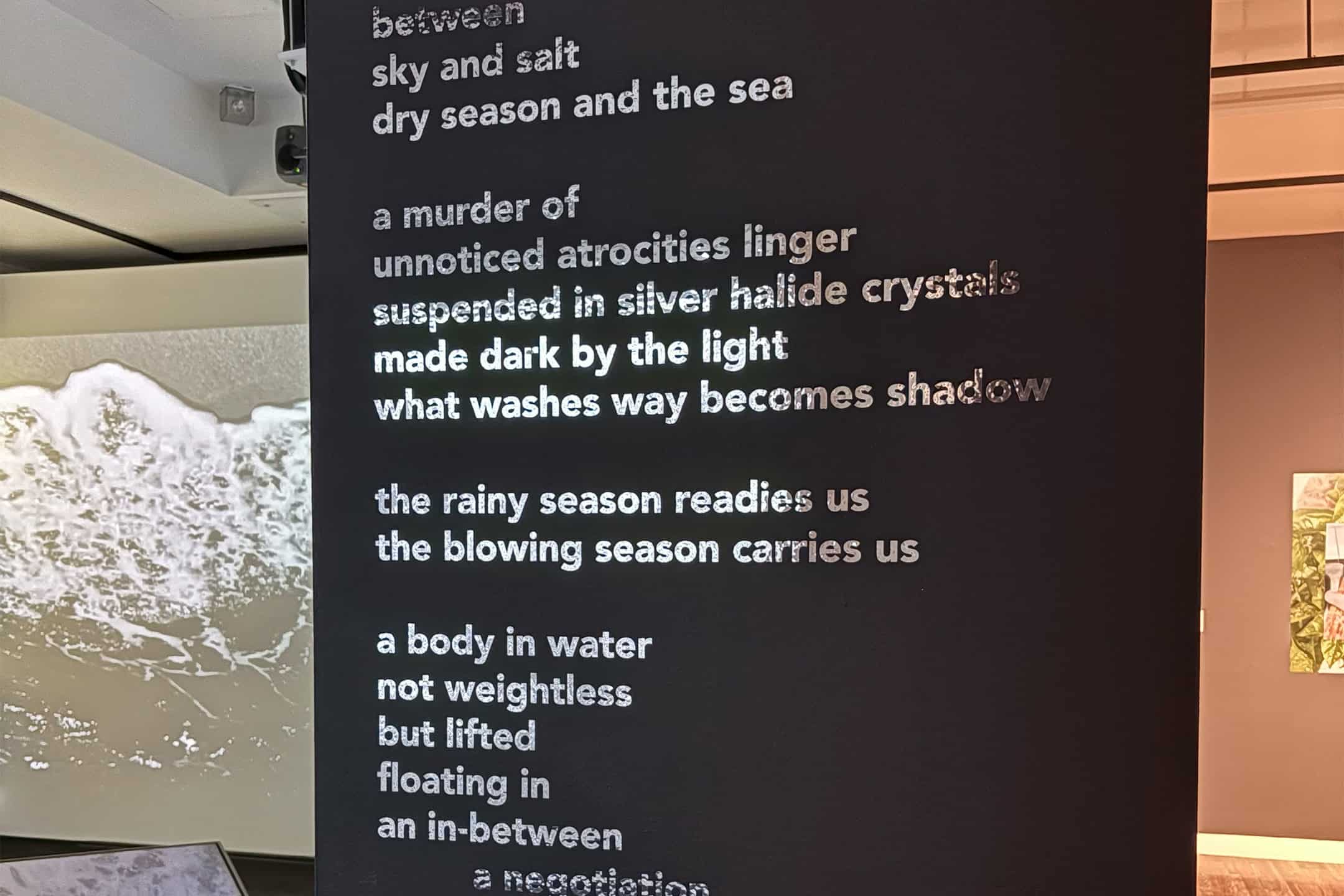
Open until August 1 at the U of T Art Museum, Land. Sea. Sugar. Salt explores the multicultural diversity across the Caribbean. Despite the region’s expansive scale, its cultures are united by shared colonial histories across 700 islands.
Fruit, industry, and colonial rule
The exhibition opens with a video projection by Deborah Jack, titled “the fecund, the lush and the salted land waits for a harvest…her people…ripe with promise, wait until the next blowing season” (2022). Jack presents the lush fruit trees and foliage of Sint Maarten, alongside archival video of the Dutch colonial salt mining industry.
Jack aims to showcase the significance of a simple fruit, to explain the disconnect between the cultivation and consumption of popular commodities. The installation has six screens, opening with clips of swaying young pomegranates, then shifting to a background of black and white rushing ocean waves. The video then shows the same pomegranates, now full and ripe, having their seeds plucked out and placed on a plate beside husks of the fruit.
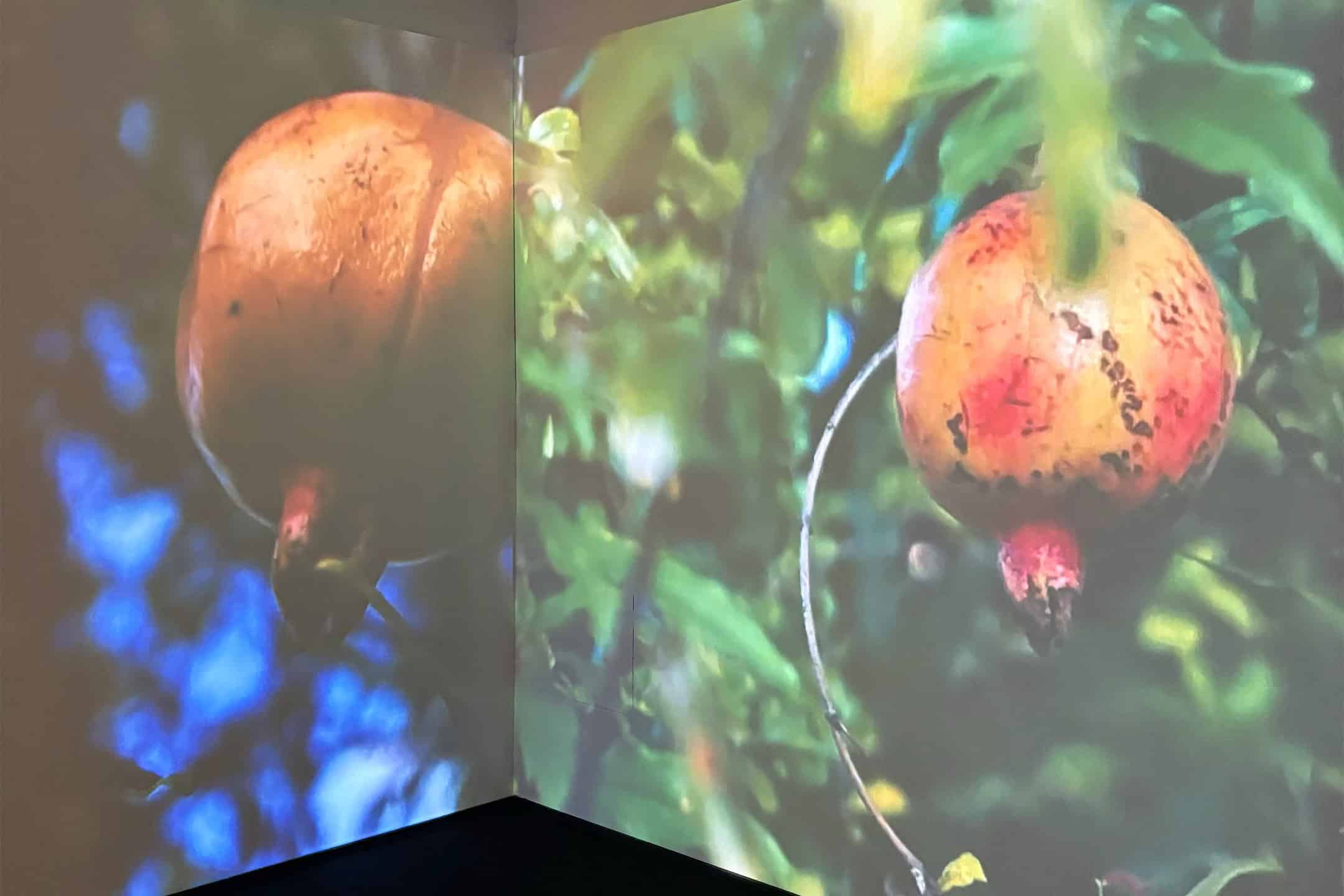
Stills from Deborah Jack’s “the fecund, the lush and salted land waits for a harvest… her people… ripe with promise, wait until the next blowing season” (2022). JUSTINE LEMAN/THE VARSITY
Initially, I was confused by the choice of pomegranates, as they aren’t a typical commodity in the Caribbean. I learned through Jack’s installation that the fruit was only introduced to the region by Spanish missionaries during colonial rule, and eventually grew to hold meaning in culture and community for the Sint Maarteners. Sint Maarten came under Dutch colonial control in 1648 and remains an island territory of the Netherlands today.
Sugar and waste
The exhibit also highlights how commodities like sugar are often consumed without a thought about their production. Most people in the West have a disregard for the physical labour that goes into producing the crop.
This idea is emphasized in Charles Campbell’s painting, “Bagasse” (2009). The painting depicts heaps of discarded sugarcane stalks, occupying both the background and focal point of the canvas.
The painting’s large scale forces the viewer to focus solely on what society has deemed to be waste. The bench in front of the painting allows more time for the visitor to take in the sheer measure of the environmental destruction.
Oil and diaspora
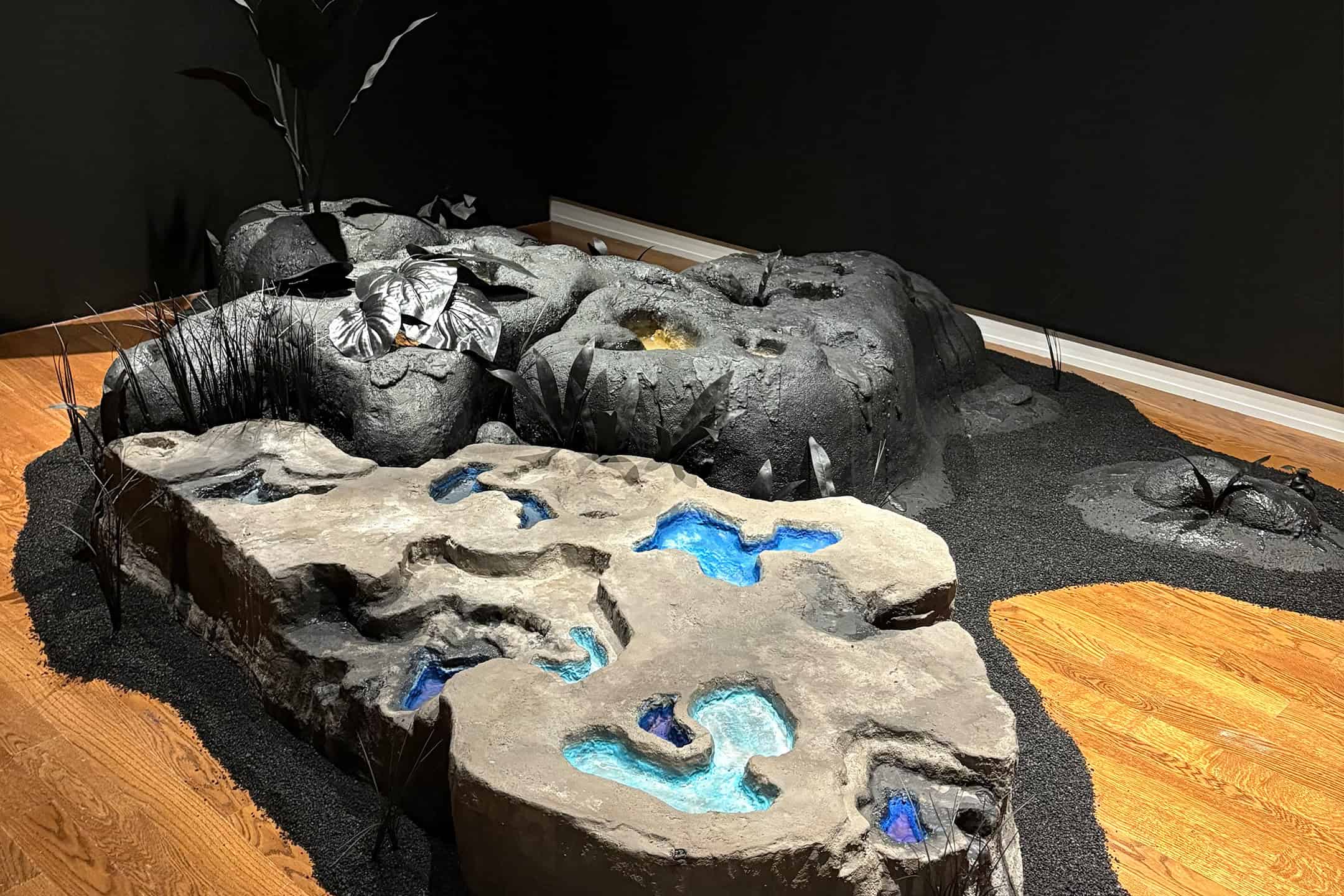
Braxton Garneau’s “Pay Dirt” (2025). JUSTINE LEMAN/THE VARSITY
Braxton Garneau’s “Pay Dirt” (2025), a mixed media installation, explores his Caribbean family’s immigration to Alberta while drawing attention to the Western world’s lack of care for places outside its own borders.
The piece includes a miniature reconstruction of Trinidad’s Pitch Lake and the Albertan waste reservoirs. Pitch Lake is the largest natural deposit of bitumen — a viscous, petroleum-based hydrocarbon found in oil sands formation — in the world. The waste reservoirs are massive pits near the Athabasca River that store 1.5 trillion litres of toxic oil sands waste.
Garneau portrays the water in his sculpture as bright blue, contrasting the surrounding darkness and representing the bitumen or oil pollution. The choice to combine two bodies of water — one natural, one man-made — creates a stark comparison in the oil economies of both his homes.
The piece made me view the contamination of oil as a dark consequence of urbanism. The pollution of water caused by the petroleum industry is not an issue unique to a single place, it is a global issue that results in the same environmental degradation.
The colonial shape of flora
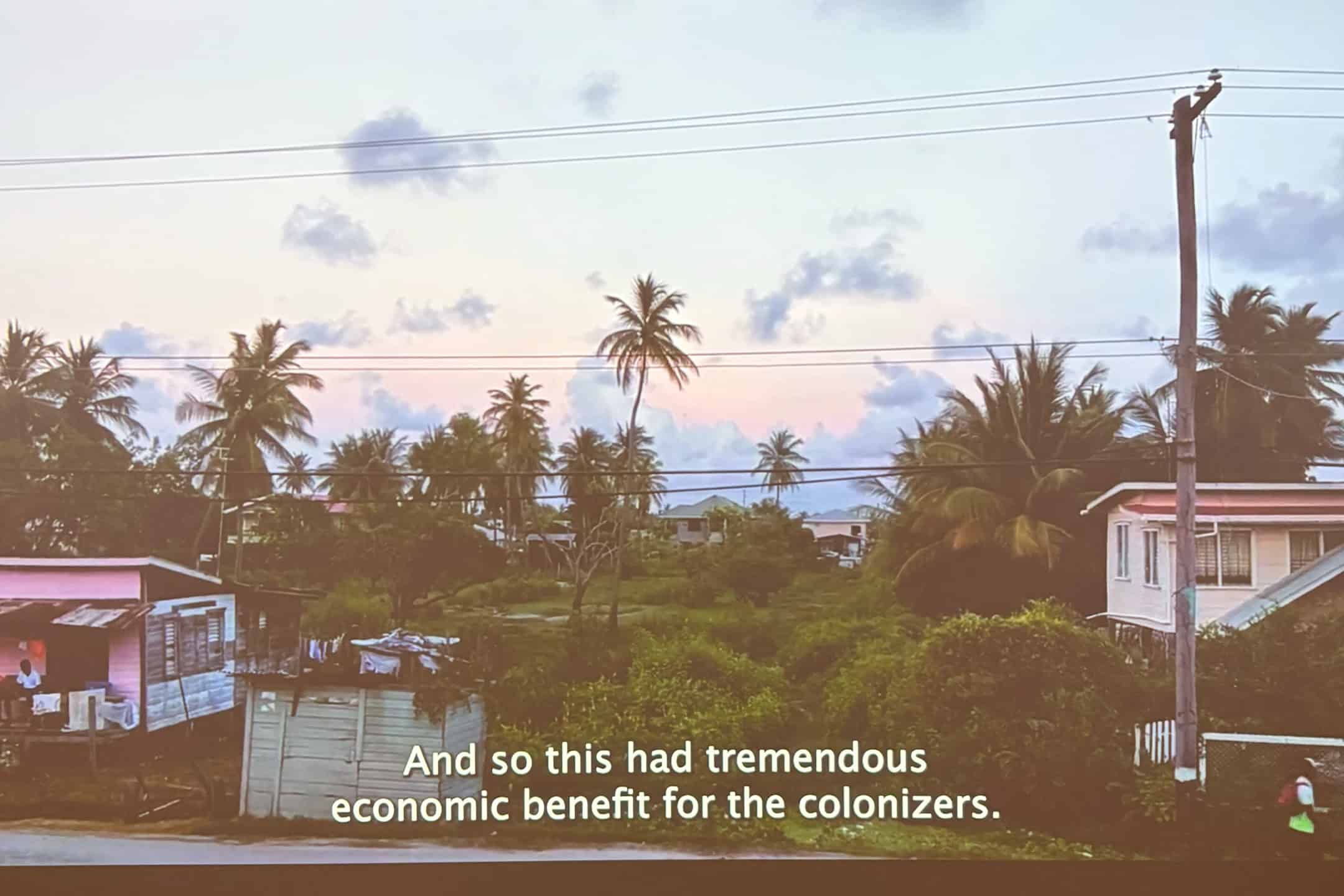
A still from Farihah Aliyah Shah’s “Always About Land” (2023). JUSTINE LEMAN/THE VARSITY
Another work in the exhibit is a video by Farihah Aliyah Shah, titled “Always About Land”(2023). Over a clip showing Victoria Village in Guyana, her father — a Victoria native — O’Keefe Shah, describes how sugarcane farming was a colonial project that did not value the lives of the people who contributed to its cultivation.
Even after Guyanese independence, there was still a strong plantation economy present in the country. When the plantation owners had acquired enough capital and economic growth, the workers were no longer needed and were carelessly discarded. O’Keefe said that these workers were now seen as nothing more than “natural blockages to their progress,” referring to the plantation owners’ desire for profit.
In her artist statement, Farihah described the challenge of recontextualizing her family’s history while watching colonial harm happen in real time in Gaza. By choosing to speak up against the current cultural and environmental obliteration and genocide of Palestinians, she emphasizes the duty we hold as human beings to condemn brutal territorial expansion.
Perhaps the most notable aspect of this exhibit is Farihah’s huge indoor garden installation, “A Garden for Lucille” (2026). It includes several kinds of tropical plants, both native to Guyana, and with origins in countries like the ones which African and Asian people were forced to leave as enslaved people or indentured workers.
Farihah’s piece highlights the connection between the land and the Caribbean people’s cultural heritage and identity. This connection is a resistance to neo-colonial industries that perpetuate socioeconomic inequalities through current environmental and human exploitation in the region.
Fostering connection to the land
The exhibit offered multiple perspectives and interpretations on the theme of the past, present, and future of the Caribbean and its lands. These artworks express that the region’s colonial past is an important aspect of modern-day exploitation and environmental degradation.
The artists in this exhibit, coming from a variety of culturally rich regions in the Caribbean, are making an important statement against forgetting historical pain, people, and stories. Generational preservation is necessary in fighting against exploitation of Caribbean land in the modern day.
This exhibition ultimately serves as an artistic statement against the limited understanding of the region presented by tourism. The curation of the exhibit presents a deeply immersive experience for all U of T and Toronto visitors.

No comments to display.