
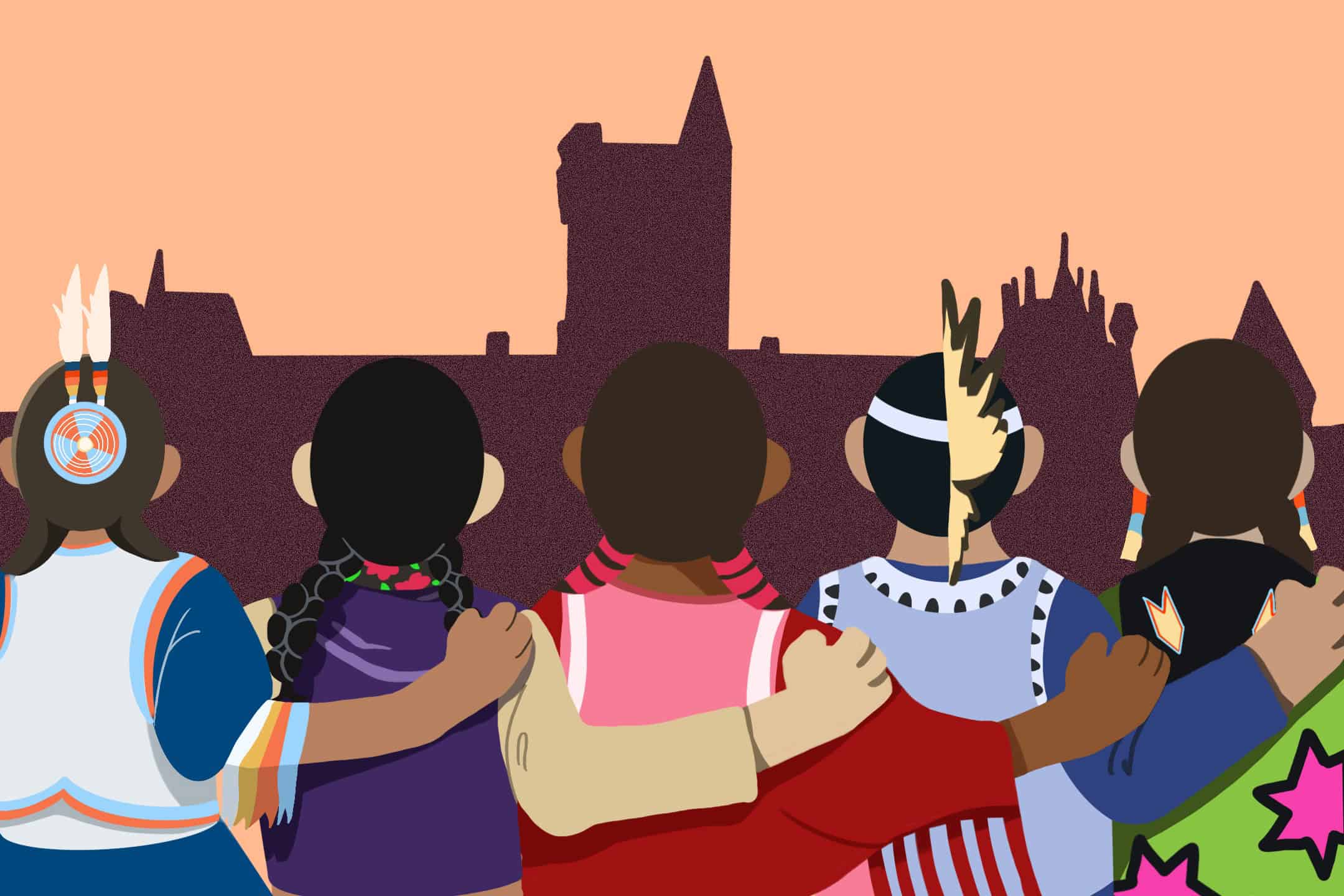
According to U of T’s equity census, 0.7 per cent — or 653 students — across the university’s three campuses identified as Indigenous as of 2023. In interviews with The Varsity, Indigenous community members at U of T shared their experiences of finding community, support, and resources at the university.
Finding community
Third-year architectural studies student Julien Todd grew up in Lac La Biche — a Métis community in Alberta.
For Todd, moving to a big city like Toronto felt isolating, but he said, “It sort of helped me become more prideful of my identity, and I think this shows up in my academic work.”
“I’m strongly interested in more Indigenous issues and Indigenous learning [in] my work here, and it made me push myself to connect with my community,” he explained.
Jaris Swidrovich — an assistant professor in the Leslie Dan Faculty of Pharmacy — is a member of the Yellow Quill First Nation (Treaty 4 territory) in Saskatchewan.
Swidrovich explained that the biggest challenge in moving to Toronto was not having direct family members here.
“It’s challenging being away from those supports, that familiarity, love, and just simple proximity, you know — something as [simple] as bring[ing] me a glass of water while I’m studying to [say] ‘let’s have dinner together,’” they explained.
However, like Todd, Swidrovich has found ways to connect with Indigenous communities through work and personal relationships.
“So within Indigenous research, a major principle is relationships and reciprocity,” Swidrovich explained, noting their involvement with 2-Spirited People of the 1st Nations, the 2-Spirit Pow Wow, and U of T’s First Nations House (FNH).
“I’m from Saskatoon, and there [are] folks who live here from Saskatoon who I’m great friends with, and I hang out with them and their families for events like Easter or Thanksgiving,” Swidrovich added. “So although they’re not officially my family, they’re certainly chosen family.”
Indigenous spaces on campus
When Todd first arrived at U of T, the first connection he made was at the FNH — a central hub offering programming, counselling, and academic support tailored to Indigenous students.
He explained that the Indigenous Student Orientation at the beginning of each year introduced Indigenous undergraduate and graduate students to one another and the facilities available on campus. For Todd, the early introductions and the consistent programming offered at FNH have been essential in helping him find a sense of belonging at U of T.
Hart House, another community space on the UTSG campus, also played a role in building connections. Todd described FNH’s 30th-anniversary gala organized in collaboration with Hart House, as “really impactful” in “bridging, creating the community as a whole, not just students, but faculty and people outside the university as well.”
Todd’s involvement in the Indigenous Students Association (ISA), where he serves as co-president, has also been instrumental for him. Through ISA events and workshops, Todd has connected with other Indigenous students, meeting frequently to discuss Indigenous issues on campus and outside of U of T.
Room for growth
Despite U of T’s ongoing initiatives to support Indigenous community members, Todd and Swidrovich see areas for growth.
Todd shared the importance of recognizing the territory that U of T’s campus is on — the traditional land of the Huron-Wendat, the Seneca, and the Mississaugas of the Credit — and continuing “Indigenous place making,” which he refers to as “making our presence recognized” on campus to ensure “a sense of belonging.”
He also observed that connecting with other Indigenous students at U of T can be challenging for some.
“I think it is very overwhelming for many, and in some cases, it can be easier to sort of retreat into yourself,” he explained. “But… I’ve noticed there’s always been a consistent drive to connect with others, and that’s why people show up to the First Nations House — to find people who are like them.”
Swidrovich noted that logistical barriers often limit students’ access to programs as well.
“Sometimes when people haven’t accessed such community building and support, it’s often because they find themselves too busy, or geographical proximity. [It’s] a challenge for people who have to commute quite a long way to come down for a coffee and chat session… To travel an hour and a half each way? That’s often a lot to ask people,” they explained.
“I think we’re doing great things,” Swidrovich added, noting U of T’s online meetings, tutoring, and cultural support programs to help Indigenous students connect remotely when in-person options are less feasible.
Indigenous perspectives in academia
At the John H. Daniels Faculty of Architecture, Landscape, and Design, where Todd studies, the integration of Indigenous perspectives has been a recent focal point.
In 2022, the faculty established an Elder Advisory Group. It is composed of Indigenous leaders who guide curriculum development and advise faculty members to include Indigenous knowledge in courses like JAV303H1 — Land, Relations, Truth and Reconciliation — which have been created in response to U of T’s 34 Calls to Action released by the school’s Truth and Reconciliation Steering Committee in 2017.
Todd recognizes the school’s positive steps but believes more initiatives are needed to expand Indigenous presence and education on campus.
Swidrovich is actively working to expand support for Indigenous students within the Leslie Dan Faculty of Pharmacy. They’ve secured funding from Ontario’s Postsecondary Education Fund for Aboriginal Learners to develop an Indigenous health certificate stream in the Doctor of Pharmacy program and regularly mentor Indigenous students in the faculty.
“We’re a small cohort, but we certainly are all connected,” Swidrovich noted.
Editor’s note (November 13, 4:40 pm): A previous version of this article incorrectly stated that Hart House organized the 30th anniversary gala for Hart House. In fact, it was the 30th anniversary gala for First Nations House.

No comments to display.