
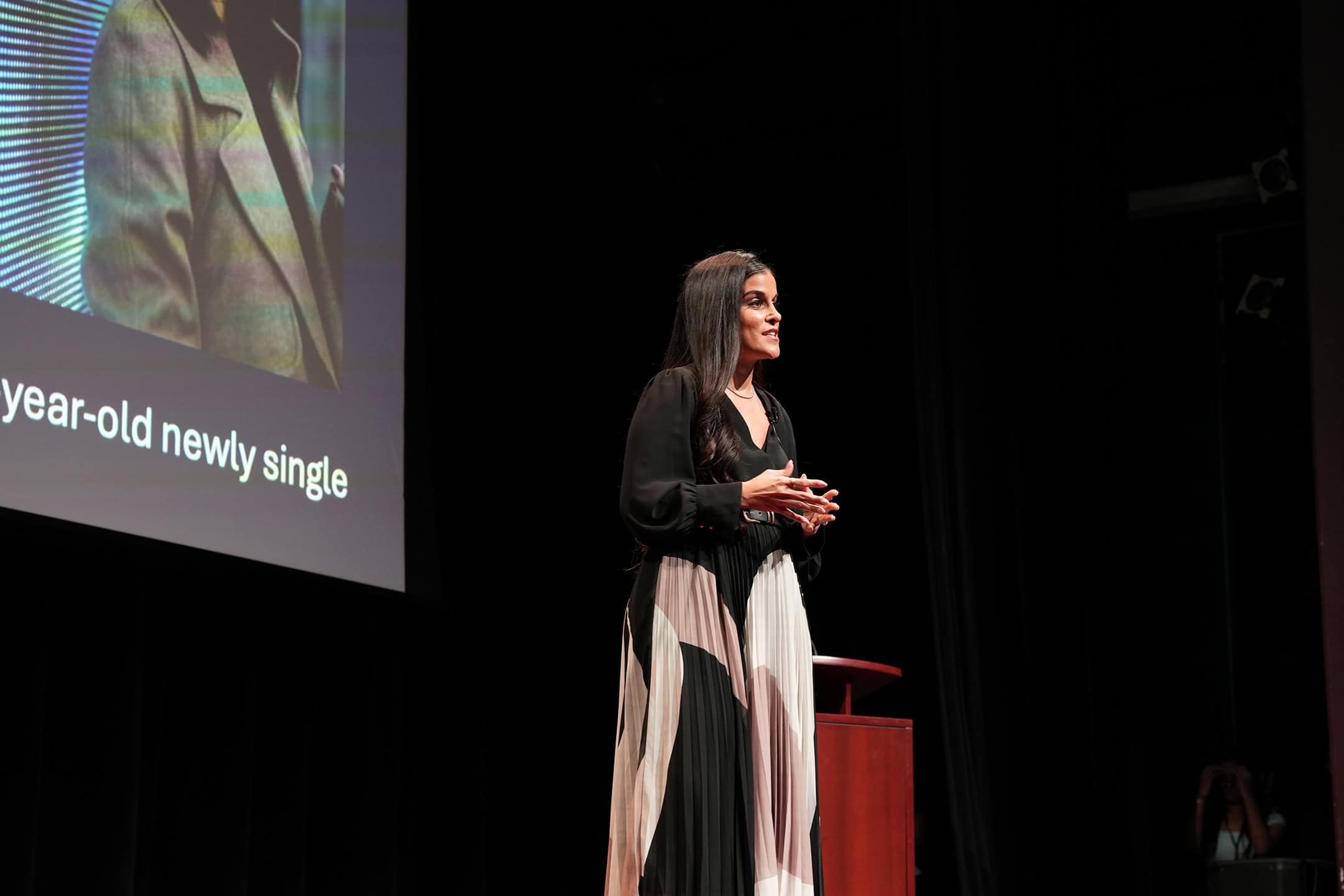
On January 26, the TEDxUofT student team organized a conference, themed “Mosaic,” where a diverse group of speakers and performers shared their experiences and perspectives on contributing to Canadian culture.
Among the speakers was Dr. Kaajal Abrol, a Toronto-based fertility specialist. As a graduate of McMaster School of Medicine, Dr. Abrol completed her residency in Obstetrics and Gynaecology and fellowship in Gynaecologic Reproductive Endocrinology and Infertility at U of T. She aimed to educate young people who are able to get pregnant through her TEDx talk, encouraging them to proactively learn about their reproductive health and take control of their fertility timeline.
Subliminal messaging and perception of fertility
Dr. Abrol began her presentation by addressing the constant influx of messages women receive about their fertility — that they won’t be able to get pregnant past the age of 30, or that if they’re any older than 18 their body is long past its prime. She pointed out that the conversation surrounding fertility remains the same as we age, even though our reproductive systems change. According to her and the World Health Organization, one in six people face difficulties getting pregnant. Infertility is now classified as one of the most common medical conditions for people of reproductive age.
Dr. Abrol has worked with women at every stage of life and has seen firsthand how the constant subliminal messaging targeted at young people about avoiding unplanned pregnancies has led to a lack of knowledge about the next phase of fertility.
“I’m healthy, I feel young. [I] thought I could get pregnant whenever I was ready,” one patient mentioned to her. Another told her, “I thought IVF [in-vitro fertilization] could help me, regardless of my age.”
As a fertility specialist, Dr. Abrol has encountered countless patients who were caught off guard by fertility challenges, all because they assumed everything would be fine. Her advocacy work, through lectures and her podcast, aims to dispel myths about fertility and share her knowledge with those who need it the most.
Taking a look at the numbers
To make the abstract concept of fertility more comprehensible, Dr. Abrol broke down the exact timeline of fertility health. At birth, an individual has about two million eggs, or ova. By puberty, this number decreases to 300,000–500,000. By age 30, it’s reduced to about 25,000. Understanding these numbers is crucial as it helps an individual assess the health and quality of their ovarian reserve, which can impact procedures like egg freezing or IVF — the process of retrieving eggs to fertilize outside the body.
She explained that the key tests for ovarian reserve include testing Follicle-Stimulating Hormone (FSH), Antral Follicular Count (AFC), and measuring Anti-Mullerian Hormone (AMH) levels. FSH is a hormone the brain releases to stimulate the ovaries to mature an egg for ovulation, while the eggs in the ovaries produce AMH. AFC is an ultrasound-based test that determines the number of eggs remaining in the ovaries.
FSH levels would be low in a healthy reproductive system, while AFC and AMH levels would be higher. According to Mount Sinai Hospital, as a cis woman ages, estrogen production decreases, resulting in higher FSH levels, which is perfectly natural with age. Dr. Abrol also noted that the average age of menopause — when the menstrual cycle typically comes to an end — is 51.
Dr. Abrol’s lecture aimed to educate the audience about what constitutes a normal menstrual cycle so that we can take action when things deviate from the norm. She goes into more detail on these topics in her podcast, Fertility Doc Talk, where she answers some of the most commonly asked questions.
Alternative reproductive routes
Dr. Abrol also explored how we should approach our own fertility. As she was speaking at a university, her advice was primarily geared toward people in their 20s and 30s who want to have children in the future. Being proactive and getting tested can have enormous benefits in terms of planning ahead — such as egg-freezing.
Egg-freezing involves removing a number of eggs from the ovaries and prompting them to mature, saving them for when you’re ready to have children. When that time comes, the eggs are thawed, fertilized, and implanted through IVF. Dr. Abrol pointed out that IVF is not always effective; it simply offers a better chance of having children later in life. Overall, it is a safe and powerful tool for navigating careers and relationships as young adults.
Dr. Abrol’s objective of raising awareness about reproductive health and encouraging earlier conversations speaks to the broader need for more accessible education about fertility and how it changes over time. In her words, “Informed individuals are empowered individuals.”

No comments to display.