
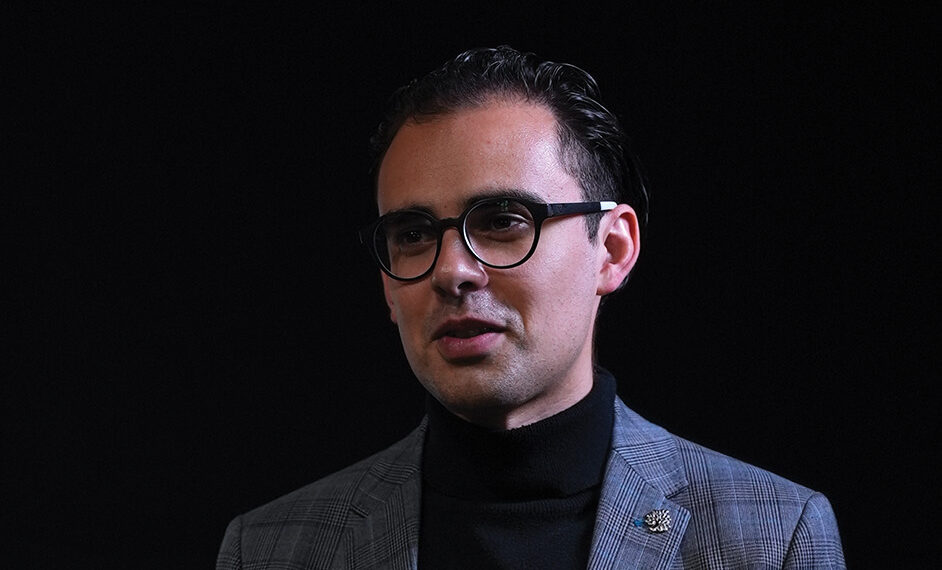
On June 14, the Toronto Symphony Orchestra (TSO) premiered “ROY,” a five-minute orchestral work by composer Andrew James Clark, at Roy Thomson Hall. The piece was commissioned by the TSO’s 2024/25 NextGen Composers program, which supports early-career Canadian composers to create orchestral works. Clark, currently pursuing a Doctorate of Musical Arts (DMA) at U of T, was one of three participants selected for the program this season.
Experiencing “ROY” live, I was drawn to the way the piece built coherence through interruption rather than continuity. It opened with a bold theme by the horns, which was shortly interrupted and echoed by the lower brass and strings.
From there, the music progressed through a sequence of contrasting sections, eventually arriving at a climactic passage where the strings presented a distorted version of the opening theme.
One moment that stood out to me was the conversation between the first and second violin sections, which were seated on opposite sides of the stage. Their brief, alternating sliding melodies moved across the sections of the orchestra, mirroring the sensation of switching between radio frequencies, creating a dialogue that was as visual as it was musical.
Following the performance, I spoke with Clark about the process of composing “ROY,” his experience working with the TSO, and how institutional support — both at U of T and beyond — has shaped his growth as a composer.
The Varsity: What was the starting point for this piece, and how did writing it specifically for the TSO shape your approach?
Andrew James Clark: I was really nervous, just flat out, because I’ve lived in Toronto my whole life, and I’ve been attending the TSO’s concerts. When they approached me to write it, that was very serious for me. They have the highest standards, which means I have to put pressure on myself to meet their standards.
The other dimension to it was, for me, that composition and orchestration are really two different things, and I feel really confident as a composer. But it can be difficult to get orchestral opportunities in Canada, so I felt more rusty with that. It was nerve-wracking because I knew I had a lot of work to do in order to get the orchestration up to par.
TV: Were there any particular challenges or moments of joy during your composition process?
AJC: During the composition process, it’s hard work. I worked for a year and a half on those five minutes. Because orchestration is difficult — I can write what I hear, but in terms of who’s playing what I’m thinking at any moment is really foggy. I wrote multiple versions of passages over and over again to get the right thing.
Another huge hurdle I’ve found is that orchestras have layers. Just like a movie, there is the foreground, the middle ground, and the background. When I was writing this piece, “ROY,” I could usually hear the foreground really, really well. I can kind of hear what is happening in the middle ground. And then the background — I have no clue.
The stress came when I would get to the orchestra, I was actually hearing two or three more layers, but I wasn’t aware of it enough to write it down. Now my piece sounds thin, and it can be really underwhelming for an audience coming to an orchestra.
So it’s a lot of work — rewrites and rewrites and rewrites. It was right until I got to work with the performers that the joy came.
TV: “ROY” weaves together references to technology, place, and even Brahms — how did those ideas come together?
AJC: Some of it was amazing luck, and some of it was bad luck.
When I first got the commission, it was supposed to be on a program with Brahms’ 2nd Piano Concerto. I wasn’t wise enough to know that concertos, in particular, are often reprogrammed by the soloist. My motive actually spins out into the opening theme of Brahms’ 2nd Piano Concerto. On the program, it was Brahms’ 1st Piano Concerto, which I didn’t learn that they had changed until I handed in my piece. I really wanted to make it about that night, and that orchestra and that place, and the Brahms reference came in with a concerto that didn’t end up getting performed.
For technology, I really like fast music. That’s the consequence of our high-speed city, the technology, and all those media shifts. I find it exciting. Being efficient is like a sport to me, and I think that shows up in my music. It’s also actually part of my research here at U of T — how the human nervous system reacts to rhythm. So my music is very percussive, driving, and always moving forward. I like it, and plus it also complements my research!
TV: What initially drew you to the DMA program at U of T, and how has your experience in the program shaped your development as a composer?
AJC: I did my undergrad and Master’s at U of T, and at a certain point during COVID-19, I thought I had to go back. There are a few things that I really wanted to complete — one was actually learning how to write for the orchestra, and the other was researching rhythm.
One of the greatest things about my supervisor, Gary Kulesha, and the Composition Department at U of T is that they don’t tell you what to do, but whatever you choose to do, they’ll support you in it. I credit a lot of my flexibility to doing that, because whatever interests I have for that year, I can get support for that right away.
When I got here to U of T, I was 18 and I felt like a teenager. And now I’m a working professional, and I got most of that from the composition program — I got a sense of professionalism.
TV: Was there anything in the NextGen program that pushed you outside your comfort zone as a composer?
AJC: I write a lot of solo music and chamber music, and I really like doing unorthodox music notation. I like the music on the page to have a shape that represents what I felt in my brain.
For the TSO, there were occasions where I wrote slightly odd notation for the orchestral musicians — the way I would have written for a soloist — because I think it communicated the direction I wanted the music to go.
The TSO Library was like, they don’t need this — do the normal, clear, standard thing. It was creating a barrier between the performers and my music, and, plus, it was the conductor’s job to interpret anyway.
That was a point of frustration but growth. I learned a lot about clarity and writing parts as simply as possible.
TV: Do you have any advice for early-career composers engaging with similar opportunities?
AJC: Whatever you do, do not quit — no matter what your parents or anybody says. People get discouraged because we often have to work non-musical jobs, and then they get upset and quit flat out.
But you have to come home from your full-time job, and write music and practise, even if it’s only five or 10 minutes, and you’re exhausted. As long as you’re doing a little every day, the exhaustion will taper off, and you will become the person you feel you will become.
This interview has been edited for length and clarity.

No comments to display.