
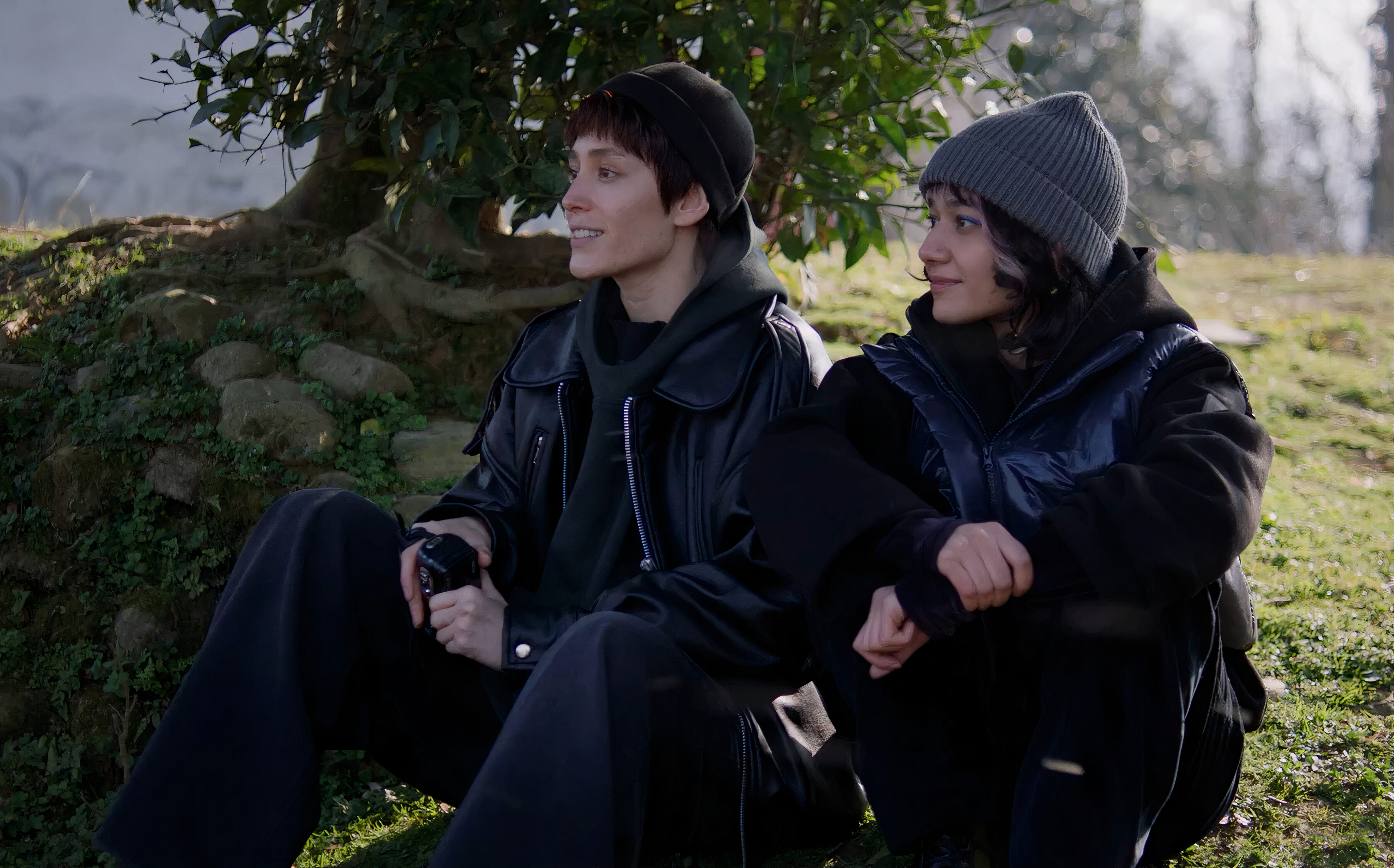
To what lengths would we go to live as our authentic selves? This was the question explored by filmmaker Farnoosh Samadi in her feature film, Between Dreams and Hope. The film is in Farsi, and centres around the lives of Azad (Fereshteh Hosseini) and Nora (Sadaf Asgari), partners living in Tehran’s underground queer community.
The film appeared in this year’s TIFF Platform programme, championing diverse perspectives in film. Previously, her feature film 180° Rule (2020) and her short film Disappearance (2017) premiered at TIFF.
The film begins with what we later learn is a Persian urban legend that involves a unique predicament with a goat, a pregnant woman, and what seems to be a nightmare. The sequence foreshadows the uncertainties that run through the story, hinting at some of the barriers that Azad will soon face.
While Iran provides some legal recognition of trans people, there is still considerable stigma and discrimination present in Iranian law and society as a whole. Hence, when Azad seeks gender-affirming care, lawyers state he can only receive said care on the condition of his father’s consent.
Azad fears approaching his father, as he has not been in contact with him for years. Almost immediately, Azad faces a fork in the road: reaching out to his estranged father, or being unable to take steps towards feeling secure in his identity.
The emotional depth, provided by actors Hosseini and Asgari, conveyed the intensity of the film and their respective roles. Some scenes in the film were too powerful for words to describe. The moments of periodic silence paired with a close view of the actors’ expressions gave me chills. The authenticity of the emotions from the entire cast, especially moving into the latter half of the film, was a clear standout feature for me. I found myself resonating with the characters’ feelings, every moment of sadness, fear, guilt, rage, joy, and peace.
Amidst the current wave of social issues — such as the rampant human rights abuses against women and the systemic erasure of the LGBTQ+ community — impeding the lives of younger generations from free expression, this film acts as both an intimate character study and a broader callout to the political regime in Iran.
Rather than portraying her story as tragic, and her characters as victims, Samadi chose to depict them as leaders defying institutionalized cruelty.
The social issues presented are not without hope and healing, which serve as an anchor guiding the characters throughout the film. There are several scenes featuring the underground queer community in Tehran, where Azad and Nora can find themselves, and, through community, begin to believe that they both will one day be accepted for who they are by Iranian society.
Their friend group is sympathetic to the issues in accessing gender affirming care that Azad faces, and offers partying and drinking as distractions.
It was fascinating for me to observe the parallels between the way the queer scene in Tehran was represented and the queer scene in Toronto. Although being LGBTQ+ in Toronto is comparatively more widely accepted, I noted that the spark that unites queer communities remains active no matter where in the world you go.
Despite their friends’ persistence that they should move abroad, Azad and Nora both agree to stay in Iran, hoping they will someday be allowed to live openly as partners in a country that learns to accept them, rather than hiding away. As Azad says, “One can hide in the dark, but they have to follow the guiding lights around them.” No matter the obstacles that he faced, Azad would not hide; he had to live in his truth.
As a queer individual myself, it was uniquely powerful to watch this film. So often, stories centred on queer and trans relationships end in tragedy and are framed in terms of loss. Witnessing a character not only endure but also overcome the many obstacles in front of him reminded me of the continuous resilience that runs deep in the queer community.
Globally, members of our community face continual discrimination, and having faced this barrier myself, I felt a profound connection to Azad’s journey. Watching his story come to life affirmed that joy and struggle can coexist, and that stories depicting this coexistence deserve to be amplified and told in their fullness.
Following the screening, I was fortunate to speak with Samadi and receive advice for LGBTQ+ identifying students. On the topic of finding resilience, she reminds us not to lose hope in the face of adversity and that we must be at the forefront of both the fight for peace and the fight for ourselves.
The film closes with a warm scene of Nora and Azad floating side-by-side in the sea. As the credits roll, Samadi imparts a message to the audience through this scene: hope will persist, even in times that we may not be able to feel it.

No comments to display.