
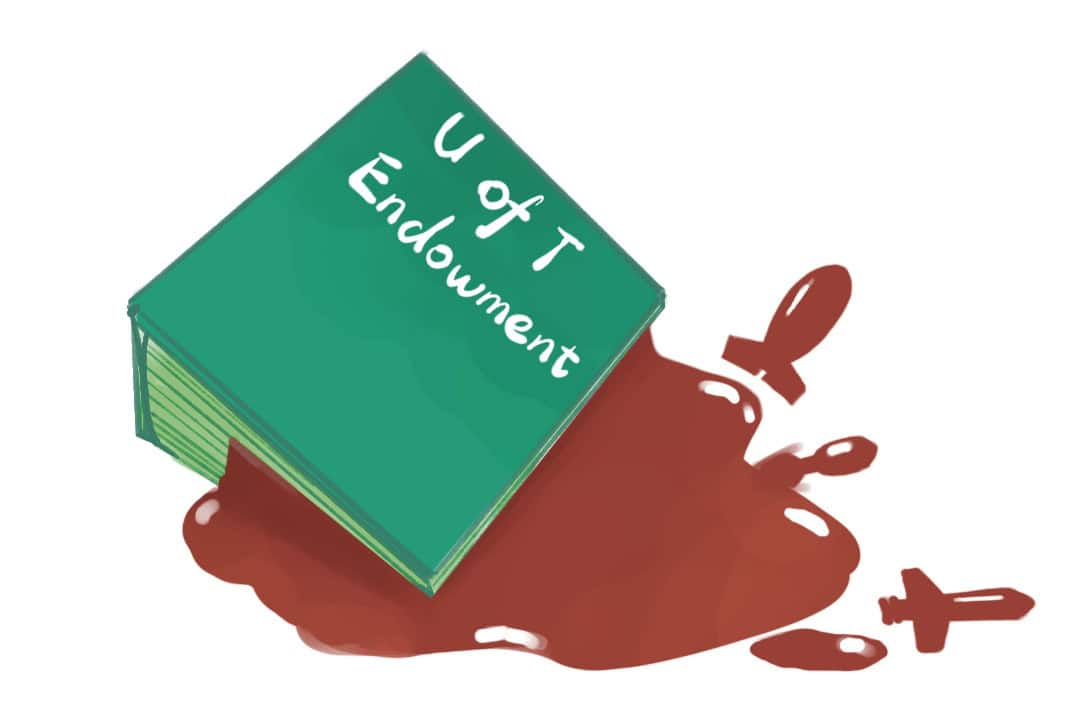
In the fight against climate change, U of T has aimed to become a leader by example, notably with its long-awaited decision to fully divest from fossil fuels by 2030. However, I believe that U of T’s actions reveal a tactic of selective ignorance by the university to appease those higher up in the corporate and governance ladder — leaving us to wonder who this justice is for.
On September 20, “Draw The Line” protestors marched through Toronto demanding the prioritization of climate justice hand-in-hand with Palestinian liberation, Indigenous sovereignty and economic accountability. High-profile climate activist Greta Thunberg echoed these sentiments by joining a flotilla that set sail to Gaza from Spain, attempting to break the aid blockade in Gaza, referring to the effort as a natural extension of the climate justice movement.
As a student who believes in the need for an intersectional struggle against climate change, how exactly does U of T measure up?
Performative justice
To truly understand why I believe that U of T’s fossil fuel divestment constitutes selective activism — a form of activism in which choosing to focus solely on one issue and ignoring other, often intersecting, forms of oppression — we must revisit what climate justice actually means. It isn’t just about reducing carbon emissions — it is the fundamental idea of fighting against systemic inequalities that make certain communities more vulnerable to environmental destruction than others. These communities include Indigenous, racialized, and colonized peoples.
U of T does not have policies that block the investment partners of the University of Toronto Asset Management Corporation (UTAM), which manages UofT’s $3.6 billion endowment fund, from investing in weapons manufacturing. I believe that by refusing to agree to the O4P encampment’s demand for U of T to create divestment policies from weapons manufacturers similar to those it has for fossil fuel divestment, U of T’s actions do not align with the principles of a just transition. I believe that this allows for U of T’s endowment to fund violence, war and catastrophe.
The university’s $3.6 billion endowment fund invested through UTAM’s investment partners is commendably fossil-free. Yet it remains concerning that there are no policies at U of T that stop UTAM’s partners from investing in weapons manufacturing. The O4P encampment last year had three central demands before being evicted from King’s College Circle. Among these demands was for the University to divest from investments and companies that sustain Israel’s apartheid, illegal occupation and genocide against the Palestinian people.
I believe that the university cannot sincerely claim to be a leader against climate change while failing to adopt policies that prevent its endowment from being invested in the violence that fuels environmental degradation in Indigenous and occupied lands.
Intersectional struggles
According to the September 2025 report from the UN Environmental Programme (UNEP), the situation in Gaza has led to a “human catastrophe.” It was perpetuated by forced displacement, water contamination, and a critical destruction of the marine ecosystems that have contaminated the food chain and led to a poisonous fish supply. This destruction is not a separate issue from the climate crisis because of the nature of the assault on ecological systems and human survival. The environmental crisis that is happening in Palestine is manmade.
Indigenous communities across Canada also face militarized police violence for defending their land against fossil fuel development. The RCMP has conducted 77 arrests of Wet’suwet’en land defenders and allies over the course of four police raids at the Coastal GasLink protest sites since 2020. Coastal GasLink is a natural gas pipeline that has been issued over 50 warnings for environmental violations by the British Columbia Ministry of the Environment and Climate Change.
From Turtle Island to the Gaza Strip, we are witnessing two large-scale ecological collapses in history. U of T’s divestment from fossil fuels, but not from militarization and settler colonial projects, shows its choice to attribute greater moral significance to one form of destruction over another. Climate change cannot be tackled in isolation from imperialism and settler colonialism.
Fossil fuel divestment as a marketing strategy, not a moral stand
It is necessary to keep in mind that U of T’s commitment to divesting from fossil fuels in 2021 came after nine years of student-led divestment campaigns from the UofT350 — a student-led climate justice group.
UofT350 pushed for this change despite significant resistance from the administration. Back in 2016, then-President Gertler rejected his ad-hoc committee’s recommendation to divest and instead stated he would take a “series of actions on environment and sustainability.”
When the divestment was finally announced, President Gertler described it as “bold actions that have both substantive and symbolic impact.” What he failed to acknowledge was that it was also the bare minimum in a rapidly changing moral landscape that now awarded institutions for their climate consciousness.
The announcement coincided with similar moves from Harvard University and the University of California. Within this climate of increasing public pressure to make ethical financial decisions, I believe that U of T’s decision was a marketing maneuver to remain competitive in global academic rankings that weigh sustainability.
I think that if the administration is a true institutional advocate of justice and sustainability, it must reevaluate all its investments that have indirectly incited aggressive action.
Towards intersectional sustainability
Intersectionality should not become a buzzword. It is a term used to articulate how multiple forms of oppression intersect and compound one another. Climate change, racism, militarization, and colonialism do not operate in silos and neither should our activism.
I believe that if U of T wants to be a genuine leader in sustainability, it must implement policies to fully prevent investing in weapons manufacturers that are complicit in human rights violations. It must lend its voice to Indigenous land defenders and implement steps towards reparative justice. Lastly, it must recognize and preserve basic human rights as part of the global climate justice movement.
The fight for a livable planet must include the struggle against imperialism and militarized violence. From Wet’suwet’en lands to Gaza’s razed olive groves, the future of sustainability rests on the shoulders of our activism and the voices we choose to uplift.
U of T must put a halt to drawing arbitrary moral lines and commit to a future that is green and just.
Kazim Abro is a fourth-year undergraduate student double-majoring in New Media and Media and Communication — Journalism Stream at the University of Toronto Scarborough.
Correction: This article was corrected to reflect that U of T does not have policies that prohibit its endowment’s third party investors from investing in weapons manufacturing and that there is no evidence that U of T invests in weapons manufacturing.

No comments to display.