
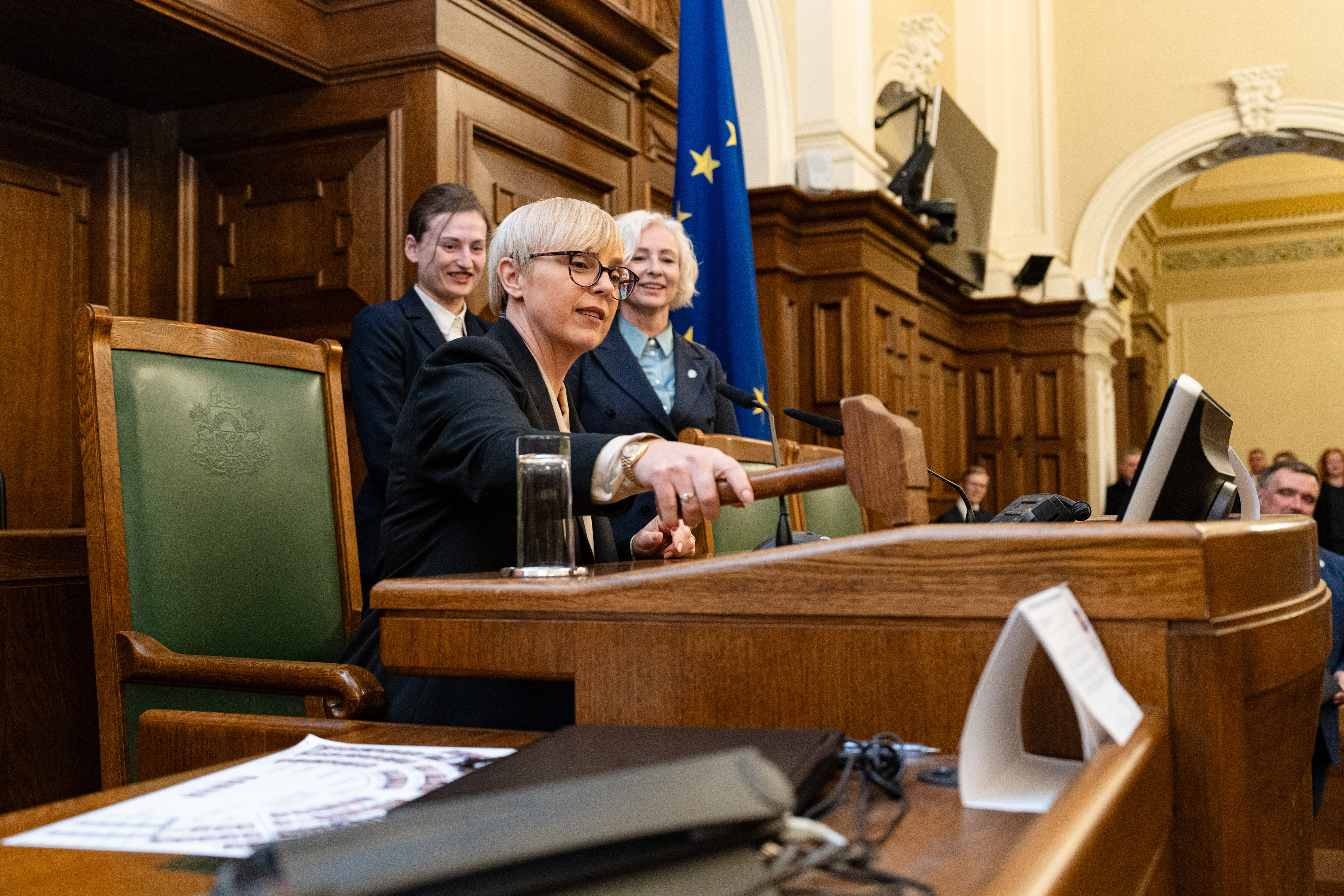
On September 29, the Munk School of Global Affairs & Public Policy held a private event in honour of Slovenian President Nataša Pirc Musar. While answering a student’s question during the event, Pirc Musar repeated a claim that perpetuates antisemitic stereotypes.
The Varsity’s account of the president’s remarks comes from student and faculty descriptions and a transcript that was read out loud at an October 6 Munk School meeting with students about the comments.
The transcript of the event reads that the president then took questions from the room after giving her opening remarks. A student asked, “Why can’t we stop the genocide in Gaza?”
“I think there’s only one country on this planet who can stop this genocide in Gaza, and that is the United States […] I’m brutally honest with you today […] It was written in [an] article that 80 per cent of all the banks in the United States are owned by Jews, 90 per cent of the media in the United States are owned by Jews, and Jews are supporting Republicans and Democrats with millions of dollars in campaign [funds]. And that’s the world that we are facing today,” responded Pirc Musar.
After Pirc Musar’s comments, a “Munk School faculty member immediately and directly challenged the comments during the event,” Munk School founding director Janice Stein wrote to The Varsity.
Vesna Drole, Slovenia’s Head of the Public Relations and Protocol Office, wrote in an email to The Varsity, “We acknowledge that, in the current climate, the words or the context in which they are spoken may well be misunderstood on occasions, or not well received. On the particular question she was asked, we must underscore that the topic is central to the President’s concerns since the Hamas terrorist attack on 7 October.”
“The quote you mention was primarily intended as a call to the Jewish community world-wide, particularly in the United States, with its considerable public influence, to do everything possible to stop the carnage in Gaza.”
“She has never said anything, publicly or privately, that could be described as anti-Semitic, nor was by no means her intention to offend anyone during the lecture, but rather to draw attention to the atrocities taking place in Gaza and, as we reiterate, to call for contributions to peace from all sides, including members of the Jewish community,” Drole concluded.
Munk School reactions
Stein wrote to The Varsity that, “The Munk School of Global Affairs & Public Policy and the University of Toronto do not tolerate antisemitism or any other form of racism or discrimination. When I learned about the comments the President of Slovenia made in a Q&A session following a speech she gave at the Munk School on Sept. 29, I took immediate action to verify what happened and address the serious concerns being raised.”
“I invited students to share their reflections with me in writing and have included them in a letter that I will be sending on Monday to the President of Slovenia and the Slovenian Ambassador to Canada. That letter will convey that her comments have no basis in fact, conform to classic antisemitic tropes and are deeply offensive.”
“I believe that the approach we have taken upholds the Munk School’s and the university’s values of evidence-based discussion, civil discourse and inclusion,” Stein concluded.
Student reactions
The Varsity interviewed five students who attended the event with President Pirc Musar.
One student said, “It was unexpected of a world leader. We kind of idolize these people, especially in the Munk School […] What the President said fell into antisemitic tropes, and perpetuated antisemitic stereotypes […] It’s tough, in the context of Slovenia being one of the first countries to recognize Palestinian statehood. But being pro-Palestine does not have to mean being antisemitic.”
A public policy undergraduate student wrote, “It goes without saying that this comment made me uncomfortable, not to mention that this only undermined [Pirc Musar’s] previously stated position regarding the ongoing atrocities by Israel in Palestine.”
Another student wrote, “[Pirc Musar] not only painted the wrong picture of the Jewish community, but also hurt the Palestinian cause she was advocating for by drawing focus to her senseless statements rather than to the daily deaths of thousands of human beings at the hands of the Israeli state.”
A fourth-year student noted, “I would not characterize her remarks as anti-Semitic, but rather as poorly worded […] I believe that the point the Slovene president was trying to make was not a conspiracy that Israel controls America, but rather that America has significant political and economic incentives to continue its support of Israel.”
“Of course, what she said was inappropriate,” the fourth year added, “however, like I said, I do not believe that it was antisemitic and that assertions that she is an antisemite or parroting antisemitic speech detract from her greater argument.”
A Munk School student wrote, “I personally had hoped to hear more discussion about the Balkans,” which was one of the topics of the lecture.
