
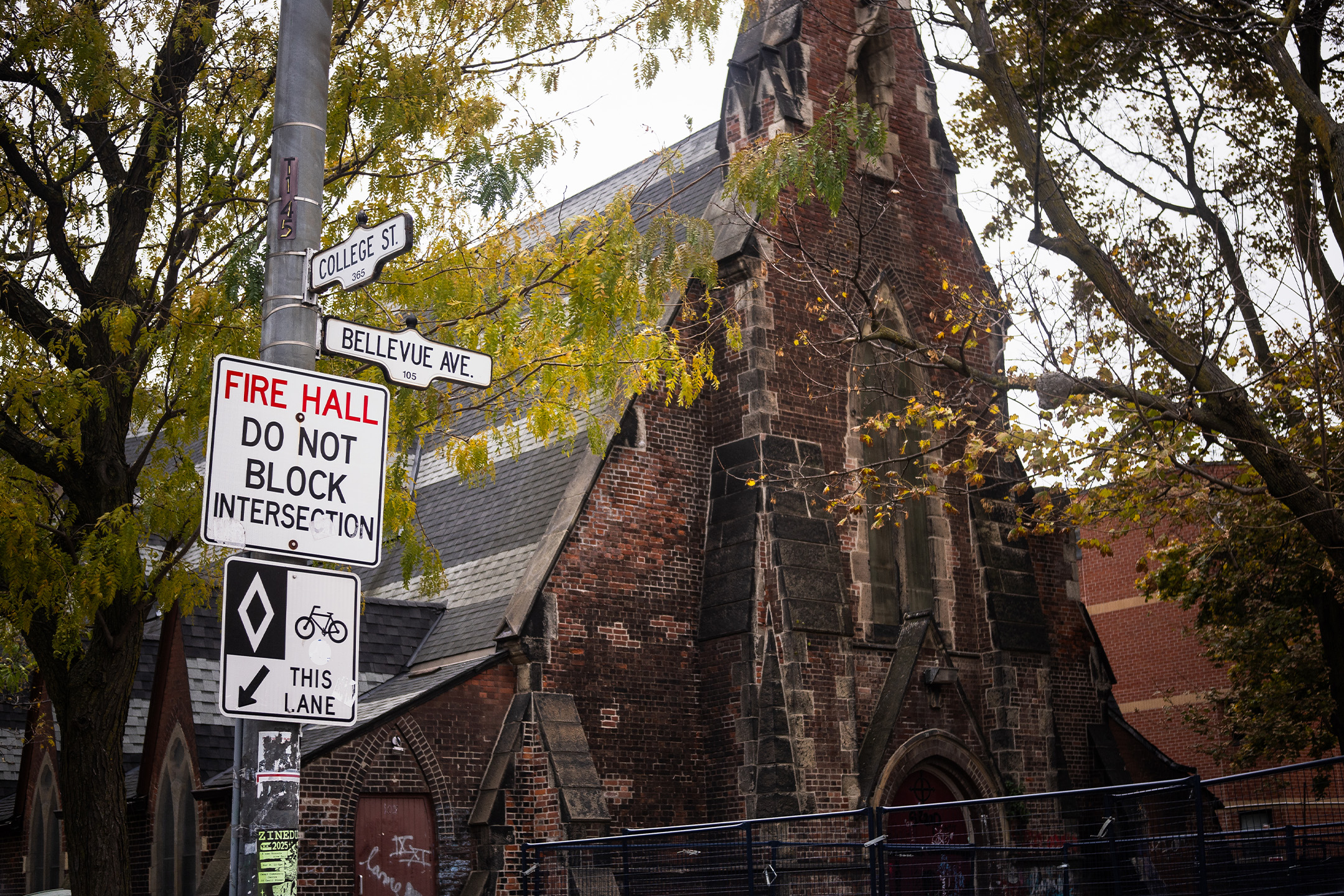
For over three years, an encampment by people facing housing insecurity was built next to the St. Stephen-in-the-Fields Anglican Church, near the Daniels Architecture building. Within it, a community grew despite the City’s best efforts to erase it. Then, for concerns for fire safety, the City destroyed it. Memories and belongings were loaded into garbage trucks and sent away.
The icing on the cake? The priest of the church, Maggie Helwig, won the Toronto Book Awards for her book about how hard she had fought for the encampment to remain, the night before she received the eviction notice.
In what city is it acceptable for the government to clear out an encampment after two whole years, in such a disturbingly detached manner? Toronto. And I want us to work together in changing that.
An unlivable city
When you walk through the streets of Toronto, you may have taken notice of the lack of benches, alongside steel nails and teeth sticking out of the pavement.
Let’s take the “Millionaire Mile” on Bloor as an example, given its proximity to the St. George campus. It’s a street lined with luxury brand names like Louis Vuitton and Tiffany & Co. — stores that look pristine but always seem empty.
Right outside these stores are hostile-looking, uncomfortable benches circled innocently around trees. These benches often form a c-curve and have a section of steel teeth sticking out of their backs, preventing unwelcomed, often unhoused people from lying on them.
Much of hostile architecture is designed so that it goes unnoticed by those it doesn’t target. It passes as an ordinary design until you understand its purpose: exclusion. And once you do, you’ll start seeing it everywhere.
After clearing the St. Stephen-in-the-Fields Anglican Church encampment as if it were a pile of trash, the City placed concrete blocks and metal fences to crush any hopes or possibilities of another encampment in its place.
Fences. Concrete blocks. Spikes on flat surfaces. Divided benches. These are all built into our everyday environment to convey one message: we, the privileged and powerful, don’t want unhoused people to be visible.
This is an example of Crime Prevention Through Environmental Design (CPTED), which claims to design the urban environment in such a way as to prevent crime. With CPTED, it isn’t just crime they’re designing against, but visibility. CPTED works to erase poverty from the cityscape, so that the truth never reaches our eyes.
As argued by Elizabeth Kiely and Katherina Swirak in Criminalisation of Social Policy in Neoliberal Societies, urban space is now carefully crafted to showcase wealth and leisure, while anything that disrupts that polished image is ‘out of sight, out of mind,’ which can explain the architecture I have noticed along the Millionaire Mile.
The uncaring City
The City’s hostility toward the unhoused is written both in law and in concrete. The Tanudjaja v Attorney General (Canada) court case reflects this erasure on a systemic level.
In 2020, four appellants and the Centre for Equal Rights in Accommodation took the Canadian government to court, claiming that their mistreatment of the housing crisis violates sections 7 and 15 of the Charter of Rights and Freedoms. They argued that the government itself has helped create and worsen housing insecurity, and that it has failed to respond with broad, systemic policies needed to fix the problem.
This case was ultimately dismissed on the grounds that it was not the role of the court to force the government to enact certain housing policies.
Despite all the human rights progress we have made, there remains a long road to achieve housing justice.
The City can commence clearance of a settled encampment after three years of it being there, and applaud a book about the encampment in the same breath. This city is being built to eliminate people living in the margins. Be it in a courtroom or on the sidewalk, poverty is made invisible and is never addressed.
People of the City
Too often, homelessness is reduced to stereotypes, but the reality is far more complex. Many people experiencing homelessness are young people, the same age as many U of T students, who lack familial support.
Some choose not to stay at shelters due to safety concerns, a desire to leave beds available for others, a wish to keep all their items, or a denial of pet entry.
Caring for this city
I believe that the municipal government is actively trying to diminish livability for homeless people, and that this reflects a systematic failure, rather than the so-called safety hazard clearance.
In writing this article, I’ve come across no shortage of non-governmental organizations working to address the housing crisis, such as Habitat for Humanity and United Way. Many people care about this issue, but only so much can be done to rectify it without government support. This fills me both with hope for humanity and rage against a system that further benefits those for whom it is already built.
We should all be asking ourselves why this city continues to be unlivable. Now is the time to transform this energy into a motivation to help.
U of T offers many opportunities to volunteer and contribute to our community to help address housing injustice. For example, I was the only person in attendance at a Philosophers for Humanity (P4H) volunteer event, an organization that raises money to support local groups addressing inequality, such as WoodGreen Community Services; there are still many roles to fill in volunteering for the unhoused.
For more focused help, U of T’s Trek for Teens Foundation raises awareness and fundraises for youth homelessness. The Prevention, Empowerment, Advocacy, Response, for Survivors (PEARS) project — an organization at U of T that advocates on behalf of survivors of sexual violence — also wrote a 2024 research paper on housing in Toronto to better understand the housing crisis and its disproportionate impact on students and survivors of sexual violence.
Not all help is monetary. It can be your time, your awareness, your voice. We have to band together and stand against a system that rewards the dehumanization of the poor and unhoused.
Jolie Chan is a second-year undergraduate studying Criminology & Sociolegal Studies, Psychology, and History.
