
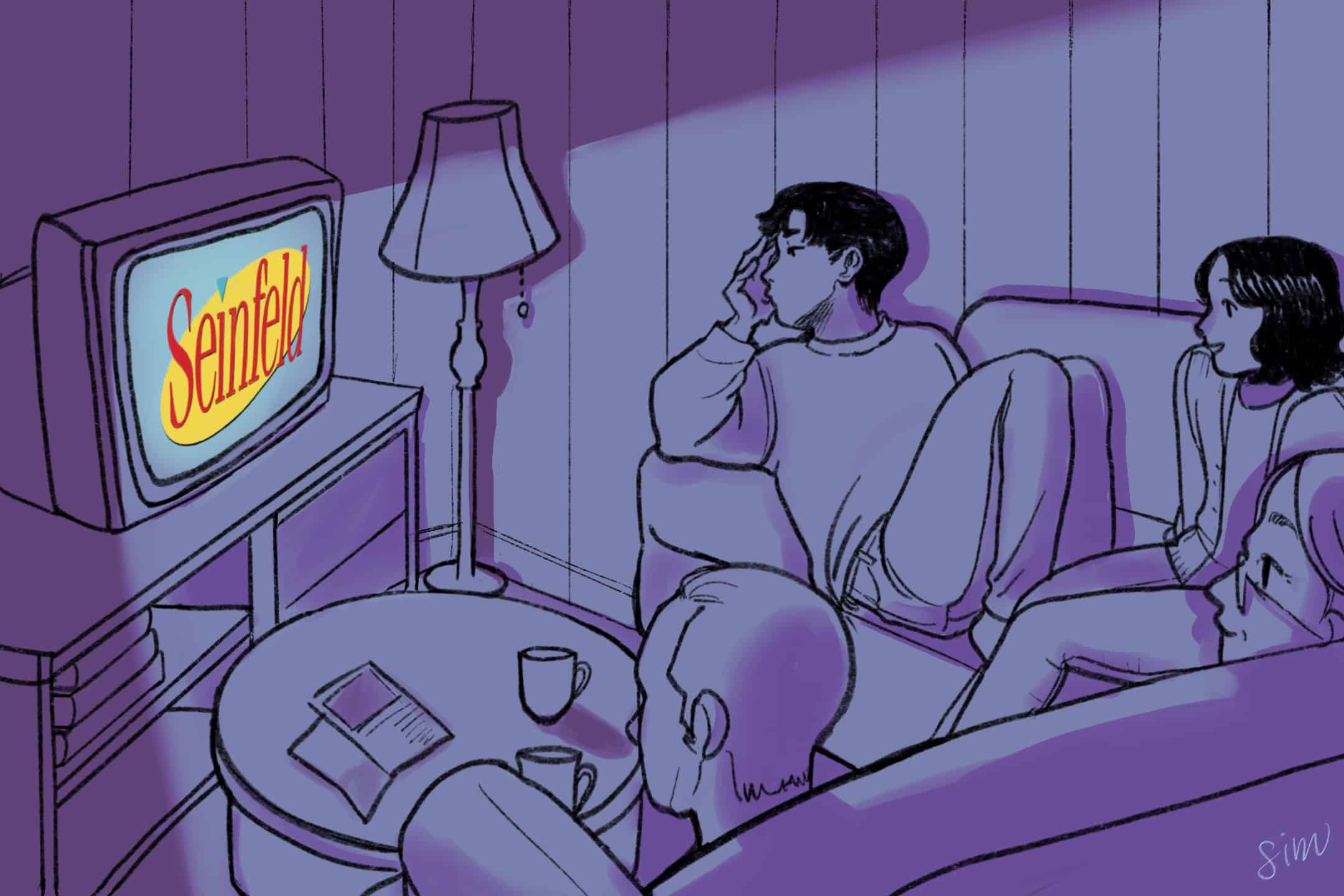
“But my feet… My feet are resilient!” My mother shouts this line from the TV show Seinfeld quite often. In my house, Seinfeld is a lot more than just a comfort show — it’s a shared language.
I’ve always thought that the best family traditions and inside jokes must include laughter and questionable ethics. Nothing says family bonding like a good ol’ ’90s sitcom — even if it’s created by someone whose politics I’d rather not bond over.
Seinfeld is often called a show about nothing, as it focuses on the everyday lives of an average group of friends. Even so, lines from countless episodes have wormed their way into mine and my family’s everyday speech and have become a shorthand for humour and irony. The show has also forced me to confront the impossibility of ethical media consumption.
More about Seinfeld to enlighten less seasoned viewers: Jerry Seinfeld — who is both the creator and star of the series which shares his surname — is a Zionist. He has expressed his support for Israel in regard to the war in Gaza, which has been deemed a genocide by human rights organizations such as Amnesty International and Human Rights Watch. In response to backlash he received for his support for Israel, he has also said that he doesn’t “care about Palestine.” Additionally, Seinfeld compared the Free Palestine movement to the KKK, in a speech at Duke University.
Still, the reality is that I adore the show. I remember watching it with my mum when I was younger, so it’s a time capsule of my childhood wrapped into a cynical package that is equally warm as it is offbeat. Within the ‘separating the art from the artist’ dilemma, is ethical consumption even possible?
Is it okay to consume media created by someone whose politics I disagree with? An answer, or at least something to consider, could be finding a way to consume Seinfeld or any media created by people with whom we politically or ethically disagree that doesn’t profit the artist directly.
Would this absolve the consumer, or is it just a convenient loophole? Would the situation become more justifiable if I told you that I only watch the show on DVD from a box set that I thrifted instead of on a streaming service that pays royalties?
I struggle to accept my relationship with Seinfeld, because although I love the show, I also know that consuming entertainment isn’t passive, and art cannot be neutral. I ask myself, how does this entertainment reflect me as a person and shape my worldview in general?
As comforting as Seinfeld is to me, its continued relevance gives Seinfeld a platform to spew hateful rhetoric. The art we consume is not separate from our political and ethical scope — and that’s why it matters. The choices we make as consumers have the power to challenge or support creators’ views.
We are deeply connected to the media we consume, especially when they are tied to memories that shape our lives in ways that we can’t clearly undo. I think that’s why it’s hard for me to come up with clear-cut answers on how to move forward.
My goal as a writer is to plant a seed of thought. In response to Seinfeld’s comment, Mo Amer, a Palestinian-American stand-up comedian and actor, recently said, “Jerry, I care about everyone.” I think caring about real people is more important than apathetic comments from influential figures. For me, it’s important to support Palestinians in their ongoing struggle for justice.
However, just as many of us continue to consume media from artists with questionable ethics, such as J.K. Rowling or Taylor Swift, Seinfeld remains a show near and dear to my heart. Nonetheless, I continue to try to navigate this complicated media landscape by watching it exclusively on DVD. I also make an effort to strengthen my media literacy and awareness of social justice issues. That way, I can engage with the show intentionally and grapple with the complicated and oftentimes disappointing legacies art and artists can hold.

No comments to display.