
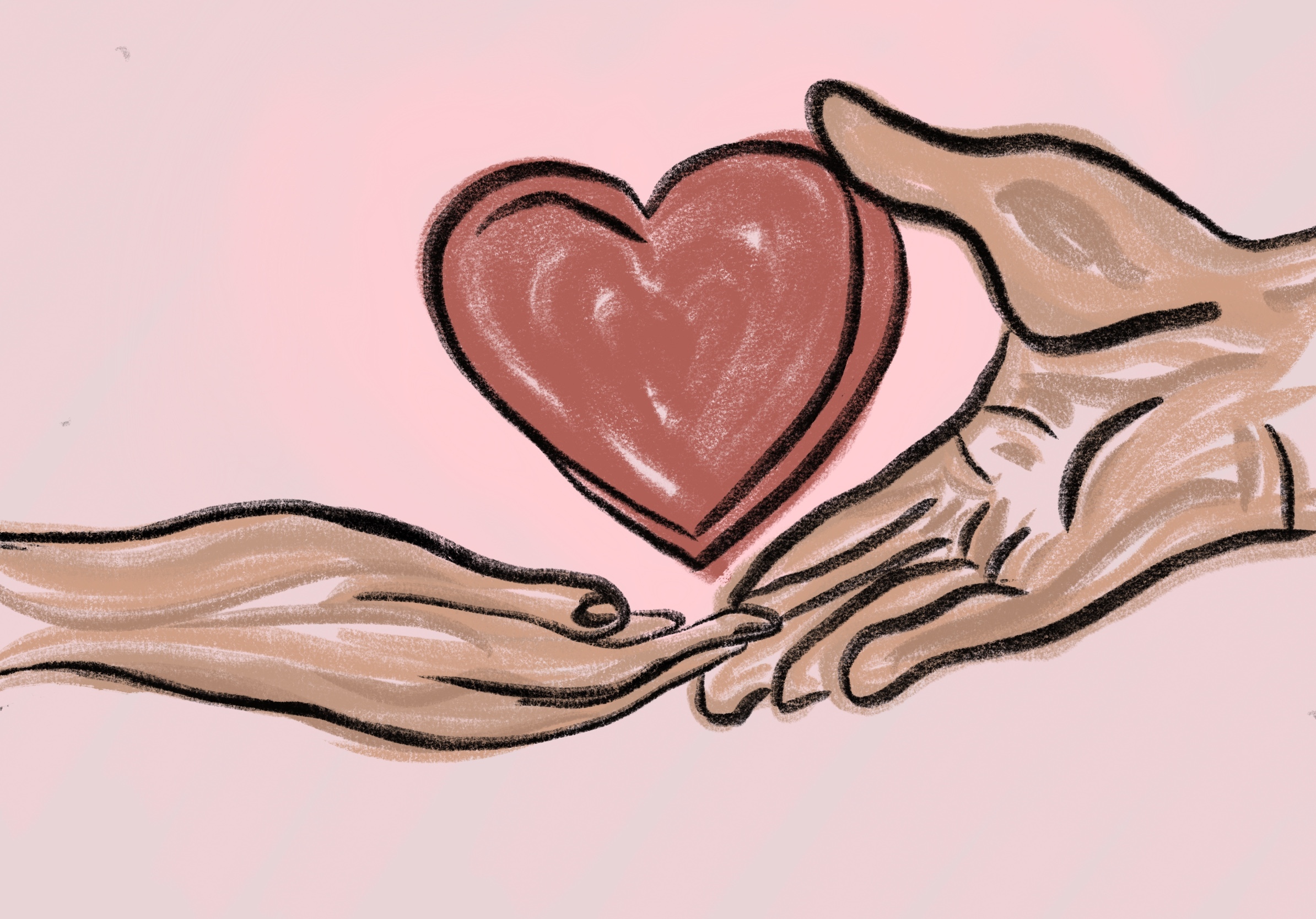
After just shy of a lifetime, I have finally started accepting my mother and her love. When you grow up feeling unloved by the family and culture that raised you, you start searching for love elsewhere.
This seems true for many of my queer friends, whose families rejected their core beings and desires, and who now search for safety and intimacy in other queer, often disabled, often leftist — outcasts. The search for love happens among those who accept you exactly as you are, with ease and undying support.
And yet, I have been disposed of by ex-partners and friends who share nearly all of my identity labels. They abandoned me the very first instance I hurt them — when they realized the lens through which I looked at the world was never the exact same colour as theirs. But my mother, who does not believe in my gender identity, and who has hurt me in ways I am not sure I can ever heal from, has never let go of me.
So, I have been questioning the idea of easy love — love without great disappointment or conflict, lost tempers or moments of carelessness — and arrived at the conclusion that such a thing does not really exist. Deep, intimate love is patient, tolerant, and enduring; it makes room for pain, hurt, forgiveness, and change. Because all humans are intensely and inexorably fallible.
The people who were ‘like me’ agreed with me, but they did not accept or tolerate me. Not when they realized the social deficits caused by my upbringing and autism would be a problem for them, too. Their love was conditional on my absolute agreement, and the moment I disagreed, I was out of their lives.
The antithesis of conditional love is unconditional love, I thought, but my friend Ayesha qualified it more precisely: one’s love should have a low degree of conditionality, and a high degree of acceptability. There is certainly a line that can be crossed for one’s love to break, but for me, that line is very, very distant, and moves further away when I feel grateful for and indebted to a person.
Relationships are built of gratitude, responsibility, and reciprocity. It is thanks to Robin Wall Kimmerer’s teachings of “gift thinking” that I have found the language to describe the deeply profound and spiritual concept of hiếu, which clinically translates from Vietnamese to “filial piety.” I would translate hiếu as “gratitude.”
Kimmerer writes in her book Braiding Sweetgrass, “Cultures of gratitude must also be cultures of reciprocity. Each person… is bound to every other in a reciprocal relationship… If an animal gives its life to feed me, I am in turn bound to support its life… [D]uties and gifts are two sides of the same coin.”
When my parents and relatives say that I “have hiếu” for visiting them, they are saying that I am performing my duties as a daughter, which shows my gratitude for the gift of my life. A gift that included feeding me for 21 years, and of giving up a culture and language so I can succeed with new ones. To me, this is the gift of love.
When we love people, we gift them time, attention, love letters, and bubble teas — to build a relationship of reciprocity. We become dutiful to each other. When I am sick and my loved one cooks soup for me, my gratitude motivates me to return the favour when they are in need. To burn a bridge is to set fire to your gifts and relinquish accountability.
I have considered going no-contact a few times with my parents, because they have caused me so much pain. Yet, because of their gifts, I cannot run away from my responsibilities. Not easily.
Last September, I called my mother and sobbed uncontrollably to her, “You have to accept this about me. This [my queer freakness] will not change.” She drove five hours north to pick me up, then five hours down, and cooked dinner. My mother accepts something she does not agree with. She loves someone she cannot understand.
And her love, before, has been destructive. It has taken me years to understand that my mother’s transphobia came from a place of love and believing she knows what’s best for her child. That when she insisted that I grow out my hair or wear feminine clothing, she did so because she did not want me to face the social rejection that, to her, defined trans people’s lives.
My past friends and partners dismissed my lack of malicious intent because, they explained, the hurt had already been done. I do not appreciate this approach. While good intentions cannot undo hurt, they inform the conversations we have after. It is not outrage but understanding that makes room for productive change. I believe that someone who intends to love you, yet has hurt you, is very likely willing to learn how to care for you in the ways you appreciate.
Oftentimes, our loved one hurts us by invalidating us in some way. I think many queer people are sensitive to invalidation, that we feel disagreement or rejection fractures our sacred safe spaces. But absolute agreement is rarely honest.
Kai Cheng Thom writes in I Hope We Choose Love: A Trans Girl’s Notes From the End of the World, “I have come to believe that strong relationships… contain the capacity for complexity and tension: That in a loving place, I am able to hear a friend disagree with me and know that they still care for me… That there is enough trust between us that our differences will not shatter us.”
It has caused me great pain that my family has never affirmed my gender, but I have become secure enough in my identity that I do not need their validation. Sometimes, I need — though I do not necessarily want, because it hurts — for my friends to tell me I’m wrong, or that I am reacting disproportionately. I need their help in grounding my emotions or clarifying my perspective. In Thom’s words: “I don’t want to be validated. I want to be loved.”
We must move towards a culture of indispensability, which is a culture of duty. I am not suggesting that we remain in toxic or abusive relationships. I am urging us to be accountable, to effectively navigate conflict, and to consider carefully when we want to cut ties, because there is a stark difference between leaving someone and disposing of them. I am urging us to accept and love people in all their flawed complexity, to value people over ideas, and to love authentically.
When the community of people who share our marginalized identities and lived experiences is particularly small, we must hold onto each other and keep each other safe. Those who understand you most intimately have the capacity to inflict hurt, and, too, the most enormous capacity to love you.
Nghi Nguyen is an interdisciplinary artist, and is a fourth-year student studying English and environmental biology.

No comments to display.