
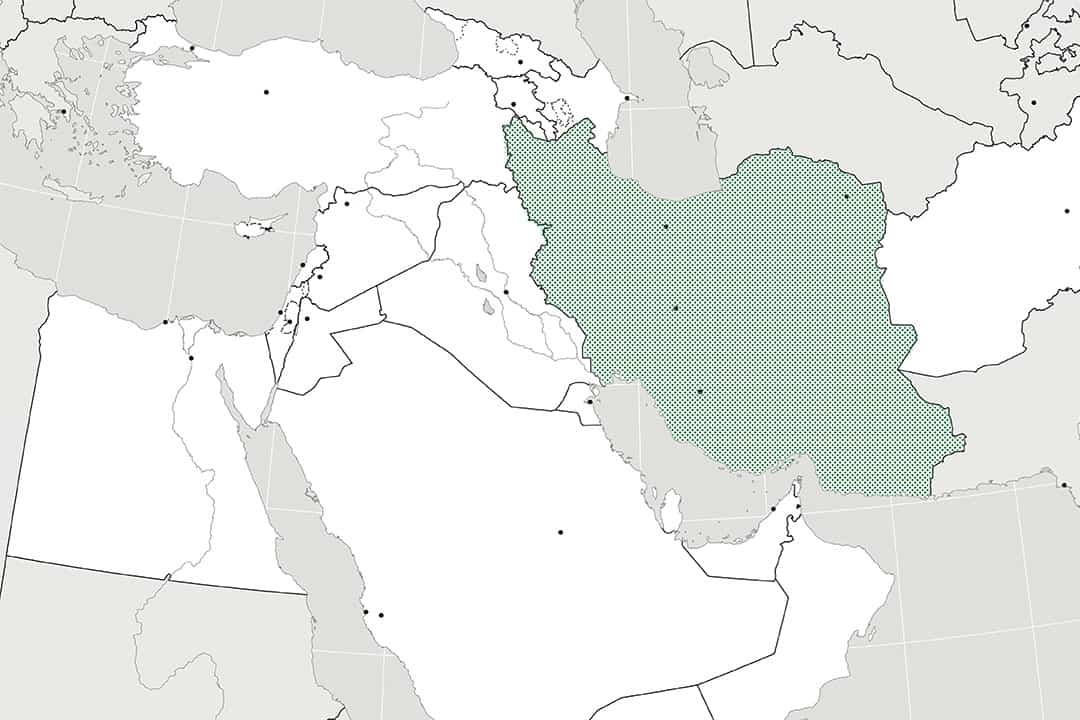
If you have been following the news over the last several weeks, you may have seen headlines about a “violent crackdown” in Iran. But “crackdown” is a sanitized word for a massacre.
According to CBS, the Islamic Republic regime has murdered between 12,000–20,000 people in just a few days. These numbers fluctuate based on reports, and the real number of such atrocities is historically higher than what is officially reported.
This killing of civilians by the government happened in the open, on the streets, in the hospitals, and right in front of Iranian people’s eyes –– however due to the fact that the regime enforced a total internet and communications blackout, most of these incidents did not reach global attention.
But, from my perspective, even when informed, the rest of the world has remained disturbingly quiet.
In the first days of the most recent wave of protests in Iran, a photo of a single protester circulated online: this protester was unarmed and in a fetal position on the ground, facing a line of heavily armed riot police.
Even with no knowledge of the context or geopolitics of contemporary Iran behind the protests, any human with basic empathy would look at that image and side with the vulnerable, with the one risking everything against the weaponized machinery of a state.
Yet, as the protests turn to slaughter, there has been a trend that is almost as suffocating as the silence: a sense of moral superiority that judges the ‘methods’ of Iranian resistance. It criticizes the slogans they choose and becomes concerned about the etiquette of the resistance, rather than the reason people are resisting in the first place.
But what happens without a collective sense of empathy? Who benefits from you sitting in comfort and frowning upon a people’s fight for survival? And if everyone is simply frowning, then who is supporting the fight?
In her book Queer Phenomenology, Sara Ahmed writes, “It matters how we arrive at the places we do.” The radical defiance that we are seeing from the Iranian people did not come out of nowhere. What they’re asking for today is built upon layers and decades of trauma, failed reforms, shattered hopes and a mountain of corpses. When you are being choked, reaching for air is not a calculated political move; it is an act of survival.
What makes this situation worse is the externally imposed standards of legitimacy, making people check their ideological handbooks to see if they are allowed to care. They pick apart Iranian people’s slogans through their morally superior lens, looking for ideological flaws. The political desires of the Iranian people remain diverse and wide-ranging. Thus, depending on one’s positionality, there will most likely always be ideological differences one can nitpick.
But it is the lived history of a struggle that shapes its present. You cannot judge the ‘correctness’ of a protest without acknowledging the decades of suffering that necessitated it.
We must dismantle the colonial gaze that views Iranians as a monolith. There is no singular ‘Iranian people.’ We are a tapestry of ethnic minorities, religious backgrounds, secularists, and various social classes. Diversity is our strength; it means our resistance takes many forms.
Any political ‘unity’ that demands a single homogeneous ideology is a failure of imagination at this point. As Saba Mahmood explored in her book Politics of Piety, people’s agency must be understood within their specific context. She challenged the idea that we only acknowledge ‘agency’ when it looks like what we’re used to seeing within Western liberal resistances.
The agency that Iranians decide on might very well offend the current sensitivities. But human rights are not a reward for having ‘the right’ politics; they are the inherent right of every person, even those facing a weaponized, aggressive and oppressive state power.
The full two weeks of internet shutdown in Iran were a calculated violation of human rights. By cutting off the Iranian’s right to communicate, the regime silenced Iranian voices and put a stop to the documentation of their crimes against humanity.
So when you withhold support because you aren’t sure if the protesters’ ‘values’ align with yours, you may unintentionally be assisting the regime in its goal of making its people invisible; Of delegitimizing their movement to justify their own violence.
The argument that ‘we must be careful who we support’ is a luxury of the safe. It follows a similar hypocritical logic that suggests queer people shouldn’t support Palestinian liberation because of the assumed social contradictions within that region. The moral standard you set for a people’s fight for life and dignity is a gatekeeping of empathy. If you would not give up your protected right to protest or your bodily autonomy, then you have no standing to criticize the methods of those who have no such choice.
For many, this is a news cycle that will eventually fade away. For diasporic Iranians and those on the ground, this is a crisis that has been impacting them on many different levels.
So in this brief window of global attention, instead of letting ideology shut down your empathy, you can let empathy guide your solidarity. Don’t claim spaces you don’t understand, and don’t assume you know the nuances of a struggle from an Instagram infographic. Check in on your Iranian friends, ask them questions, and learn.
The right to exist is not up for debate, and human rights are not a prize to be won by those who are most ‘politically correct.’ Stop checking your handbook to see if you are ‘allowed’ to care. Let your empathy guide you, and you’ll find that it’s not complicated to care.
Banafsheh Cheraghi is a second-year graduate student in the Master of Social Work program at the University of Toronto, specializing in mental health and health.
