
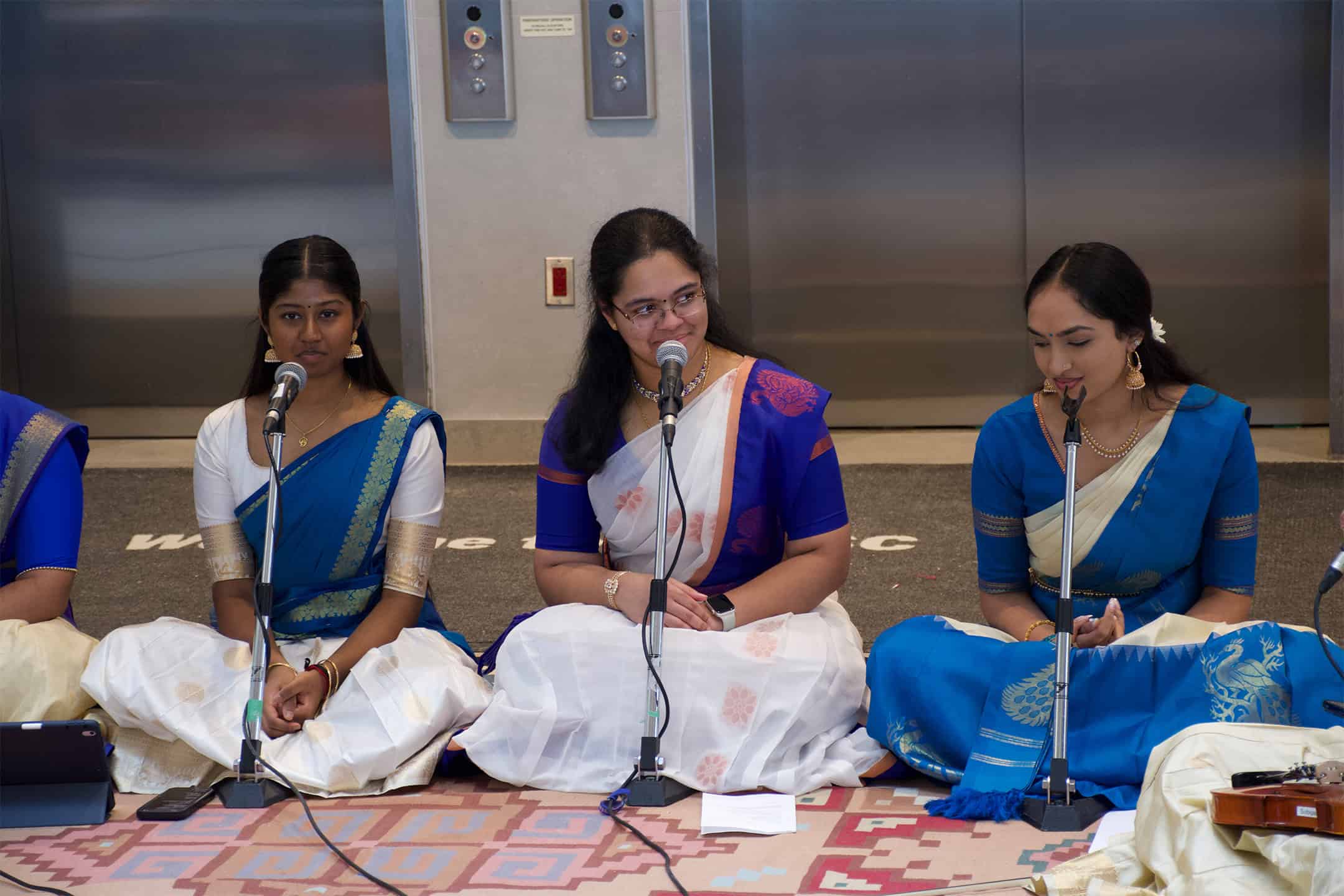
On Saturday, January 24, the Digital Tamil Studies project at UTSC hosted its fourth annual Digital Tamil Studies Symposium to celebrate Tamil Heritage Month. Canada is home to one of the largest Tamil diaspora populations in the world, nearly half of which resides in the GTA. Every January, Tamil Heritage Month serves as an opportunity to recognize Tamil culture and the contributions that Tamil-Canadians have made to the country.
Honouring Tamil heritage
As an attendee, I was able to spend a day surrounded by heritage, scholarship, and community. The symposium began in the morning in UTSC’s Environmental Science and Chemistry Building. A booth was set up displaying the UTSC library’s award-winning Tamil archival collections, with library archivist John Yolkowski on hand to assist with questions about the collection. Once settled into our seats, attendees heard from Tamil professionals in various fields, presenting on topics ranging from building AI language models for Tamil, to archiving Tamil history.
When lunch was served, attendees watched two performances by UTSC students. The first was a musical performance featuring singers, a violinist, and a miruthangist — a musician who plays a double-headed South Indian percussion instrument called the mridangam.
Four of the songs were Carnatic, an ancient style of music rooted in Hindu traditions and commonly associated with Southern India. The final song was a modern Tamil anthem about strength and resilience, called “Ezhunthu Vaa Thamizha,” or “Rise up, Tamilian.”
The second performance was a showcase of Silambam, an ancient Tamil martial art form where a martial artist uses a bamboo staff to perform attacks and blocks in a fluid, spinning motion. The performance was a powerful display with bamboo swishing around in the air — the sound of the strikes was even cutting through the music over the loudspeakers! Silambam represents the resilience of the Tamil people, as it persisted despite being banned by British colonial authorities until India’s independence in 1947.
Portraying histories and memories through art
I particularly enjoyed the final lecture of the day on “The Art of Archiving — Art, Memories, and Heritage in Post-Armed Conflict Sri Lanka,” by Thamotharampillai Sanathanan, a Tamil artist and professor of art history at Jaffna University in Sri Lanka. Sanathanan spoke about how he uses his art to portray themes such as home, migration, and loss. These concepts are particularly important to members of the Tamil diaspora, which consists of the 300,000 Tamils displaced during the Sri Lankan civil war.
I felt privileged to hear Sanathanan speak about his work, especially in Tamil, a language whose existence in Sri Lanka was threatened for decades. I learned about the many ways in which one can portray history and their experiences of it through art.
One artwork Sanathanan showed that stuck with me was a painting titled “Grandmother’s Courtyard,” in which he painted a map of the neighbourhood where his grandmother’s house was, from memory. He explained that people from the area started to leave their homes, and that the neighbourhood was destroyed by airstrikes.
Sanathanan also pointed out the lone figure of a boy in the top right corner of the painting, sitting on a swing, looking down at hues of orange, green, and purple. He explained that there was a single swing in his grandmother’s courtyard that would be shared among 11 grandchildren. This would often result in constant bickering over who got to play on the swing. Presently, Sanathanan is the only member of his family who remains in the area, like the lone figure on the swing.
Final thoughts
As a Tamil-Canadian visual art hobbyist myself, Sanathanan’s work and the thoughtfulness behind each piece deeply resonated with me. Art may be considered an unconventional way of exploring history and experiences, but it allows for self-expression that can be difficult to do in writing.
The lecture spoke to me as someone who grew up with stories of the war — how it affected my family and the loss of the homes they once knew — which is why “Grandmother’s Courtyard” was particularly so powerful to me.
The Digital Tamil Studies Symposium brought together community members, professionals, and scholars for a day of discussion and reflection on Tamil heritage. It was a bright and reflective way to mark the end of the 2026 Tamil Heritage Month, where we thought about the collective Tamil past and how to move forward, integrating the knowledge of our shared history and heritage.

No comments to display.