
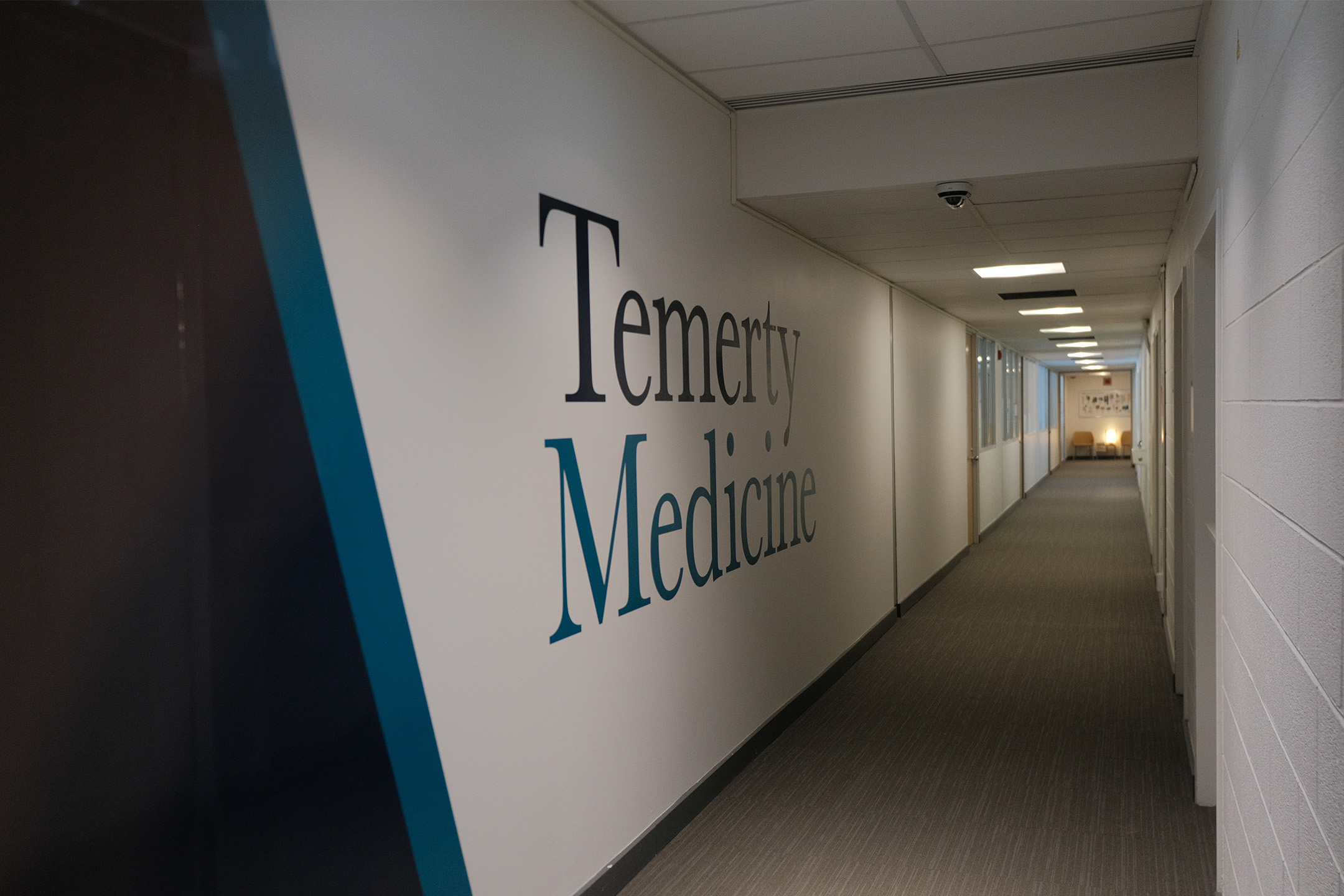
The Temerty Faculty of Medicine went viral earlier this winter after Conservative MPs posted clips of Vice Dean Patricia Houston declining to condemn Saudi human rights violations. Houston was summoned to a November 27 House of Commons committee hearing concerning the faculty’s $50 million-a-year international student deals with Saudi Arabia and five of its neighbours.
The committee’s Liberal MPs emphasized that U of T’s push to attract Saudi capital aligns with the government’s agenda, as Prime Minister Mark Carney attempts the same in a bid to diversify away from the United States.
Value(s)
“The Associate Director of Postgraduate Medical Education at the University of Toronto refused to appear before the Health Committee three times,” wrote Dan Mazier, the Conservative Shadow Minister for Health, on Facebook in mid-November. “Parliament has now summoned her.”
That summons came as part of a Tory-driven study scrutinizing a practice at Canadian medical schools of accepting postgraduate students funded by foreign states and their agencies.
U of T’s Temerty faculty receives approximately $50 million annually from the governments of Saudi Arabia, Bahrain, Kuwait, Oman, Qatar, and the United Arab Emirates combined. They receive this funding in exchange for residency and fellowship positions for students from those countries, at a rate of $100,000-per-head annually, with program length ranging from two to over seven years, according to Houston’s testimony.
After reading out the U of T’s mission statement, which enshrines “vigilant protection for individual human rights […] equity and justice,” Conservative MP Burton Bailey asked Houston whether she thought “the Kingdom of Saudi Arabia shares these values?”
“I can’t comment on that,” replied Houston, architect of Temerty’s recent expansion onto the Scarborough campus. “I haven’t looked at the mission statement of the Kingdom of Saudi Arabia.”
Within 26 minutes — before the meeting had even adjourned — a clip of that exchange was posted to Bailey’s Facebook account, where it amassed 156,000 views.
In his own Facebook post of a clip from Houston’s testimony, Mazier suggested that foreign-sponsored students took up program space at Canadians’ expense, writing that, “Meanwhile, thousands of Canadians who go to medical school abroad can’t return home because they are told there is no training capacity for them.”
A question from a Liberal MP gave Houston the opportunity to note that residency students, including the externally-funded ones, work up to 50 or more hours a week in clinics and hospitals.
Medical residents, as health care workers, are paid for by the province, with the number of non-externally-funded residency spots determined by the provincial government.
Houston testified that the externally-funded residency programs help subsidize the cost of provincially-funded spots, rather than taking away from them.
Another Conservative MP highlighted the risks of dependency on foreign funding, pointing to an incident in 2018 when Saudi Arabia moved to recall its sponsored trainees amidst a diplomatic row with Ottawa.
“2018 was a wake-up call for all of us,” replied Houston. “We have since ensured that, as needed and when needed, we will be able to continue to support our educational and academic programs.”
Behind the wheel
“So the Temerty Faculty of Medicine does not have a view on whether women should be allowed to drive?” asked Dr. Matt Strauss, Conservative rookie MP for Kitchener South—Hespeler.
“The Temerty Faculty of Medicine would not put forward a view on that,” replied Houston. At another point, Houston said, “It is not my role. I do not take a role in the political arena.”
The faculty has not always maintained a neutral position on outside issues, as in 2022, when it spoke out to condemn Russia’s invasion of Ukraine as a “vicious and wanton attack on humanity.” That was two years after the faculty received a record-breaking $250 million donation — and a new name — from Ukrainian-born businessman James Temerty.
Strauss also claimed to have received an email from a Temerty faculty member, who requested anonymity for “fear of reprisal from the administration.”
The alleged whistleblower expressed that “the impression of rank-and-file faculty is that the Saudi money is used to prop up the growing administrative structure and roles of the faculty rather than improving the training quality and experience of Canadian learners,” according to Strauss.
“Such claims have no basis in fact,” a U of T spokesperson wrote in an email to The Varsity.
One Temerty faculty member interviewed by The Varsity expressed that they were not aware of any such impressions among colleagues, and that they had not previously known of the agreement with Saudi Arabia.
The Varsity also asked whether fears of reprisal against an outspoken faculty member were realistic, but our source, who had requested anonymity to speak freely, did not respond.
Clips from Houston’s testimony were posted to Instagram, Facebook, and X (formerly Twitter) by Strauss, Bailey, Mazier, and others. The incident was picked up by RTNtoronto, a provocative Instagram news page reminiscent of 6ixBuzz.
The story was also covered by Juno News, a right-wing alternative media outlet linked to Trump-aligned Canadian big tech mogul Kaz Nejatiyan.
To Riyadh with love
Divisions across U of T have recently moved, in concert with the federal government, to ramp up ties to the wealthy oil-producing economies of the Persian Gulf, after a reduction in immigration pathways caused a plummet in lucrative foreign enrolments.
Deepened relations have reportedly been brokered with help from U of T alum Jean-Philippe Linteau, Canada’s Ambassador to Saudi Arabia, Yemen, Bahrain and Oman. “Linteau has been instrumental in strengthening partnerships between Saudi Arabia and U of T,” read U of T Arts and Science News in May. “In particular, [at] the Temerty Faculty of Medicine, the Ontario Institute for Studies in Education and the Munk School for Global Affairs & Public Policy.”
The Munk school trumpeted its Gulf-bound ambitions back in May, when Janice Stein, the school’s founding director, visited Riyadh, the capital of Saudi Arabia, to meet with Saudi officials.“My strong sense is that the Gulf is growing in strategic importance,” remarked Stein, drawing praise from state-linked media. “I thought, what a wonderful time to find an institutional partner here.”

No comments to display.