
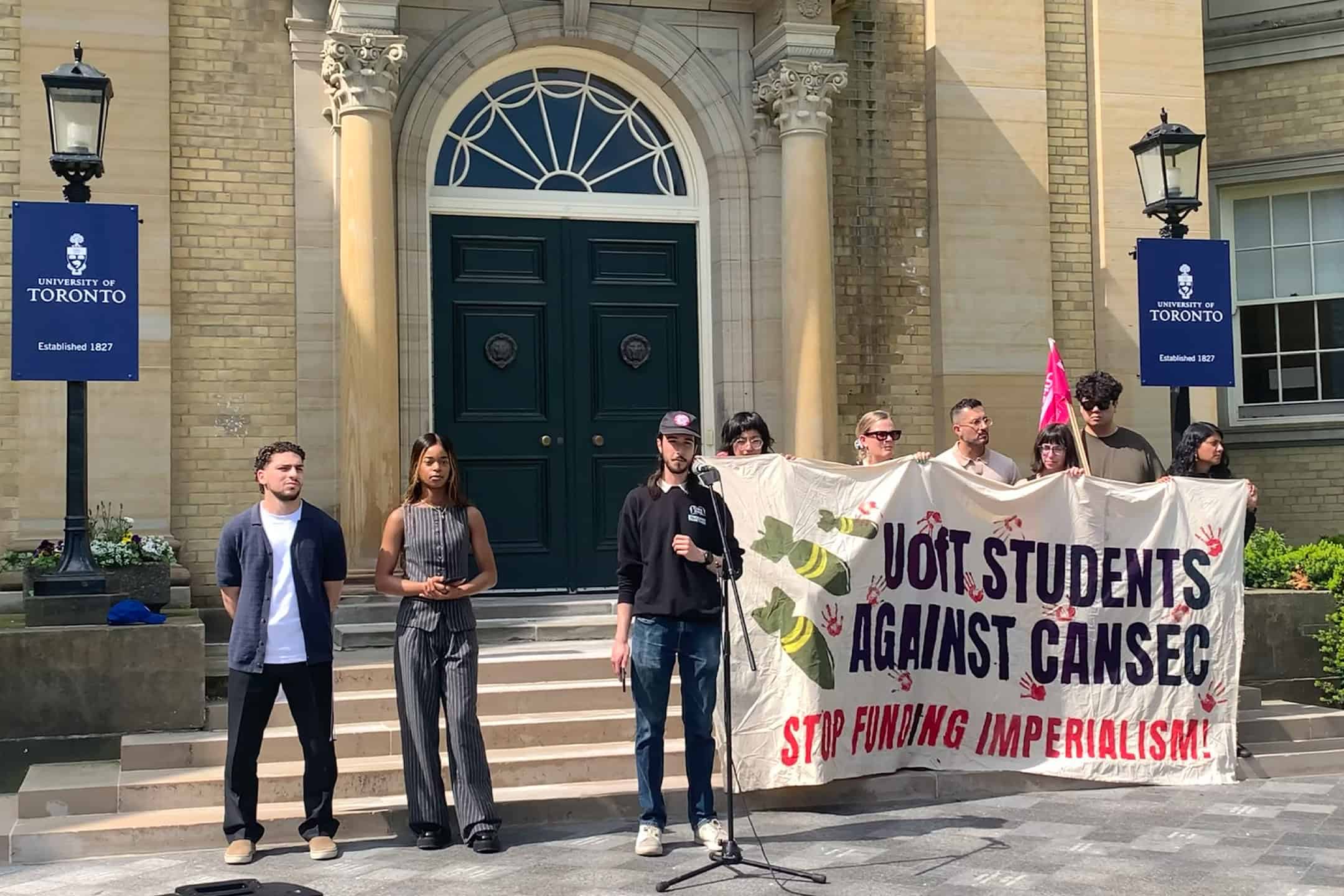
On May 27, the Canadian Federation of Students Ontario (CFSON), the University of Toronto Mississauga Students’ Union (UTMSU), and CUPE3902 Unit 1 hosted a joint press conference to condemn U of T’s sponsorship of CANSEC, Canada’s largest security and defence trade show.
CANSEC is hosted annually in Ottawa and showcases “leading-edge technology, products and services for land-based, naval, aerospace, and joint-forces military units.” It is organized by the Canadian Association of Defence and Security Industries, of which U of T is a partner.
CANSEC has been criticized for hosting weapons manufacturers and governments accused of war crimes and human rights violations. This includes Elbit Systems, which manufactures 85 per cent of the drones used by the Israeli Air Force, Lockheed Martin, the largest military contractor in the world, and General Dynamics, which manufactures equipment and services used by the American and Israeli militaries. Israeli armed forces have been connected to human rights violations, war crimes, and crimes against humanity against civilians in Gaza.
This year, U of T became the first university to sponsor CANSEC in its 28 years of hosting, specifically through a $10,300 advertising package, which includes logo placements on CANSEC’s website and on-site during the event, as well as networking opportunities.
Press conference
At the press conference, speakers called the university’s decision to sponsor the event a move to align itself with the military-industrial complex.
CFSON Chairperson, Cyrielle Ngeleka, said that U of T’s sponsorship of CANSEC is a “deliberate political choice” which “clearly outlines everything we need to know about institutional priorities.”
UTMSU President Adam El-Falou echoed this, saying that the sponsorship represents U of T’s central administration “choosing to put the university’s name, reputation, and credibility beside the weapons industry.”
“We believe it is a part of a broader pattern,” El-Falou said. “This year, U of T has launched a new defence-focused website. It holds and continues to build pathways through co-op programs, research collaborations, and partnerships with weapons manufacturers, and while students demand transparency, disclosure, and divestment, the university refuses to disclose or divest its endowment from weapon companies.”
El-Falou also stated that the university cannot claim to stand for human rights “while sponsoring an event that platforms, and includes companies and state actors accused of contributing to human rights abuses, war crimes, genocide, and violence against communities around the world.”
When asked if the university can still be considered neutral during/amid international conflicts, as it has claimed to be, Ngeleka said that U of T “cannot be neutral when they decide to blatantly invest in weapons manufacturers and war profiteering.”
Open letter response and Governing Council
On May 12, a collective open letter was published and included signatures from 20 different student groups, workers, unions, and university faculty, demanding that U of T revoke their sponsorship of CANSEC. The letter claims that sponsorship goes against the university’s mission statement, which commits to a “vigilant protection for individual human rights, and a resolute commitment to the principles of equal opportunity, equity and justice.”
The letter alleges that U of T’s sponsorship of CANSEC demonstrates “a coordinated effort by U of T administration to associate [U of T] with CANSEC and the global military industrial complex,” rather than “being a part of the solution and investing in justice-oriented projects.”
U of T responded to the letter by stating that “as part of our institutional purpose to support cutting-edge research, the university fosters a variety of partnerships with external organizations, including through sponsorships of conferences such as CANSEC,” writing that it is “an important venue for U of T to connect with government and industry.”
Lead Steward Unit 1 of CUPE3902, Julian Nickel, spoke at the May 27 press conference about how he was denied the opportunity to express his concerns at a U of T Governing Council meeting on May 13, despite claiming to have followed all required procedures.
Nickel was told that his concerns were not on the agenda for the meeting, and despite there being a provision allowing up to 15 minutes to be allocated to items not on the agenda and a lottery system in place to decide speakers in this time, Nickel was told that no such lottery had been done.
Nickel said that the Governing Council’s decision to not put the lottery on the agenda “is clearly the silencing of student voices.” It is up to the discretion of the Executive Committee whether or not to allocate time to items not on the agenda.
University response
In a statement to The Varsity, a spokesperson for the university stated that their partnerships with external organizations, including CANSEC, are “part of our institutional purpose to support cutting-edge research.” They added that the attendance of Canada’s Prime Minister and Ontario Premier “shows the event is an important venue for U of T to connect with government and industry, which can lead to research funding and partnerships for faculty.”
The spokesperson also stated that “As always, any research or partnerships will uphold relevant university and government policies and the law.”

No comments to display.