
Content warning: This article includes graphic descriptions of the Russia-Ukraine war.
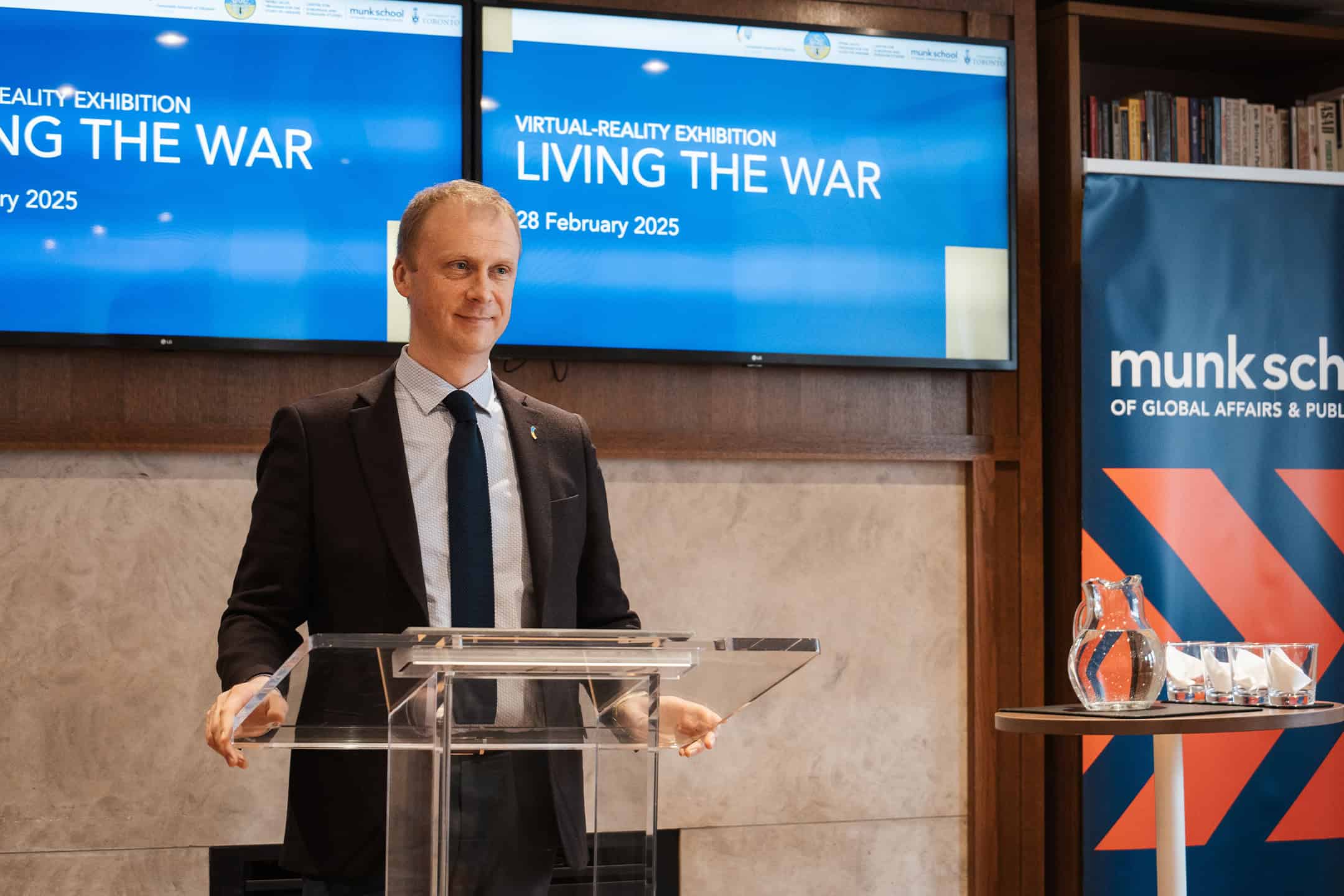
On February 28, just four days after the third anniversary of Russia’s invasion of Ukraine, the Munk School of Global Affairs & Public Policy hosted a virtual reality (VR) exhibition called Living the War and a lecture by Johns Hopkins University Professor Eugene Finkel on his recently published book, Intent to Destroy: Russia’s Two-Hundred-Year Quest to Dominate Ukraine.
VR exhibition
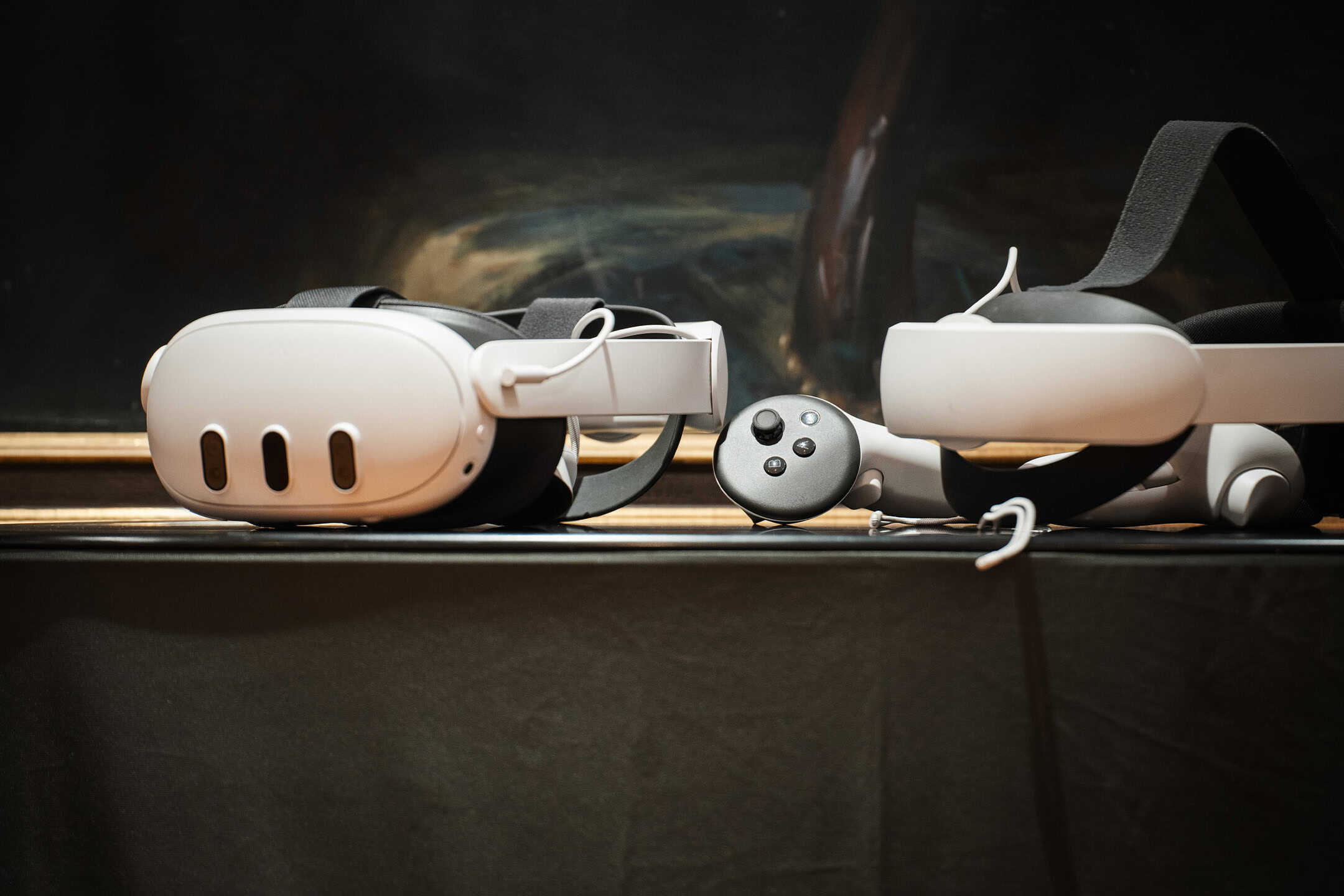
The VR exhibition took place in the lounge next to the Campbell Conference Facility. The exhibition had two sets of chairs and VR headsets set up for people to experience a 10-minute VR video created and produced by the non-governmental organization The Game Changers, and the Ministry of Foreign Affairs of Ukraine.
The Game Changers, the independent Ukrainian team behind the VR video, prides itself on their mission to “provide immersive experiences to people from all over the world. Helping them feel events [in Ukraine] and understand their consequences better,” through a combination of “empathy and technology to help Ukraine and the Free World fight tyranny and disorder.”
From my position in Canada, far outside the orbit of the conflict, the Russia-Ukraine war has always felt distant to me, existing only in news reports. But given our constant exposure to reports of bombings and war crimes in the news, it’s unfortunately easy to grow desensitized to the egregious nature of the violence presented to us. So, walking into the exhibition, I thought I knew what to expect.
However, looking into the Russia-Ukraine war through the VR headset challenged my expectations. Through the headset, a prompt urged me to experience the war firsthand through all five senses. I glimpsed corpses and battlegrounds, and I heard air raid alarms and the cries of babies. It’s painful to try to empathize with grief and terror of such magnitude.
The exhibition ended with a call to action for distant spectators to empathize and politically engage, despite the physical distance between the rest of the world and Ukraine. While the war in Ukraine may be geographically bounded, the outcome of this war hurts our shared human principles around sovereignty and state-recognition, setting precedents that impact the global order.
It raises a foreboding question: what will become of our world if we don’t act?
Ukrainian identity
Following the exhibition, we moved inside the Campbell Conference Facility, where Professor Finkel presented the key arguments from Intent to Destroy. Finkel’s book explores the history of Russia’s violence against Ukraine by examining the origins and rationale behind Russia’s aggression, which argues that Ukraine’s democratic values pose a direct threat to Russia’s regime.
The book posits that Russia’s “obsession” with Ukraine stems primarily from the Russian perception of Ukrainian identity. Both nations trace their origins to Kyivan Rus, an east slavic federation from the ninth century, with the Russian establishment viewing itself as the rightful heir to the medieval state, justifying its dominance over Ukraine and claim on Kyiv. This belief, further reinforced by historical geographical terminology, rhetorically frames Russians as “Great Russians,” Belarusians as “White Russians,” and Ukrainians as “Little Russians,” constructing them as subordinate.
Additionally, Russian narratives have long dismissed the Ukrainian language as merely a dialect, a tradition of propaganda Professor Finkel traces as far back as Tsar Nicholas II’s rule more than 200 years ago. He identifies its popularization in the mid-nineteenth century in reaction to the Polish independence movement, which aimed at maintaining control over Ukraine and Belarus.
Threat to Russia
Finkel also argued that the obsession also stems from Ukraine’s threat to Russia’s national and, more importantly, regime security.
Russia is wary of democratic ideas from Ukraine spreading to its own people, potentially inspiring them to demand the same rights as their “little Russian brothers” in Ukraine, thereby threatening the regime’s long-standing autocratic rule.
To prevent this, Russian governments have historically sought to divide Ukraine’s diverse population, isolating and repressing certain groups while elevating others to ensure loyalty to Moscow. However, by 2022, Ukraine’s national identity had grown strong enough that the Kremlin’s effort to divide and repress failed, forcing Russia to resort to force and invasion.
Taking action
When reading news about Ukraine, I often feel powerless and hopeless. What can we do to stop the bombings? Most of us don’t know, and so we may do nothing.
However, breaking down the origins of why Russia is willing to fight this war makes the prospect of advocating for peace feel more actionable. With an understanding of Russia’s rationale, at least our understanding of the root of the issue can become clearer: Ukraine’s democratic values are seen as a direct threat to Russia’s regime.
There is a solution to this — war is not inevitable. Professor Finkel argued that Russia’s obsession with Ukraine is a choice. The supposed threat to Russia’s regime would disappear if Russia acknowledged Ukrainians and Russians as distinct peoples.
This would challenge Russians’ long-held narratives of Ukraine, but such shifts are possible. Of course, this is a drastic and optimistic simplification — much easier said than done. Professor Finkel also noted that changing long-held perceptions of the masses requires action from the top down, and such changes take time to sink in.
Nevertheless, the narratives fueling aggression are constructs afterall — deeply entrenched, but ultimately manufactured by a government intent on redefining Ukrainian identity as what it is not. Like all constructs, this too can and should be dismantled.

No comments to display.