

When you think of fungi, you might picture mushrooms sprouting from forest floors, mould creeping over leftover bread, or maybe even Penicillin — a common antibiotic derived from fungal moulds. But there’s a strange fungus you have probably never heard of, one that doesn’t grow in soil or food but thrives deep inside the guts of aquatic insect larvae and immature insects, called nymphs, that live in aquatic ecosystems.
These fungi, known as Trichomycetes, live inside the guts of mayflies, stoneflies, and other freshwater insects. Notably, these fungi are completely dependent on their insect hosts, deriving all their nutrients from them; in return, they may benefit their hosts, harm them, or leave them unaffected.
These microscopic fungi have existed quietly within insects around the world for more than 200 million years. Yet, they have largely remained scientific wallflowers due to population changes, difficulty in culturing, and limitations in molecular biology resources and technologies.
Hidden signals in the insect gut
Freshwater ecosystems are under threat due to urbanization. As cities grow, they send stormwater runoff — which often carries excess nutrients, sediments, heavy metals, and other pollutants — into lakes, rivers, and streams. This disrupts the delicate chemical balance of local ecosystems. In addition to runoff, urbanization introduces chemical pollutants through industrial discharge and household waste. These pollutants cause physical habitat disruptions such as altered flow patterns, channelization — changing a river or stream’s flow by building artificial channels — and the removal of vegetation.
Scientists need reliable ways to detect when these ecosystems are becoming stressed or degraded, because early detection allows for intervention, restoration, and policy development before irreversible damage occurs.
That’s where bioindicators come in. These are organisms whose survival and community composition are tightly linked to specific environmental conditions and thus make them sensitive indicators of ecological change.
Environmental scientists have long used benthic insect larvae and nymphs as bioindicators because they are sensitive to pollution and are extremely easy to collect. But here’s the catch: many insect species tolerate a wide range of conditions, and their responses to stress can vary in intensity. What if we could zoom in further, all the way into their gut, and find something even more sensitive to pollution than benthic insects?
This question drives my research in the Wang Lab — led by Yan Wang, an Assistant Professor at U of T’s Department of Ecology and Evolutionary Biology. The Wang Lab is where I first learned about Trichomycetes, igniting my passion for these fungi.
Trichomycetes are obligate symbionts — meaning they can’t survive without their insect hosts. They’re deeply intertwined with their host’s biological composition and health. If environmental stressors affect the insects — say, by changing the chemistry of the stream water — those changes might show up even more clearly in their gut-dwelling fungi. In other words, Trichomycetes could serve as ultra-sensitive bioindicators, offering a warning system for ecological disruption.
Mapping a microscopic world
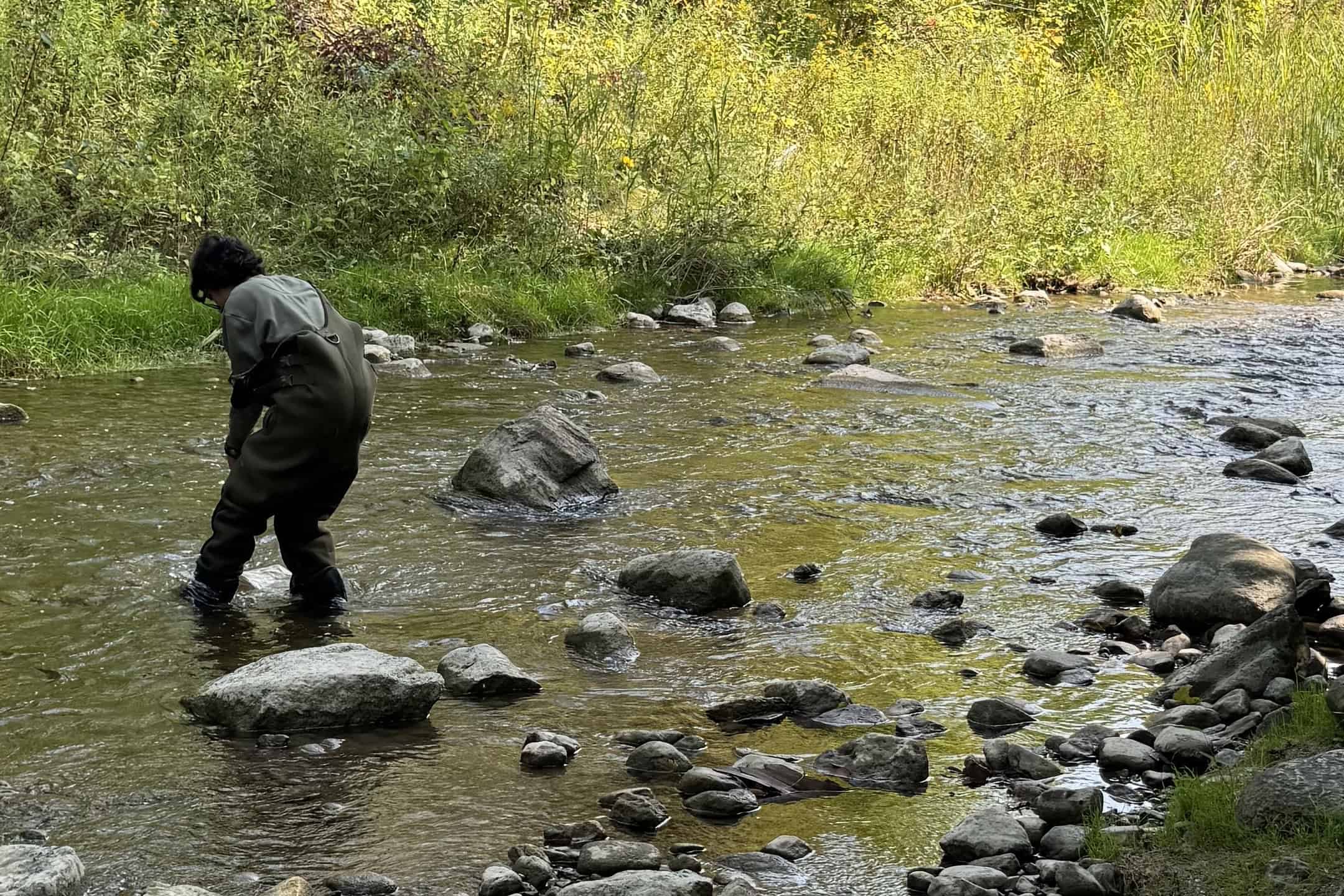
To test this idea, I began collecting aquatic insects from two urban stream systems in the GTA: the Rouge National Urban Park Stream and the Highland Creek Watershed. These streams offer fantastic comparative models as the Highland Creek stream flows through areas affected by urban development, while the Rouge Park stream remains in a more conserved area, making them ideal case studies for tracking the effects of environmental stress on diverse ecosystems.
After collection, each insect was carefully dissected under a microscope, and their gut tissue was teased apart in search of fungal filaments. Some samples were identified using morphological keys, which are guides that help identify the exact species of fungi based on their physical features. Others were sent for DNA sequencing, specifically targeting the 28S rRNA gene region. Gene regions are specific stretches of DNA that code for particular molecules or functions. 28S rRNA codes for part of the ribosomal RNA structure, which is crucial for making proteins.
In this case, the 28S rRNA gene is useful because it evolves slowly and remains mostly unchanged in ancient fungal groups like Trichomycetes. This stability makes it a reliable marker for identifying and classifying fungi at a deeper evolutionary level.
This process went on for three years, wherein we made some amazing discoveries. And recently, something unexpected happened.
Among the samples of aquatic insects, we discovered a species of Trichomycetes that had never before been reported in North America, and whose genome — a complete set of DNA — had never before been documented. The genome of this fungus, which is still being analyzed, represents not only a new data point but also a reminder of how much microbial biodiversity remains hidden in urban streams. Like so much microbial biodiversity research, the work on understanding this new species is also ongoing.
Patterns in the prevalence
Through this work, we’re beginning to notice patterns: certain Trichomycetes species appear more frequently in cleaner, less disturbed sites. Others may be tolerant of, or even thrive in, water with high levels of dissolved solids or metal concentrations. We are also finding that the diversity of Trichomycetes tends to drop in polluted or heavily urbanized streams, suggesting that their presence or absence in the water could reflect ecosystem quality on a very fine scale.
To better understand these correlations, we measure variables such as pH level, temperature, total dissolved solids (TDS), levels of urbanization close to the freshwater ecosystems, and metal concentrations at each collection site.
Over time, this dataset could reveal new insights into how environmental stressors influence not just insects or fungi individually, but entire ecological networks, from streams to stomachs. By tracking shifts in composition of species in the system and environmental variables like heavy metals or nutrient levels, these indicators can reveal cascading effects on food webs, microbial communities, and ecosystem health.
A window into ecosystem health
What excites me most is that we’re only scratching the surface. There’s still so much we don’t know about Trichomycetes, like how they establish symbiosis, how they interact with other microbes, and how quickly they respond to environmental shifts — but the possibilities are thrilling.
Imagine a future in which Trichomycete surveys are part of routine water-quality monitoring; imagine being able to detect pollution not just from chemical tests, but from changes in the microbial communities inside a mayfly’s gut.
This is the kind of imaginative, fine-scale science that could transform how we manage and protect freshwater environments. Unlike traditional methods that rely on momentary snapshots of water chemistry, gut microbiota reflect cumulative exposure and biological responses to stressors over time. This makes them sensitive, integrative indicators of ecosystem health.
By incorporating bioindicators like Trichomycetes into ecosystem health assessments, we could catch subtle, early-warning signs of ecological degradation before they escalate — improving our ability to intervene, restore, and conserve aquatic systems with greater precision and foresight.
Following my gut
Looking back, I think my fascination with insects and nature started much earlier than university. As a child, I used to collect tiny bugs and water critters from puddles and streams, inspecting them with wonder and curiosity. I didn’t know it then, but that early fascination would one day guide me toward a career in ecological research and lead me to a fungal world hidden inside the gut of an insect.
Sometimes, we’re told to ignore our gut feelings. But for me, following mine opened up a world of science I never knew existed. If there’s one message I would share with the next generation of curious minds, it’s this: trust your instincts, stay curious, and don’t be afraid to explore what others overlook.
Sometimes, the answers to big questions can be found in the smallest places!

No comments to display.