
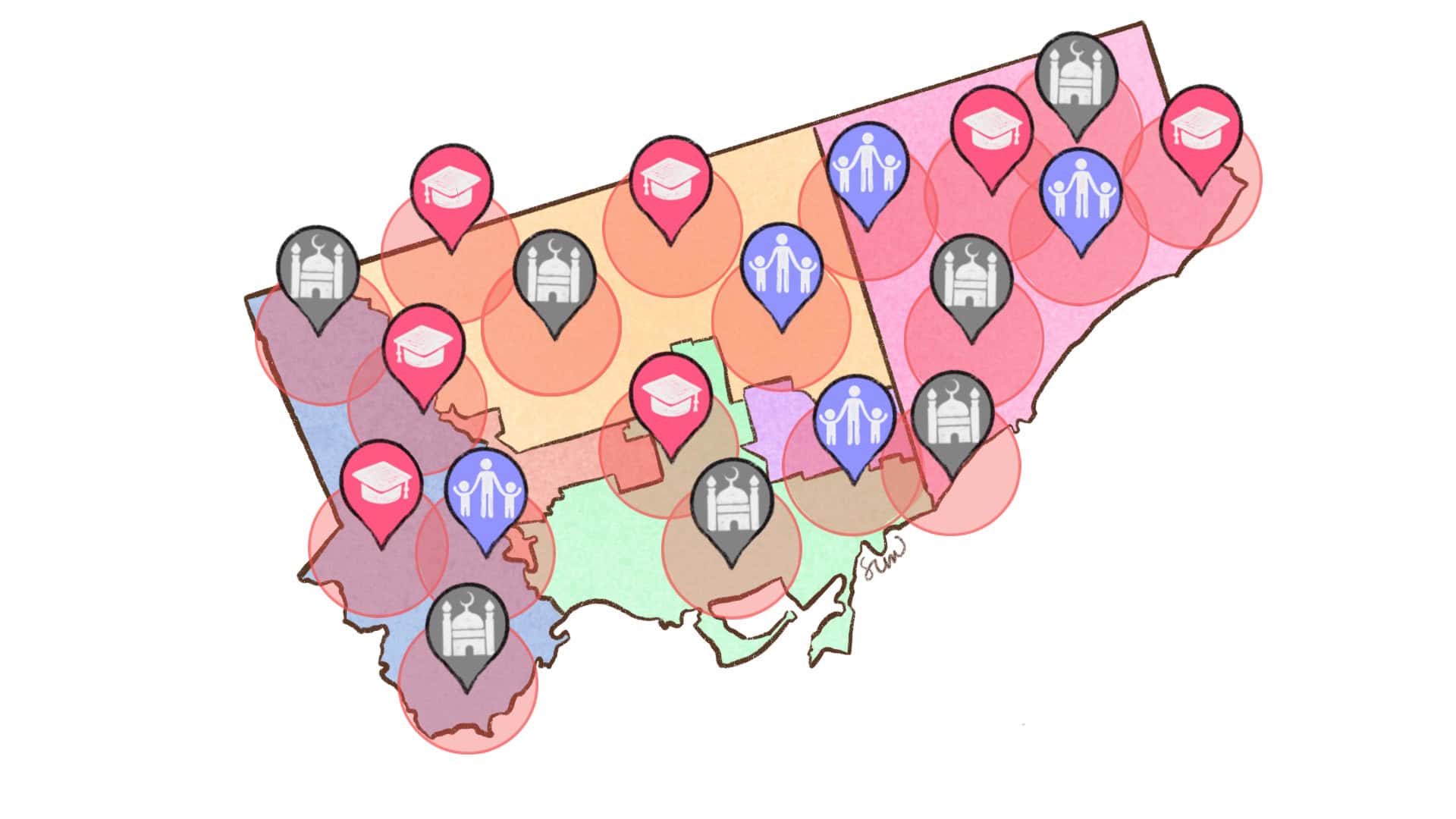
On May 22, Toronto City Council approved the Safe Access to Social Infrastructure bylaw, which allows owners of places of worship, child care centres, and elementary, middle, and high schools to restrict protests within a 50-metre radius of the institution. Of the nearly 3,000 eligible sites, 46 have established protest-restricting bubble zones since applications opened in July.
As of September 4, there are no bubble zones established on U of T campus. However, the nearest bubble zone — the Miles Nadal Jewish Community Center — is less than a kilometre away from Robarts Library, the Ontario Institute for Studies in Education (OISE), and Sidney Smith Hall.
The bylaw states that blocking or discouraging people from accessing a facility or “expressing an objection or disapproval towards any person based on identity” is prohibited in a bubble zone. Enforcement officers may issue fines of up to $5,000 for people engaging in prohibited behaviour.
Although post-secondary institutions don’t qualify for bubble zone status, campus facilities such as daycares and religious centres are eligible to apply. When asked whether the university has applied for a bubble zone or intends to do so and whether religious groups and places of worship on campus could request a bubble zone independent of the university, U of T Media Relations stated that “it would appear [the bylaw] does not apply to universities, but the reporter should confirm with the City of Toronto.”
In a statement to The Varsity, the City confirmed that “an owner or operator of Social Infrastructure, which includes childcare centres and places of worship as defined in the by-law, may submit a request for the establishment of an Access Area.” In the new bylaw, bubble zones are referred to as Access Areas. Across its three campuses, the University of Toronto operates six child care centers and approximately 20 multi-faith spaces.
The bylaw is intended to protect vulnerable institutions and ensure that people can safely and freely access social infrastructure. York Councillor James Pasternak, one of the bylaw’s leading advocates, hopes that it will address concerns about the safety of Jewish facilities following attacks on religious community centres. The City’s public consultation report found that even though 70–90 per cent of participants strongly opposed the bylaw, its supporters expressed a need for safeguards at faith-based institutions.
In a statement released on May 29, the Canadian Federation of Students – Ontario said, “As we are seeing more efforts of crackdowns, surveillance, and suppression since October 2023, the use of law enforcement is a blow to freedom of expression; further, criminalizing pro-Palestine demonstrations is a pattern that can be seen across our campuses, the province, and the country.”
Editor’s note (September 22, 2:10 PM): This article has been updated to reflect that the 26 potential sites can be found on all three campuses rather than just UTSG.

No comments to display.