
From first-time attendees to veteran viewers who clap during TIFF’s Varda café-bar ad, this year’s Toronto International Film Festival (TIFF) lineup had something for everyone.
I was lucky enough to snag a ticket to Arco for the film’s North American premiere. The film was screened in English, but it is a French animated sci-fi film directed by Ugo Bienvenu, starring the voices of Natalie Portman, Mark Ruffalo, America Ferrera, Will Ferrell, and Andy Samberg.
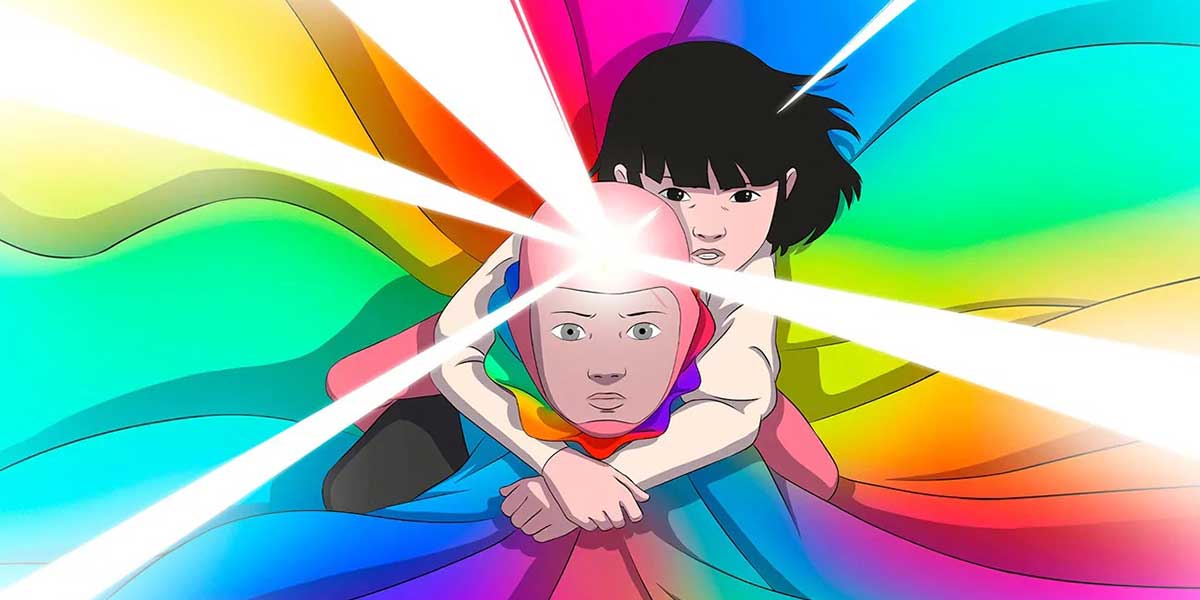
Arco is a colourful reimagination of time travel, playing off the idea that every rainbow represents a time traveller from a distant future.
The premise
It is the year 3000, and our protagonist, Arco, is a 10-year-old boy who lives with his family in a floating home in the clouds, where humans have gone to live to give the earth a break from the overuse of its resources.
Arco’s family works to bring back extinct flora by travelling back in time to procure live samples to plant and repopulate their self-sufficient home garden with. Using multi-coloured capes and a special light-refracting crystal embedded in its hood, they are able to literally soar through the sky, leaving rainbow arcs behind them.
The capes let them use rainbows to fly to any time of their choosing — similar to how hyperspace works in Star Wars — but instead of reaching new locations, they travel to entirely different eras. It felt like the capes turned them into casual heroes, though flying and time-travelling still come with their own rules.
All Arco wants to do is see dinosaurs, but children under 12 are not allowed to time-travel. He is jealous of his sister’s adventures, especially since she’s only a few years older than he is. One night, Arco steals his sister’s rainbow cape and crystal, and jumps off the ledge of his home, hoping to use the rising sun’s light to fly.
With no training, however, he just barely takes flight long enough to crash land in the year 2075, in the forest behind the school of a girl named Iris.
Iris and her nannybot, Mikki
Iris is about Arco’s age, and in her time, humans were still living on Earth. Every building in her city is equipped with bubbles that block out all extreme weather — which is necessary for the amount of rainstorms and wildfires they experience as a result of increasing temperatures and a depleted ozone layer.
In 2075, robots have replaced human teachers, construction workers, police officers, and even caretakers. Iris and her baby brother Peter are home alone most days with Mikki, their nanny bot, as their parents work in the city and only return on weekends, if at all.
As the kids celebrate a parent’s birthday while the parents attend as holograms, Iris is visibly disappointed that her mother wouldn’t even leave work for a special occasion. Mikki is a replacement parent in every sense, but the physical absence of Iris’ parents leads to her feeling alone and distracted at school the next day. She makes an excuse to get out of class, which is when she finds Arco after his crash.
2075 is not an absurdly far time from where we are now. Arco introduces the reliance on technology in Iris’s world from the second we see her character on screen. During Iris and Peter’s bathtime, we hear a voice imitating various characters behind the shower curtain at the children’s request, as a parent might do to entertain two small children. When the curtain draws back, we see that it was Mikki the whole time. The robot even speaks using a mechanical blend of Iris’ parents’ voices.
The children’s relationship with Mikki reminds me of the reliance many of us have on chatbots and AI today. It seems that as a caretaking robot, Mikki’s primary goals are to keep the children safe, fed, and aware that their parents still love them. If an algorithm can think for you, why wouldn’t you take advantage of that?
When Iris asks Mikki about why her parents didn’t come home, the robot reassures Iris that the hologram robot she calls her parents on nightly was always near. If it seems absurd that a robot could aim to make a child feel better, have you ever heard of ChatGPT therapy? 2075’s tech might not be so far off.
The technology in Iris’s world is embedded in every part of their day-to-day life. Even her classroom is a 360-degree immersive screen showing today’s lesson topic, complete with teacher robots. Moreover, the name of every citizen is stored in a shared database for robots to access, which is not too dissimilar from our current reality, with its ubiquitous face recognition software and information databases. In fact, because of this, the two children crash Mikki’s software by sharing Arco’s name, which doesn’t yet exist in the android’s database, and Mikki is picked up by insurance bots for testing. It’s unsettling how much surveillance is possible by having robots in every home.
The climate crisis from a child’s perspective
Arco is told mainly through the dialogue of young children, with the occasional input from humanoid robots and bumbling — adult time travel conspiracists that the kids brush off anyway.
While they are just kids, the film does an amazing job of showing the danger of letting the earth suffer at our hands while also showcasing how mundane these extreme weather events have become. The rousing score and clean, vibrant imagery take a sharp turn as a wildfire takes over the town. Until that point in the film, everything was light and pleasant. The shock of a blazing fire was a bit of a reality check for me as I watched the movie.
Canada’s National Wildland Fire Situation Report lists a whopping 8.8 million hectares of fire this year, which is more than double the 10-year average. Every data centre needs cooling towers, and every cooling tower needs water, not to mention. According to an article published in July by Communications of the Association for Computing Machinery, global AI water use is projected to hit 4.2–6.6 billion cubic metres by 2027.
The humans in 2075 allocate insanely effective technology to protect their buildings, but no apparent infrastructure protects their forests or their planet. Arco briefly mentions a huge climate event that pushed all humans to move to the sky, something so severe that they had no choice but to give the earth a break, possibly due to the overuse of their technology.
Without spoiling too much of the plot for those of you who will be patiently waiting for the unannounced Netflix release date, Arco is a magical film for all ages. I was absolutely expecting a heartwarming story of friendship between Iris and Arco, but it was much more than that, addressing climate and privacy concerns that are highly relevant today.
The climate commentary, the physics of time travel, and of course, the stunning animation and score made it a must-see for me. I’ve loved science fiction for as long as I can remember, and Arco was a very welcome addition to my favourite genre.

No comments to display.