
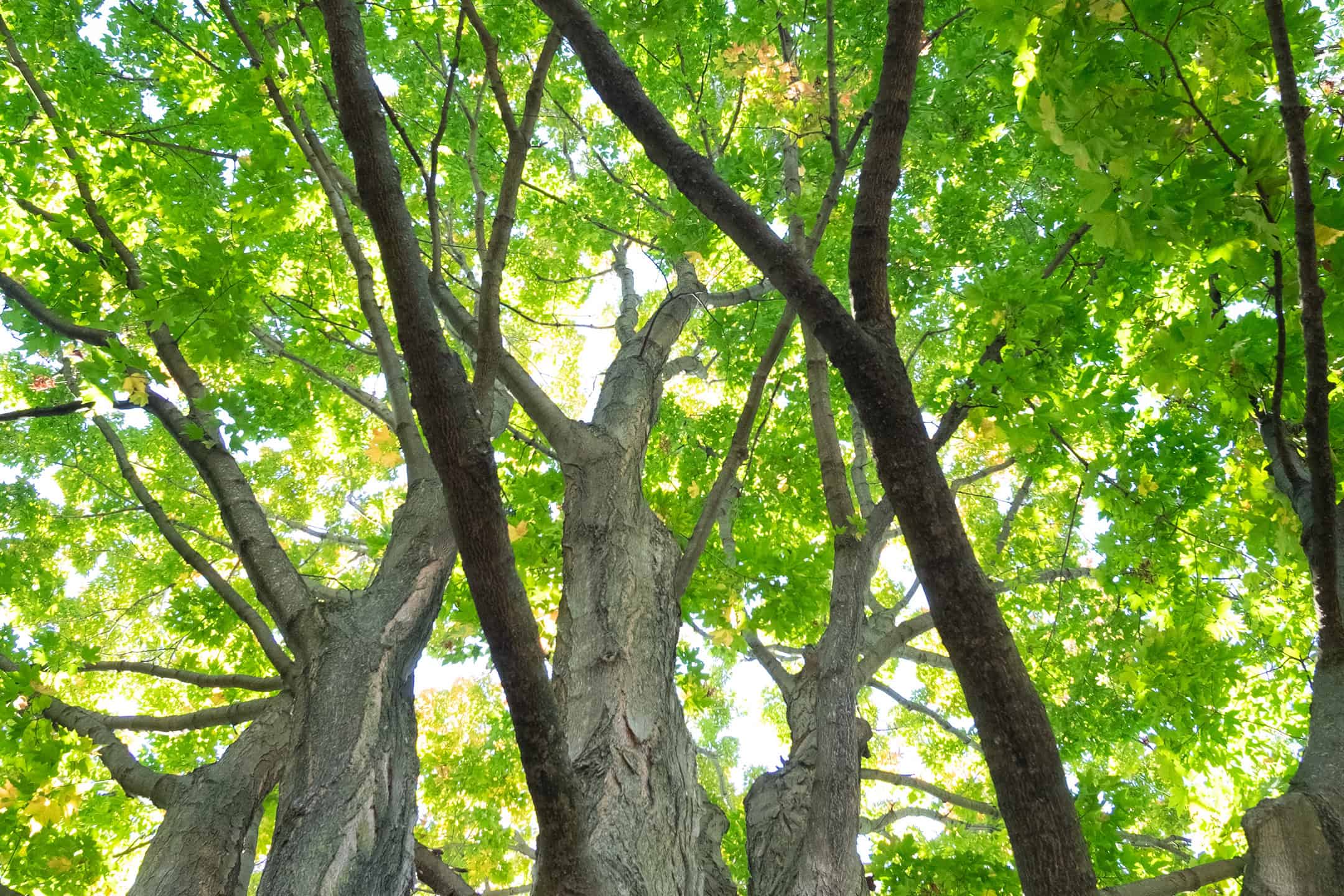
Despite the fact that they are on practically every street on campus, trees are often forgotten about as vital parts of urban ecosystems. More than just tall plants, the myriad of important functions trees perform are central to a healthy, sustainable city. The dense university foliage planted across the St. George campus helps students and faculty alike.
Our green friends on campus
Many of us don’t even realize the benefits we are reaping from nearby trees. “[It’s] something that typically most people don’t think about,” said Danijela Puric-Mladenovic, an Associate Professor of Forestry at U of T, in an interview with The Varsity.
We can often fail to actively consider the origins of something as simple as shade, even if we ‘know’ where it’s coming from. When we walk through Queen’s Park or sit under the canopy surrounding King’s Circle, we might understand that trees are covering us, or walk on the shaded side of the street, but sometimes we forget that there is a living thing providing that shade.
Beyond shade, trees also soften what can otherwise be a harsh landscape of concrete. Puric-Mladenovic, a researcher in urban modelling, conservation and restoration, emphasizes the importance of considering different types of trees for their aesthetic and seasonal contributions. While we might enjoy the greens, reds and yellows during spring, summer and fall, it is also important to make use of evergreen or coniferous species, such as fir and pine, which add some much-needed colour during the frigid winter months.
In an email to The Varsity, Hannah Ezwawi, Chair of the Forestry Graduate Students Association (FGSA), added that trees also have a subconscious value, often helping us feel more grounded or connected to nature. In fact, time in nature has been linked with improved mental health and even cognition.
In the same vein, decompressing in public parks can help manage one’s blood pressure, and emerging research also shows that those who live near trees may tend to live lives that are healthier and happier. While not a magical cure-all, during the stressful life of a university student, the trees’ aid can nonetheless be invaluable.
Additionally, trees, of course, serve important environmental functions. In cities, steel buildings tend to absorb heat during the day, then release it at night, keeping temperatures high. Trees counter this effect and help reduce this emission of heat energy by up to 25 per cent, cooling streets and houses during the summer months.
All in all, trees contribute to an amazing number of things! They help our bodies, our minds and our communities, despite us not always realizing it. Even so, they often can use our help to survive within urban jungles, so that they’re able to thrive as well.
Difficulties facing trees in cities
Despite their resilience and importance in urban environments, many trees are at risk within cities. According to Puric-Mladenovic, the use of weed-killers and de-icing agents often throws off the soil’s pH. This can lead to abnormal growth cycles, prevent the uptake of vital nutrients, and, in some cases, cause the roots themselves to die off.
Puric-Mladenovic stresses the importance of caring for young trees properly — for example, adding mulch when planted. Foot traffic around trees also compacts the soil, causing it to be less aerated. This soil denseness limits the movement of oxygen and water through the soil and makes it harder for roots to grow and spread. As a result, nutrient absorption becomes difficult, and the growth of beneficial bacteria involved in nutrient production may be inhibited.
Furthermore, it’s often forgotten just how deep roots can stretch underground, resulting in a vast network that doesn’t always have room to expand in the dense city fields. Puric-Mladenovic highlights lawnmowing as one of the most common risks to these roots, scarring both them and the portions of trunk close to the ground.
Ezwawi, on the other hand, offers a principle from urban development: “the right tree for the right place.” Knowing what trees flourish where — and prioritizing native varieties — helps ensure tree survival in the difficult urban environments.
So where does this leaf us?
The St. George campus alone is home to over 100 species of trees, with many being over 150 years old — almost as ancient as the university itself. Some are cultivars, trees which have been selectively bred for a unique trait like their leaves or flowers. Puric-Mladenovic highlights the ornamental cherries and crab apples at King’s College Circle as examples.
At the end of the day, trees quietly enrich campus life. Puric-Mladenovic says her favourites are the Indian elm and the white oaks on and around campus, while Ezwawi prefers the black oak.
If you’re looking to relax between study sessions, you can always explore the area to find what your own favourite trees are. The forestry building at 33 Willcocks is a great place to start, with an open courtyard that boasts several trees to enjoy. While you might not need to know the complicated science behind plants, it’s easy to see how many ways we rely on them in our day-to-day lives. For a campus in the middle of a forest of concrete and steel, having some wood and leaves tends to be good for the palate.

No comments to display.