
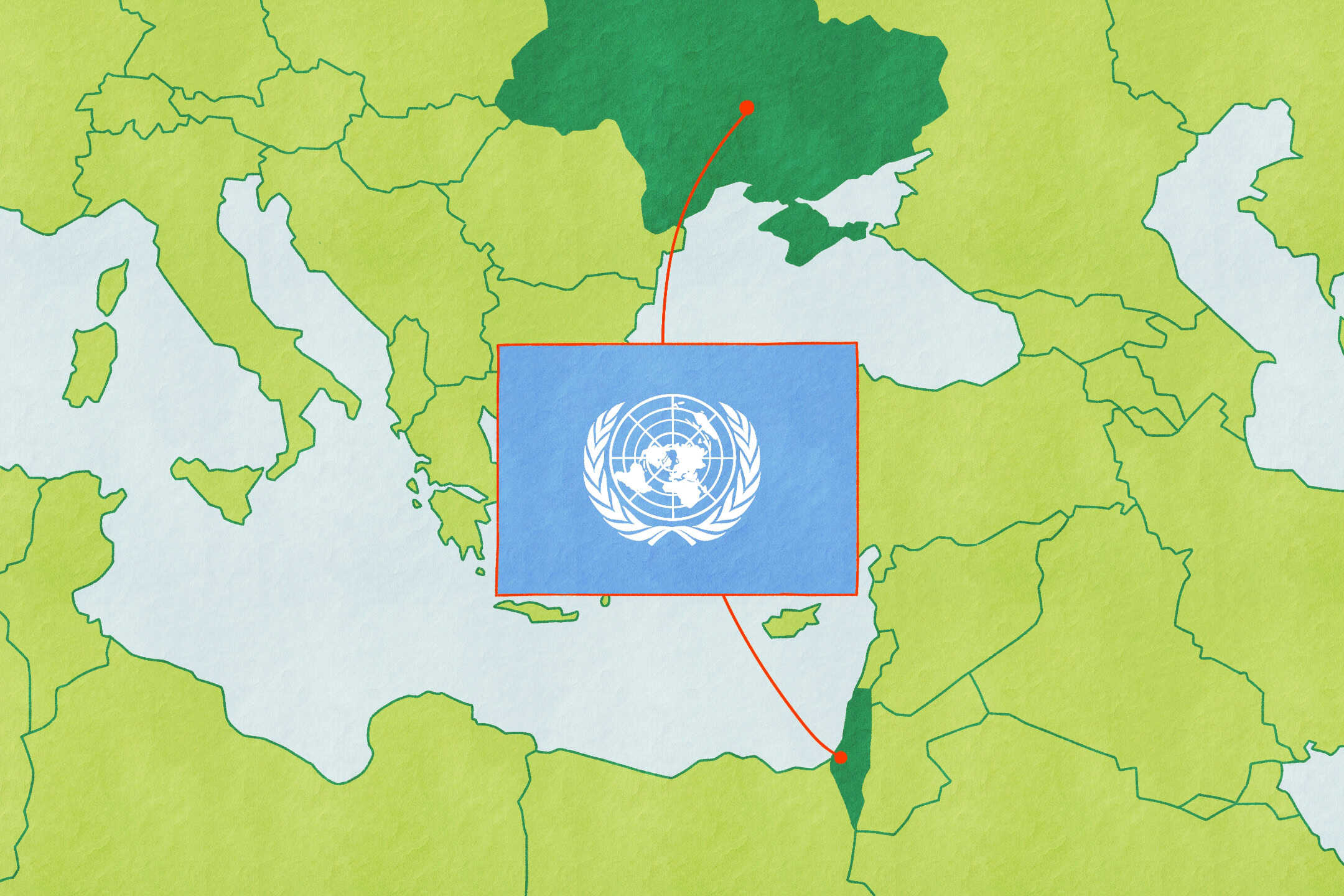
On February 24, 2022, infantry, armoured vehicles, and missiles poured over the Ukrainian border from Russia in the east and Russia-aligned Belarus in the north. Just moments before, Russian President Vladimir Putin claimed this was a “special military operation,” but to those of us watching, it was very evident what was happening: war.
Approximately 2,600 kilometres south of this conflict, another decades-long crisis has since hit a turning point. Following the Hamas attack on October 7, 2023, Israel and its armed forces have rained hell on the Palestinians living in Gaza, attacking civilian infrastructure, blocking off humanitarian aid, and indiscriminately bombing buildings and refugee camps. The United Nations (UN) commission has deemed this campaign a genocide.
The Ukrainian war has reminded us of the weakness of our international norms, such as sovereignty — which cements borders and defines who has authority over which landmass — that the UN pushed for to avoid future eruptions of violence and war. Similarly, the ongoing genocide of Palestinians in Gaza questions the power of international institutions and law, as shown by Israel’s effort to antagonize the UN.
The war in Ukraine and genocide in Gaza, on the surface, are seemingly different issues: both have different histories, combatants, allies, and objectives. However, these conflicts cannot be viewed as separate. They test the survival of the international order and the strength of UN organizations established after the devastation of the Second World War, to ensure that this level of warfare is not repeated. I believe that these conflicts have demonstrated to the world the lack of power our international institutions have and the urgent need to strengthen them.
War in Ukraine
As I watch the destruction of Ukrainian cities increase every day, I am reminded that international politics can at any point revert to old-school practices of conquest and imperialism.
As we approach the fourth anniversary of the invasion, and there remains no end in sight, how the world reacts is remarkably important. If Putin is successful in his takeover of Ukraine, and Canadian leaders back this by recognizing Russian annexation — in which Ukraine falls under official Russian control — I believe that the idea of sovereignty, which has been the very foundation of the international order, will be lost.
Canada must stand firm in its support for Ukraine, not only for the sake of Ukrainians but for the principles of international law itself. I believe that how Canada approaches this crisis will indicate to the global community Canada’s willingness to stand for international law or for ignorance towards it.
Genocide in Gaza
In the past two years, Israel, the ‘only democracy in the Middle East’, has continued its offensive operations in Gaza, and has received countless accusations of war crimes, crimes against humanity, and genocide. Israel’s willingness as a democratic country — according to Freedom House, an organization that advocates and researches the state of political and civil rights in countries globally — to ignore international law and institutions should ring alarm bells, as it demonstrates the weakness of these institutions.
The International Court of Justice concluded in 2024 that Israel’s occupation of Gaza was unlawful, and demanded that it immediately withdraw, a demand which was rejected by the Israeli government. Furthermore, the US government has fully backed Israel’s operation, providing at least 16.3 billion dollars in military aid to Israel since the attacks on October 7, and has sanctioned the International Criminal Court (ICC) after it issued warrants for Israeli officials.
Despite the relentless bombing and lack of humanitarian aid allowed into the Gaza Strip, Palestinians have demonstrated their resolve during the course of these inhumane conditions, but their struggle has reminded Canada and the international community of our failure to stop genocide in its tracks. Even as the current ceasefire between Israel and Hamas holds on tentatively, there have been several cases of the Israeli military killing Palestinians over the last few weeks following the agreement.
As Canada has rightfully acknowledged the crimes Russia has committed in Ukraine by imposing sanctions on Russia, I believe that Canada must also aid the Palestinians in their struggle. To do so, we must uphold international law, and stand firmly behind UN institutions — unlike the Canadian government’s previous defunding of the United Nations Relief Works Agency — even if it negatively impacts our relationship with our allies such as the US.
Looking forward
All hope is not yet lost. Both of these catastrophes have seen the ICC issue warrants for Vladimir Putin and other Russian officials for crimes against humanity, making Russia the first country to have a warrant for its leader while being a permanent member of the UN Security Council. The ICC is not turning a blind eye to crimes from liberal states, either, issuing warrants in November 2024 for Netanyahu and former Minister of Defence Yoav Gallant, accusing both of war crimes by using starvation as a method of warfare and other inhumane acts.
The validity of these warrants is heavily dependent on whether or not other world leaders abide by the foundations of international law. The response to the warrants against the Israeli officials has been met with large support from key actors, with both Justin Trudeau and Mark Carney supporting the court decision alongside the European Union, Britain, France, and Italy. Nevertheless, we still do not know the outcome of these warrants.
For every UN report accusing Russia or Israel of war crimes, every warrant issued, and every charge brought to the international court that is not upheld by UN member states, we are reminded of the decreasing power of these institutions. What we need now is for Canada and all members of the international community to step up and bolster their commitment to international institutions and law.
Cyrus Gazdar is a fourth-year undergraduate student at the University of Toronto Mississauga studying political science and history, focusing on American foreign policy and American Cold War history.

No comments to display.