
From July 2024 to June 2025, 250 complaints of discrimination or harassment were received at U of T. Of these, 158 have been resolved, 65 remain in progress, and 27 have been discontinued.
This process is governed by U of T’s Statement on Prohibited Discrimination and Discriminatory Harassment, which outlines the university’s rights and responsibilities when addressing physical and verbal harassment. This does not include harassment based on sex and gender, which is instead managed under the Policy on Sexual Violence and Sexual Harassment.
Under the Ministry of Training, Colleges and Universities Act, U of T must annually report on the implementation of anti-racism and anti-hate policies. This data only involves formal complaints made to the university. This does not encompass all instances of discrimination or harassment, and early-stage resolutions to complaints are not logged.
This year, the discrimination and harassment annual report came to the Governing Council (GC) alongside a report reviewing the university’s statement. It recommends establishing a new policy based on the statement, which the university currently aims to bring to the GC for approval by June. The report also proposes clear steps to improve the complaint pathway.
Who filed complaints
Among the formal complaints recorded, 43 were filed by students against faculty members. This was followed by 37 staff-to-staff complaints, 33 student-to-student, 31 students-to-staff, and 26 faculty-to-faculty complaints. A smaller number of complaints involved staff-to-faculty and faculty-to-staff.
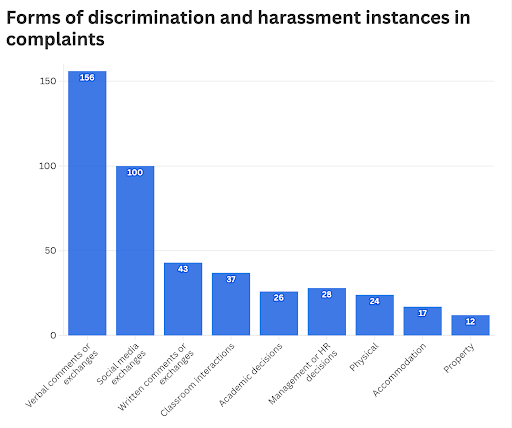
Discrimination and harassment complaints overwhelmingly involved verbal, online, or written comments and exchanges. Other incidents reported also included classroom interactions, academic decisions like grades and tenure, management decisions like hiring and discipline, and unwanted physical contact.
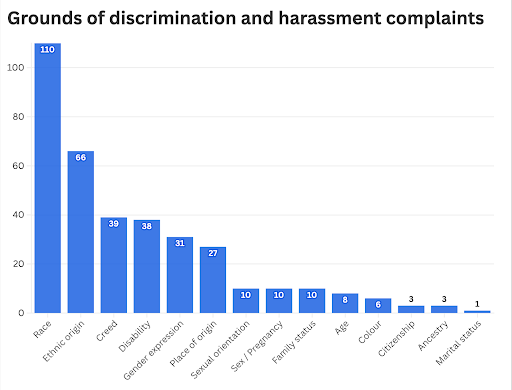
Many complaints cited multiple protected grounds under Ontario’s Human Rights Code. Race appeared in 110 complaints, followed by ethnic origin in 66, creed in 39, disability in 28, gender expression in 31, and place of origin in 27.
Of the Anti-Hate and Anti-Racism categories, antisemitism accounted for 37 complaints, anti-Black racism for 33, Islamophobia for 24, ableism for 23, anti-Asian racism for 17, and anti-Indigenous racism for 11.
After receiving a complaint, the university decides the next steps, which can include informal resolution, investigation, or no action against the respondent. If no action is taken against the respondent, the complainant is offered support. This can include mental health or community safety support, or, in some instances, the university system changing itself.
Formal complaint outcomes and investigations
Following the initial assessment of the complaint, 86 cases were resolved between parties without an investigation, 73 proceeded to investigation, and 55 found no grounds for action against the respondent.
After an investigation, 33 cases found that allegations were substantiated, and eight found that no allegations were substantiated.
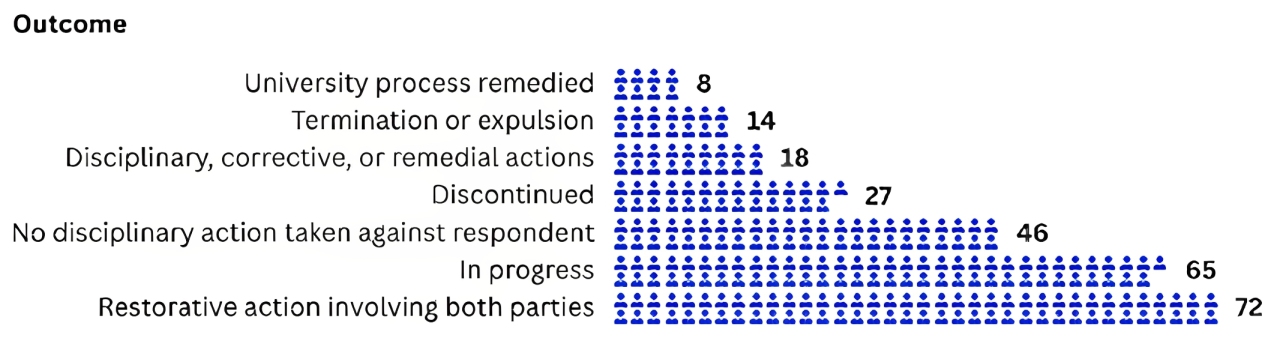
The most common outcome was restorative action between parties, then no disciplinary action taken against the respondent, then disciplinary, corrective, or remedial actions. 65 cases are currently in progress, including 30 investigations, and 27 have been discontinued.
The process is discontinued if the university does not have jurisdiction, if the complainant voluntarily withdraws, or if the respondent or complainant leaves the university. 16 of the 250 complaints involved law enforcement.
Report and consultations on process
In early 2025, the university commissioned a review of the Statement by Co-Chairs Brenda Cossman, Professor of Law and Associate Dean of Research for the Faculty of Law, and Caroline Rabbat, former Director of High Risk, Faculty Support & Mental Health for the Faculty of Arts and Science.
To review the Statement’s strengths and weaknesses, Cossman and Rabbat held in-person and online consultations, including 45 closed consultation sessions, eight open sessions, an online survey, and emails with written feedback.
Cossman and Rabbat’s report goes over their findings, which culminated in the major recommendation to replace the Statement altogether. Cossman and Rabbat wrote that the statement has “outlived its usefulness,” and its “outdated language and references to offices that no longer exist diminish its relevance and credibility.”
They recommended incorporating the existing Statement on Prohibited Discrimination and Discriminatory Harassment, and Statement on Human Rights into one formal policy. Consultations found that where a statement can feel “aspirational and culture-setting,” policies are perceived as providing “actionable guidance and enforceability.”
The report also recommended improving clarity — such as the relationship between different university policies and establishing definitions — and simplifying the pathways for complaints.
The proposed framework for the formal pathway includes five stages: intake, institutional assessment, investigation, decision or outcome, and restoration and repair.
At intake, the report recommended clearly identifying the office where formal complaints can be made. To improve this stage, it is recommended to establish a Human Rights office for students to create one clear entry.
At institutional assessment, the Vice-Presidential or Vice-Provostial Office would assess if the alleged conduct breaches policy, and whether it will proceed to investigation. This same office would decide the outcome after the investigation in consultation with appropriate divisions, such as Human Relations or Labour Relations, as relevant.
The report stated that investigations are often traumatic for complainants, respondents, and witnesses, so the proposed restoration and repair stage includes trauma-informed support, facilitated discussions, apology and amends processes, and restorative circles.
Noted recommendations also include prohibiting reprisals, identifying appropriate time limits for reporting and for resolving complaints, and establishing pathways for appeal after the outcome decision.
The report also focused on education and promotion of the new policy and the use of a centralized system to track data and report outcomes.
Trevor Young, Vice-President & Provost, and Kelly Hannah-Moffat, Vice-President, People Strategy, Equity & Culture, wrote in the letter of acknowledgement attached to the report that they were pleased to announce the university will “begin working towards the implementation of the recommendations based on further consultation with the U of T community and discussion with partners across our three campuses.”
In the meantime, existing university policies and statements will continue to guide discrimination and harassment complaints. The university has a web resource for complaints and concerns about discrimination and harassment at people.utoronto.ca/inclusion/complaints/.

No comments to display.